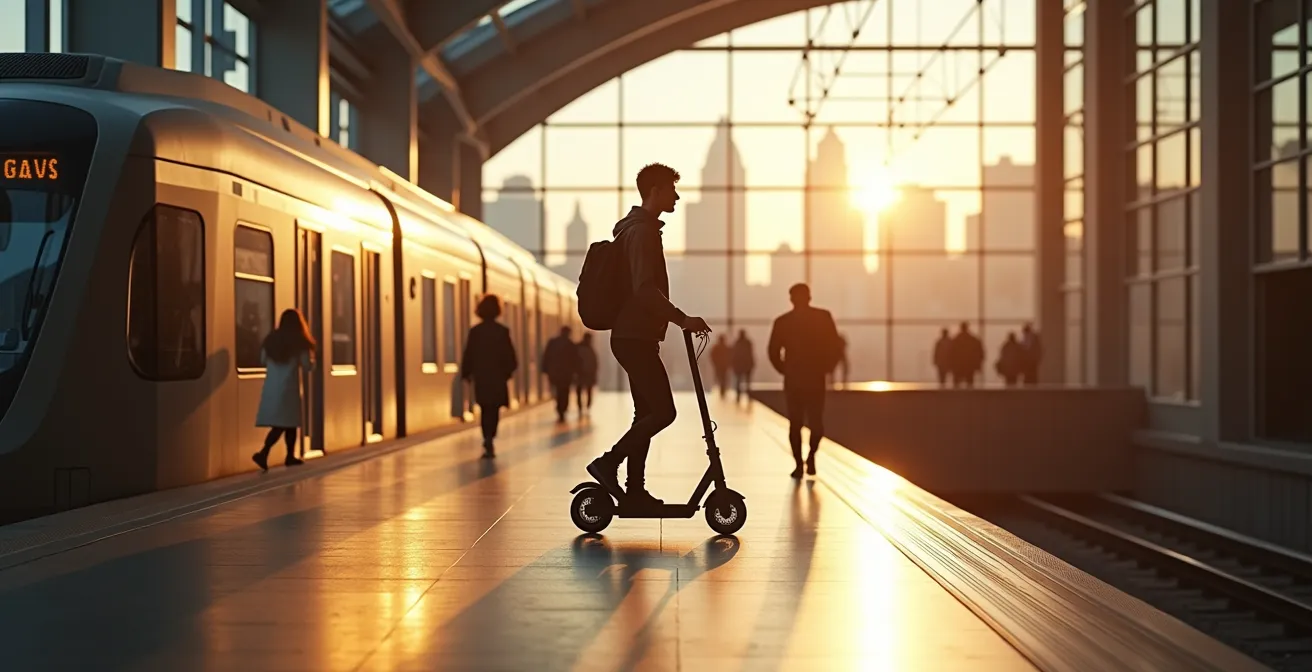
The key to the fastest city commute isn’t choosing the right vehicle, but mastering the art of the ‘seamless switch’ between them.
- Combining long-range trains with flexible e-scooters solves the “last mile” problem, turning transit gaps into opportunities.
- A multi-modal strategy requires logistical planning, from knowing scooter parking rules to having multiple provider apps ready.
Recommendation: Stop thinking in single-transport trips; start planning your journey as a fluid, interconnected system to save time and energy.
The scene is all too familiar: you step out of a train station, energized and ready to explore, only to realize your destination is an awkward 20-minute walk away. It’s too short for a taxi, but long enough to drain your enthusiasm. Many travel guides offer simple advice, suggesting you “walk it” or “grab a bus.” They treat urban transport as a series of isolated choices rather than an interconnected system. This approach often overlooks the friction points—the dreaded “last mile,” navigating confusing local transit, or simply running out of energy before the day is over.
But what if the true secret to urban mobility wasn’t just about picking one mode of transport, but about mastering the art of the seamless switch between them? The real key to a fast, efficient, and enjoyable city commute lies in logistical fluidity. This is the ability to weave together different transport options—like the train and the e-scooter—into a single, cohesive journey. This strategy transforms travel from a sequence of stressful decisions into a smooth, calculated flow. It’s not just about getting from A to B faster; it’s about reclaiming your time and energy to actually experience the city.
This guide deconstructs the multi-modal commute as a complete logistical system. We will explore the practicalities of switching between transport modes, the mindset required to plan effectively, and the strategies to manage your energy, ensuring you arrive at your destination not just quickly, but ready for what comes next.
To navigate this topic effectively, this article breaks down the core components of mastering multi-modal urban travel. The following summary outlines the key logistical and strategic pillars we will cover, from on-the-ground etiquette to high-level planning.
Summary: Mastering the Multi-Modal Commute
- How to Ride a Bike in Amsterdam/Copenhagen Without Angering Locals?
- Why Ferries Are the Best “Hidden” Sightseeing Transport Mode?
- Walk or Ride: How to Judge Distances on Deceptive Tourist Maps?
- How to Plan a Wheelchair-Accessible Route in Historic Cities?
- How to Solve the “Last Mile” Problem When Your Hotel Is Far from Metro?
- Why Street Art Tours Are Replacing Traditional Museum Visits for Gen Z?
- Train vs. Plane: At What Distance Does the Train Become Cleaner?
- How to Plan the Perfect 48-Hour City Break Without Burnout?
How to Ride a Bike in Amsterdam/Copenhagen Without Angering Locals?
While the title mentions cycling in specific cities, the underlying principle applies universally to any form of micro-mobility you introduce into a dense urban environment: understanding and respecting local traffic culture is paramount. Whether on a bike in Copenhagen or an e-scooter in New York, being a good “guest” on the pavement and in the bike lane is non-negotiable. The biggest source of friction between locals and travelers often comes down to parking and pathway obstruction. For e-scooter users, this is a critical aspect of logistical fluidity.
Cities are actively trying to manage this integration. For instance, NYC’s infrastructure development shows a plan for over 200 dedicated e-scooter parking zones by late 2024, with more to follow. These designated areas, often painted boxes on the sidewalk or corrals highlighted in provider apps, are not suggestions—they are mandatory in many high-traffic zones. Ignoring them can result in fines and, more importantly, create hazards for pedestrians and anger residents.
The core of not angering locals is to think like one. This means parking your scooter with consideration, leaving clear paths for wheelchairs and strollers, and never blocking building entrances or access ramps. In areas without designated zones, the rule is to use the “furniture zone” of the sidewalk—the area near benches, trees, and signposts—keeping the main pedestrian thoroughfare completely clear. Mastering this etiquette is the first step in making your seamless switch a welcome addition to the cityscape, not a nuisance.
Why Ferries Are the Best “Hidden” Sightseeing Transport Mode?
In the quest for speed and efficiency, it’s easy to forget that not every “seamless switch” needs to be about minimizing time. Sometimes, the most valuable switch is one that maximizes experience. This is where ferries and water-based public transport come in as a powerful, often-overlooked tool in the urban traveler’s arsenal. While a train gets you across land quickly and an e-scooter solves the last mile, a ferry transforms the journey itself into a destination.
Think of it as an experiential switch. In cities like New York, Sydney, or Istanbul, the commuter ferry system offers the same stunning waterfront views as expensive tourist boats, but at a fraction of the cost. By weaving a ferry ride into your daily itinerary, you are not just getting from one point to another; you are gaining a unique perspective on the city’s skyline, bridges, and coastline. This is a strategic move in energy budgeting: instead of a tiring walk or a stuffy subway ride, you get a relaxing, scenic journey that recharges your mental batteries while still advancing your route.
The key is to view public transport maps not just as a grid of lines, but as a menu of experiences. Planning a route that intentionally incorporates a ferry crossing—for example, to reach a waterfront neighborhood or an island park—adds a memorable chapter to your day without sacrificing mobility. It’s a perfect example of how a multi-modal approach isn’t just about logistical optimization; it’s about enriching the travel narrative itself. The best hidden sightseeing mode is often the one hiding in plain sight on the public transit map.
Walk or Ride: How to Judge Distances on Deceptive Tourist Maps?
One of the most common mistakes travelers make is misjudging distances on a map. A short-looking hop on a tourist map can turn into a grueling 30-minute walk under the sun, draining your energy before you’ve even reached the main attraction. The decision to walk, take the metro, or grab an e-scooter is a critical calculation in your daily energy budgeting. Making the right choice depends on having a realistic understanding of time, distance, and your own physical limits.
This is where data, not just a map’s scale, becomes your best friend. A multi-modal mindset requires you to think in terms of “effective speed,” which accounts for waiting, traffic, and transition times. An e-scooter might seem fastest, but if it’s a 10-minute walk to find one, a direct bus route could be more efficient. The key is to analyze the trade-offs for each segment of your journey. For short distances under a mile, walking is often the most reliable option. For 2-5 mile trips with clear paths, an e-scooter is unbeatable. For longer distances with “mobility dead zones” at either end, the train and e-scooter combo is the superior solution.
To make this judgment call less of a guess, it helps to see a direct comparison of different transport combinations. The following table breaks down the effective speeds and best-use cases for common urban transport modes.
| Transport Mode | Average Speed | Transition Time | Best For |
|---|---|---|---|
| Train + E-Scooter | Combined: 25-30 mph effective | 2-5 minutes | Long distances with last-mile gaps |
| Bus Only | 12.7-14 km/h in traffic | N/A | Direct routes without transfers |
| Walking Only | 3-4 mph | N/A | Distances under 1 mile |
| E-Scooter Only | 15-20 mph | 1-2 min (unlock) | 2-5 mile trips |
As this comparative analysis from Apollo Scooters shows, there is no single “best” mode, only the best mode for a specific context. By learning to accurately assess the time-versus-energy cost of each option, you can make smarter decisions and avoid the classic tourist trap of deceptive maps.
How to Plan a Wheelchair-Accessible Route in Historic Cities?
The concept of “logistical fluidity” takes on a deeper meaning when we consider physical constraints. While this section’s title focuses on wheelchair accessibility—a critical and often underserved aspect of urban planning—the underlying theme is broader: how do we navigate a city when our mobility is constrained, whether by a wheelchair, heavy luggage, or the need to carry a personal transport device like a foldable scooter?
This challenge is central to the train-plus-scooter strategy. A successful seamless switch depends entirely on the physical logistics of the transition. As the Apollo Scooters Research Team notes in their guide, the portability of modern scooters is a game-changer. They state:
Scooters also fold up and most can be carried onto other modes of transportation like buses and trains. This allows for first- and last-mile hybrid commuting.
– Apollo Scooters Research Team, The Ultimate Guide to Electric Scooters for Commuting
However, “can be carried” involves a set of practical steps. For travelers using their own foldable scooters, success lies in preparation. This includes practicing the folding mechanism at home, ensuring the battery complies with train operator regulations (typically under 300Wh), and choosing stations with elevators. According to testing data from major scooter models, the average weight for a portable commuter scooter is around 27-34 pounds (12-15 kg). This is a manageable weight for short distances but can become a burden without accessible infrastructure like ramps and elevators. Therefore, planning a route involves checking not just train schedules, but also station accessibility maps, a practice essential for both scooter users and travelers with disabilities.
How to Solve the “Last Mile” Problem When Your Hotel Is Far from Metro?
The “last mile” problem is the Achilles’ heel of public transportation and the single biggest reason travelers default to expensive taxis. It’s that frustrating gap between the metro station and your final destination. This is precisely the scenario where the train and e-scooter combination transforms from a clever idea into an essential urban mobility strategy. The train provides the high-speed backbone for the long haul, while the e-scooter offers the on-demand flexibility to bridge that final gap with ease.
This isn’t just a theory; it’s a proven solution. Research increasingly confirms the powerful synergy between shared e-scooters and public transit. For example, a study on urban mobility in Chicago found that factors like transit service frequency and dense multimodal networks significantly boost the integration of e-scooters for accessing train stations.
Case Study: Chicago’s Multimodal Integration
A study of e-scooter trip data in Chicago confirmed that the integration of shared e-scooters with public transit is a promising solution for the first/last-mile challenge. Researchers found that the frequency of train service had a direct positive effect on the use of e-scooters for getting to and from stations, demonstrating a clear symbiotic relationship between the two modes.
To successfully execute this strategy, you must be prepared. The key is to anticipate your need for a scooter before you even leave the train. This means having the right tools ready on your smartphone. Relying on a single scooter provider is a rookie mistake; service areas and availability can vary dramatically. A multi-app strategy is crucial for maximizing your chances of finding a ride.

As the image above suggests, the moment of transition is digital. While on the train, use the travel time to check the maps on apps like Lime, Bird, and Veo to see what’s available at your destination station. This proactive approach turns waiting time into planning time, ensuring your seamless switch is truly seamless.
Action Plan: The Multi-App Strategy for Scooter Availability
- Download multiple providers: Install apps for the top 2-3 scooter companies operating in your destination city to maximize your options.
- Check availability in transit: Use your time on the train to scout scooter locations and battery levels near your arrival station.
- Compare pricing and policies: Be aware that providers may have different per-minute rates, unlock fees, or service boundaries.
- Set up payment in advance: Pre-register your account and add a payment method to avoid delays when you’re ready to ride.
- Know the service boundaries: Before you ride, familiarize yourself with any no-ride zones or mandatory parking areas on the app’s map to avoid penalties.
Why Street Art Tours Are Replacing Traditional Museum Visits for Gen Z?
The shift towards multi-modal transport isn’t just changing how we move through cities; it’s changing what we choose to see. The logistical fluidity offered by combining trains and e-scooters empowers travelers to break free from the traditional “honey pot” tourist sites. Instead of being confined to a central museum district, they can explore decentralized, organic attractions like street art, which often thrive in a city’s less-traveled corners.
Street art is, by its nature, a distributed museum. Masterpieces aren’t housed in one building but are spread across dozens of neighborhoods. This makes them difficult to access with traditional, linear transport methods. However, for a traveler equipped with a transit pass and a scooter app, the city becomes an open-air gallery. You can take a train to a promising neighborhood and then use an e-scooter to “gallery hop” from one mural to the next, covering far more ground with less effort than walking. This trend is not just anecdotal; it’s a significant and growing part of the tourism economy. In fact, market research indicates the street art tourism sector reached a value of $6.2 billion globally in 2024, with strong projected growth.
Case Study: Paris’s Boulevard Paris 13
A prime example of this phenomenon is Boulevard Paris 13 in Paris. What was once a typical urban artery has been transformed into an open-air museum featuring over 50 massive murals. This district, supported by local galleries and the city government, is a major draw for art lovers. The experience is often facilitated by guided tours, many led by artists themselves, which help visitors navigate the sprawling collection.
This new form of cultural tourism is powered by the flexibility of modern mobility. As noted by industry analysts, the consumption of this art form is also evolving. DataIntelo’s research highlights this shift:
Guided tours remain the most popular format, accounting for nearly 45% of the total market share in 2024. These tours are typically led by local experts or artists who offer in-depth insights into the history, techniques, and cultural significance of street art.
– DataIntelo Research Team, Street Art Tourism Market Research Report 2033
The ability to easily join these tours or create your own self-guided version is a direct benefit of a multi-modal travel strategy.
Train vs. Plane: At What Distance Does the Train Become Cleaner?
A truly holistic urban mobility strategy begins before you even arrive in the city. The choice between taking a train or a plane for the inter-city leg of your journey sets the stage for your entire trip. While planes are often perceived as faster for long distances, this perception crumbles when you factor in the total door-to-door travel time and environmental impact. The train is not just a mode of transport; it’s the foundational pillar of an efficient and sustainable multi-modal system.
From a logistical standpoint, the “break-even point” where a train becomes faster than a plane is typically around 4-5 hours of rail travel. Consider the full process of air travel: traveling to a distant airport, arriving 1.5-2 hours early for security, the flight itself, deplaning, and then traveling from the arrival airport into the city center. A 1-hour flight easily becomes a 4-5 hour journey. In contrast, trains travel from city center to city center, eliminating those lengthy, stressful transitions. You step off the train and are immediately in the heart of the city, ready to initiate your first “seamless switch” to a scooter or the metro.
From an environmental perspective, the choice is even clearer. Rail travel generates significantly fewer carbon emissions per passenger than air travel, especially over shorter to medium distances. For the eco-conscious traveler, the train is almost always the “cleaner” option. By choosing the train as your primary mode for connecting cities, you are not only setting yourself up for a more efficient arrival but also aligning your travel with more sustainable practices. This macro-level decision has a direct impact on the quality and efficiency of your micro-level urban navigation.
Key Takeaways
- Master the Seamless Switch: The core of efficient urban travel is not a single vehicle, but the fluid transition between modes like trains and e-scooters.
- Plan for the Last Mile: Proactively use a multi-app strategy on your phone while still on the train to locate and secure a scooter at your destination.
- Budget Your Energy, Not Just Time: Choose transport modes strategically to manage physical and mental fatigue, using scenic routes like ferries to recharge.
How to Plan the Perfect 48-Hour City Break Without Burnout?
The 48-hour city break is the ultimate test of a traveler’s logistical prowess. With limited time, the pressure is on to maximize experiences without succumbing to exhaustion. This is especially true for younger generations, as travel behavior analysis shows a rise in ‘micro-cations’ of 3-4 days, where every hour counts. The key to a successful short trip is not to cram more in, but to move smarter. This is where the entire multi-modal system of “transport weaving” comes together.
A successful 48-hour itinerary is built on strategic energy budgeting. Day 1 should begin with a broad reconnaissance. Use the train or metro system to get an overview of the city, arriving at your first key area fresh and oriented. From there, deploy an e-scooter for targeted exploration within a specific neighborhood, covering ground quickly but with the freedom to stop anywhere. As evening approaches, switch to walking for short distances to dinner, deliberately winding down your energy expenditure. Day 2 can be for more ambitious attraction-hopping, using the train for long-distance jumps between neighborhoods and an e-scooter for the intensive “last mile” exploration at each stop.

This approach allows you to see more with less stress. You’re not just moving; you’re flowing through the city. The final evening could be capped with a scooter ride during golden hour, a low-effort, high-reward experience that creates lasting memories without demanding your last reserves of energy. By treating your transport choices as a dynamic toolkit, you can craft a trip that is both action-packed and restorative, beating the clock without burning out.
By adopting this multi-modal mindset, you transform yourself from a passive tourist into an active urban navigator. The next step is to apply these logistical strategies to your own travel plans, starting with your very next city break.