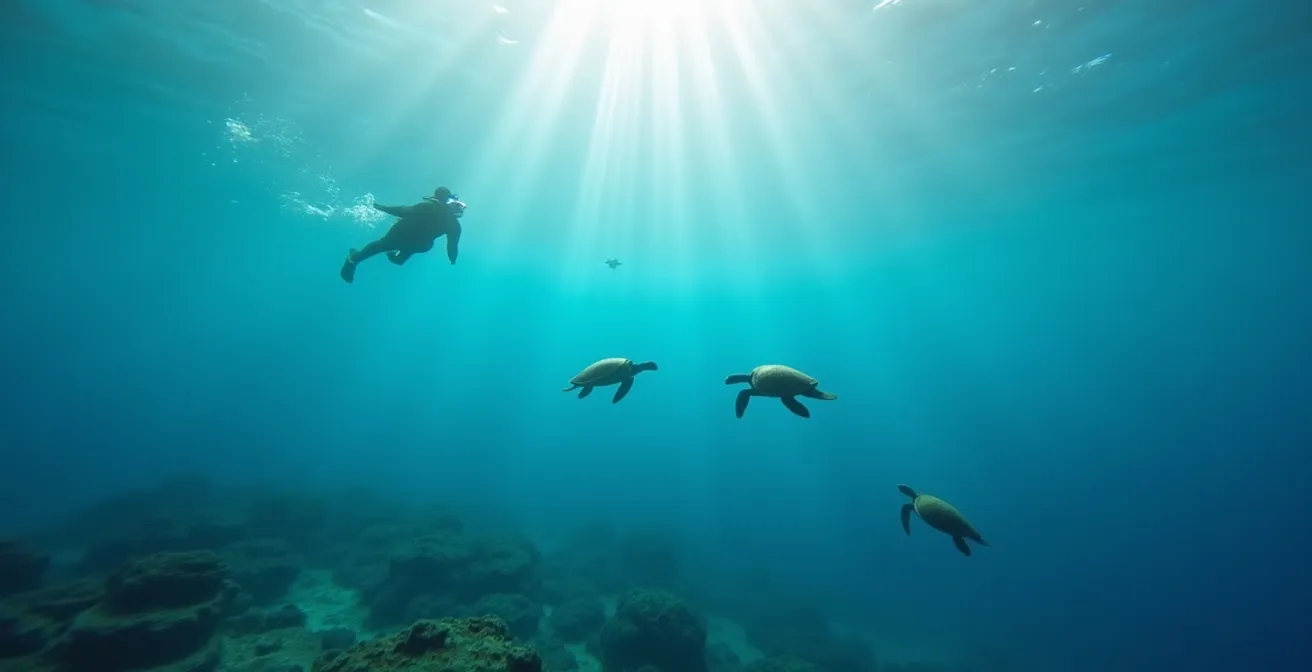
The desire for a magical connection with marine life can unintentionally lead to stress, harm, and even death for the animals we admire. The solution isn’t just a list of rules, but a deeper understanding of the ‘why’ behind them. This guide shifts the focus from simple dos and don’ts to comprehending the physiological impacts of our presence, reading crucial animal body language, and identifying truly responsible tour operators who prioritize wildlife over photo ops.
The dream of swimming alongside a majestic whale, a graceful sea turtle, or a pod of playful dolphins is a powerful one. It represents a connection to the wild, an experience that transcends the everyday. In pursuit of this moment, most people follow the basic advice: don’t touch, don’t chase, keep your distance. While well-intentioned, these rules are only the surface. They are the “what,” but they often lack the critical “why.” Without understanding the profound biological and ecological reasons behind these guidelines, we risk causing significant harm without ever realizing it.
What if the key to a truly ethical and breathtaking encounter wasn’t about following a checklist, but about developing a deeper literacy in the language of the ocean? The truth is, a seemingly innocent pursuit can cause a turtle to drown from stress-induced exhaustion, a simple touch can transmit deadly diseases, and the promise of a “guaranteed” sighting often conceals practices that disrupt entire ecosystems. True respect for marine life begins with knowledge.
This guide is designed to provide that knowledge. We will move beyond the superficial rules to explore the science of stress in marine animals, the hidden dangers of direct contact, and the subtle cues of shark behavior that signal discomfort. By understanding the world from their perspective, you can transform your role from an intrusive tourist into a passive, respectful observer, ensuring your presence is a neutral event in their lives and that your memories are built on authenticity, not harassment.
In the following sections, we will delve into the specifics of ethical interaction, providing you with the tools to assess situations, read animal behavior, and make choices that genuinely support marine conservation. This is your path to becoming a more conscious and informed ocean explorer.
Summary: A Guide to Safe and Ethical Encounters
- Why Chasing a Turtle Causes It to Drown from Stress?
- The Bacterial Risk of Touching Marine Mammals (For You and Them)
- Sea Pen or Open Ocean: Which Dolphin Encounter Is Ethical?
- How to Read Shark Body Language to Avoid an Attack?
- When Is the Best Season to See Migrating Whales?
- The “Guaranteed Sighting” Scam: Do They Bait the Leopards?
- The “No Touch” Policy: The Hallmark of a Real Eco-Tour
- How to Choose a Safari Operator That Contributes to Conservation?
Why Chasing a Turtle Causes It to Drown from Stress?
One of the most common and tragic mistakes well-meaning swimmers make is pursuing a sea turtle for a better look or a photo. What feels like a harmless chase is, for the turtle, a life-or-death panic. Sea turtles are air-breathing reptiles, but they are masters of breath-holding, capable of staying submerged for long periods. This ability, however, is dependent on them being calm and conserving oxygen. When a turtle is pursued, its heart rate skyrockets, and it rapidly burns through its oxygen reserves. This state of forced submersion is known as hypoxia.
To survive this oxygen-deprived panic, the turtle’s body switches its metabolism to anaerobic glycolysis. This emergency power system doesn’t require oxygen, but it produces a harmful byproduct: lactic acid. As lactate floods the turtle’s system, it leads to severe metabolic disruption. The animal becomes exhausted, disoriented, and critically vulnerable. Even if the chase ends and the turtle reaches the surface, the recovery period can last up to 20 hours, during which it is an easy target for predators or boat strikes.
Furthermore, rapid, panicked ascents from depth can be fatal. Research shows there is a 50% higher risk of fatal gas embolism for turtles caught at depths greater than 65 meters. This condition, similar to “the bends” in human divers, occurs when gas bubbles form in the bloodstream, causing catastrophic organ failure. The cardinal rule is to let the turtle control the encounter. If it swims away, you must let it go. Your fleeting photo is not worth its life.
Watch for early stress signals like rapid finning, sudden changes in direction, or tucking its head. If a turtle approaches you out of curiosity, the best reaction is to remain completely still and “boring,” allowing it to decide when the encounter ends.
The Bacterial Risk of Touching Marine Mammals (For You and Them)
The urge to reach out and touch the smooth skin of a dolphin or seal is understandable, but it poses a significant and often invisible threat to both you and the animal. Marine mammals and humans host distinct communities of bacteria, viruses, and fungi. When we touch them, we initiate a two-way exchange of pathogens, a process known as zoonotic transmission. You could be introducing a foreign microbe to an animal with no natural immunity, or exposing yourself to a marine-specific disease.
A primary concern for marine mammals is the transfer of human bacteria that can breach their natural defenses. For cetaceans like dolphins and whales, their skin is a dynamic organ. Touching them can disrupt their sensitive skin and protective layers, making them susceptible to infections. For pinnipeds like seals and sea lions, human-borne pathogens can contribute to mass die-off events, especially in dense colonies where disease can spread rapidly.
The risk is just as real for humans. Marine mammals carry pathogens that can cause serious illness. For instance, species of the bacterium Brucella can be transmitted from dolphins and seals to humans, even without direct contact, through aerosolized water droplets. These infections can lead to chronic, debilitating conditions like arthritis and neurological issues if not properly treated. The table below details some of the known risks, highlighting that the “no touch” rule is a matter of public and animal health.
As this breakdown of zoonotic diseases shows, the potential for cross-contamination is a serious scientific reality. Respecting their space is respecting their health—and your own.
| Pathogen | Marine Host | Human Risk | Symptoms |
|---|---|---|---|
| Brucella ceti | Dolphins, whales | Confirmed cases without direct contact | Flu-like, neurological issues |
| Brucella pinnipedialis | Seals, sea lions | Occupational exposure risk | Chronic arthritis if untreated |
| Mycoplasma | Pinnipeds | Seal finger from bites | Painful finger infection |
Ultimately, these animals are not domesticated pets. They are wild creatures with complex immune systems finely tuned to their environment, not ours. Maintaining distance is the most profound sign of respect you can show them.
Sea Pen or Open Ocean: Which Dolphin Encounter Is Ethical?
The opportunity to see dolphins up close has spawned a wide spectrum of tourist experiences, ranging from highly ethical to deeply exploitative. At one end, you have “swim with dolphins” programs in sea pens or lagoons. At the other, you have tours that observe dolphins in their natural, open-ocean habitat. Understanding the difference is crucial for making a responsible choice. Captive encounters, even those in large sea pens, involve animals that cannot escape, hunt naturally, or maintain their complex social structures. They are often trained to perform unnatural behaviors for food, existing for human entertainment.
A truly ethical encounter prioritizes the animal’s freedom and well-being above all else. This means observing dolphins in the wild, from a respectful distance, on their terms. The goal of a responsible tour is to be a temporary, neutral guest in their world, not the center of their attention. The ideal scenario involves a boat that positions itself ahead of a traveling pod and cuts its engines, allowing the dolphins to choose whether to approach, ignore, or avoid the vessel entirely. This philosophy of passive observation is the gold standard.
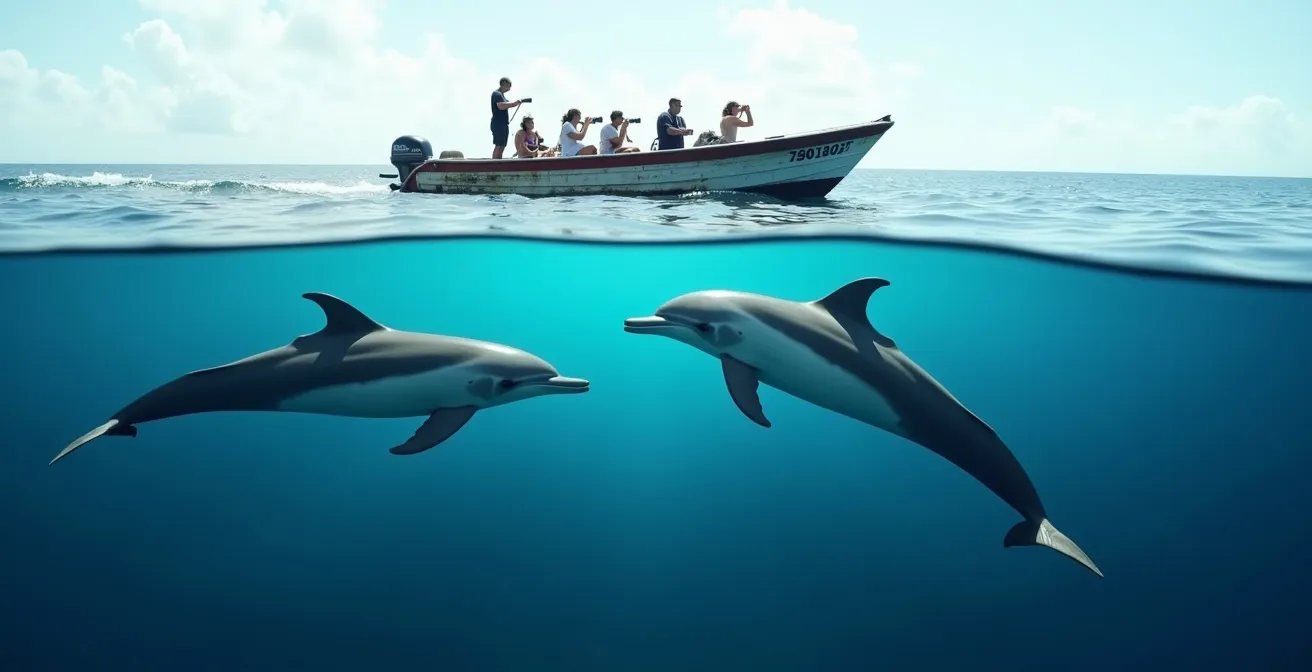
This visual contrast is key: the animals are free and undisturbed in their vast environment, while human activity remains distant and non-intrusive. True sanctuaries are those dedicated to rescuing, rehabilitating, and providing a permanent home for animals that can no longer survive in the wild. They do not breed animals for display or force them to interact with tourists. As the team at Storylines notes, some nations have taken this to a macro level: “French Polynesia is the largest marine mammal Sanctuary in the world, protecting 20 species of whales and dolphins in the area.” This commitment to large-scale, wild sanctuaries is the future of conservation.
Checklist: Differentiating a Real Sanctuary from a ‘Sham-ctuary’
- Verify the facility exclusively houses non-releasable animals with documented rescue histories.
- Ensure educational programs are focused on conservation science, not circus-like entertainment.
- Look for transparent financial reporting that shows a significant portion of funds go towards conservation efforts.
- Confirm there are no active breeding programs for the purpose of keeping animals in captivity.
- Check for participation in legitimate research partnerships with universities or scientific bodies, not just internal “research.”
Before booking any tour, use this checklist to investigate the facility or operator. A genuine sanctuary will be proud to provide this information, while a commercial attraction will often hide behind vague “eco-friendly” marketing.
How to Read Shark Body Language to Avoid an Attack?
Sharks are not the mindless killers portrayed in movies. They are complex predators with a sophisticated communication system designed to avoid conflict. Attacks on humans are incredibly rare and almost always a case of mistaken identity or a defensive reaction to perceived threats. Learning to read a shark’s body language is the most effective way to ensure a safe and respectful encounter. Just as a dog growls before it bites, a shark gives off clear warning signals before it acts defensively. This is known as an agonistic display.
One of the most common and reliable indicators is the pectoral fin dropping. Sharks typically swim with their pectoral fins (the large fins on their sides) held out horizontally. When a shark feels threatened or agitated, it will angle these fins downwards, often steeply. This change in posture makes the shark more hydrodynamic for a quick burst of speed and serves as a clear visual warning to “back off.” It’s a sign that you have entered its personal space and are causing it stress.
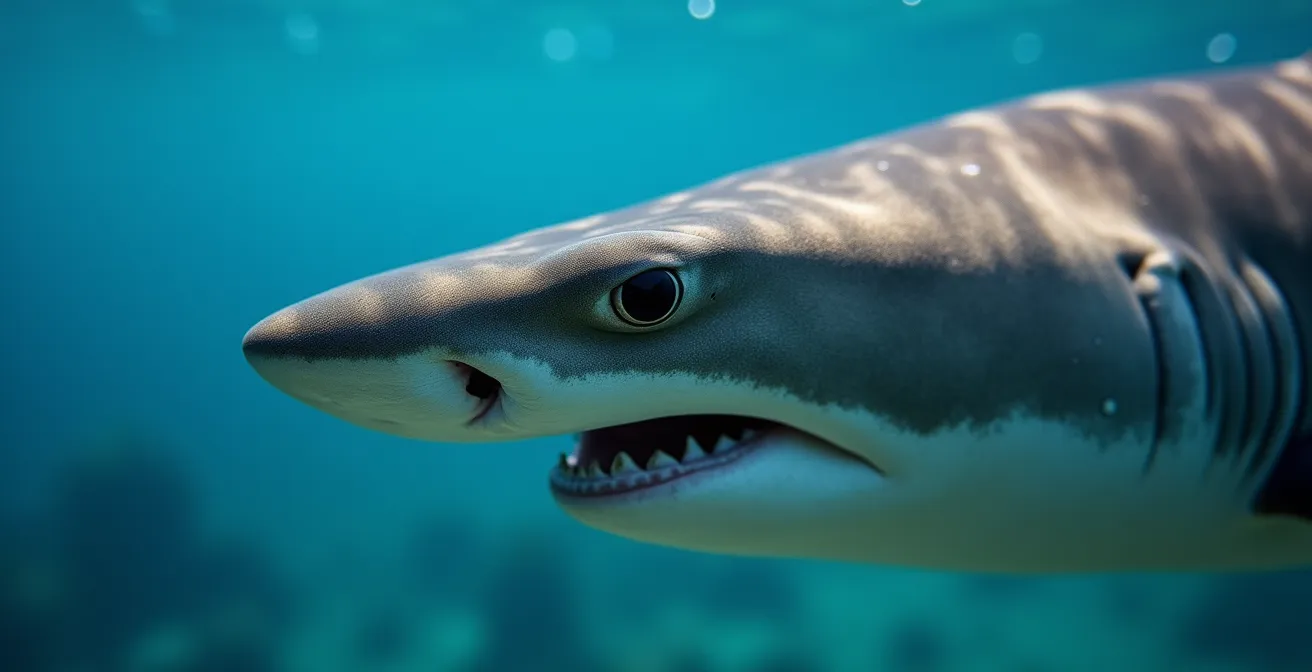
Other key signs of agitation include an arched back, which tenses the shark’s body for an attack, and “gaping,” where the shark repeatedly opens and closes its mouth. It is also crucial to consider the context. A reef shark in a group might display these behaviors due to social dynamics, while a solitary tiger shark exhibiting them is a more direct warning to you. The presence of bait or chum in the water, a practice used by irresponsible operators, can dramatically increase agitation and unpredictable behavior. If you observe any of these agonistic displays, the protocol is simple: stop moving, avoid direct eye contact, and slowly and calmly increase the distance between you and the animal, ideally by backing away without turning your back.
By learning to recognize and respect these communications, you shift from being a potential threat to being an informed observer, capable of coexisting peacefully with these magnificent apex predators.
When Is the Best Season to See Migrating Whales?
Witnessing the immense scale and grace of a migrating whale is an unforgettable experience. However, the timing of your trip is critical not only for your chances of a sighting but also for the ethics of the encounter. Whale behavior changes dramatically throughout their migration cycle, and responsible operators adjust their approach distances and interaction protocols accordingly. Understanding these phases is key to planning a respectful trip.
Generally, whale migrations are tied to three main activities: mating, calving, and feeding. Each phase carries different levels of sensitivity. The mating season is often characterized by high-energy activity, with males competing for females. While exciting to watch, this is a stressful and crucial period for the whales, requiring operators to maintain a greater distance to avoid interfering with natural selection and courtship rituals.
The calving season is the most sensitive time of all. Mothers with newborn calves are extremely protective and vulnerable. Calves are weak, need to surface frequently for air, and are learning essential survival skills. Any disturbance can separate a mother and calf or cause undue stress that impacts the calf’s health. Consequently, regulations and ethical guidelines often demand double the standard observation distance and minimal noise. Finally, the feeding season may offer more predictable viewing opportunities as whales concentrate in areas rich with food, but care must still be taken not to disrupt their feeding patterns.
The following table provides a general overview, but always remember that specific seasons and regulations vary greatly by location and species. A reputable tour operator will be an expert on the local patterns.
| Behavior Phase | Season | Required Distance | Special Considerations |
|---|---|---|---|
| Mating | July-September | 100+ meters | High activity, competitive groups |
| Calving | January-March | 200+ meters | Double distance, minimal noise required |
| Feeding | April-June | 50-100 meters | Predictable patterns, less sensitive |
For a truly low-impact experience, as the experts at One with Whales suggest, “Consider choosing less trafficked destinations, like Rurutu, Tubuai, or Niue, where interactions are more intimate and ethical.” This not only reduces pressure on popular whale populations but also supports economies that are building a sustainable tourism model.
The “Guaranteed Sighting” Scam: Do They Bait the Leopards?
In the world of wildlife tourism, the word “guarantee” should be your biggest red flag. Wild animals are, by definition, unpredictable. A tour operator that promises a “guaranteed sighting” or offers your money back is almost certainly engaging in practices that harm the animals and manipulate their natural behavior. The most common of these harmful practices are baiting and feeding, often referred to as food-conditioning.
Operators may use “chum” (a mix of fish parts and blood) to attract sharks, hand-feed rays at popular sites like “Stingray City,” or use underwater acoustic devices that play sounds of Orcas (a predator) to force dolphins to surface. While these methods deliver a thrilling, close-up encounter for the tourist, the ecological fallout is devastating. It teaches wildlife to associate humans with food, a dangerous habituation that can lead to aggressive behavior when food is not offered. It disrupts natural predator-prey dynamics, alters migration patterns, and can increase aggression between animals competing for an unnatural food source.
A truly ethical operator embraces the uncertainty of the wild. They rely on their expert local knowledge, understanding of tides and seasons, and patience to find animals. They sell an authentic experience, not a guaranteed outcome. Their policy will explicitly state that sightings are not guaranteed, framing it as a mark of their commitment to non-interference. The difference between these two philosophies is stark, as shown in the comparison below.
| Red Flags (Unethical Practices) | Green Flags (Ethical Practices) |
|---|---|
| Guarantees wildlife sightings or money back | Explicitly states ‘no wildlife guarantee’ policy |
| Uses feeding, baiting, or acoustic attraction | Relies only on expert knowledge and patience |
| Allows unlimited time chasing one animal | Sets and enforces strict time limits per encounter |
| Markets “once in a lifetime” photo opportunities | Emphasizes animal wellbeing over guest photos |
When you choose a tour that respects the wildness of wildlife, you are voting with your wallet for a more sustainable and ethical form of tourism. You are choosing an authentic search over a staged performance.
The “No Touch” Policy: The Hallmark of a Real Eco-Tour
A strict and clearly communicated “no touch” policy is one of the most reliable indicators of a genuinely responsible marine eco-tour. This rule is not arbitrary; it is rooted in a deep understanding of marine biology and environmental protection. It encompasses not only refraining from touching animals but also avoiding all contact with the underwater environment, from delicate corals to the seemingly robust seabed. The principle is simple: leave no trace, physical or chemical.
Touching marine life can have dire consequences. As discussed, it facilitates the transfer of diseases. Furthermore, many fish and marine invertebrates are covered in a protective slime coat, which is their primary defense against infection—their external immune system. Your touch can strip this layer away, leaving the animal vulnerable to a host of parasites and bacteria. Beyond the biological impact, you may also be transferring harmful chemicals. The sunscreen, lotions, and oils on our skin contain substances that are toxic to marine life, particularly corals. These chemicals can cause coral bleaching and disrupt their reproductive cycles.
The “no touch” rule extends to the environment itself. Divers and snorkelers who lack proper buoyancy control frequently collide with coral reefs, breaking off decades or even centuries of fragile growth. Excellent buoyancy skills are essential. As PADI’s training demonstrates, mastering peak performance buoyancy can lead to a 97% reduction in reef contact for divers. This skill allows you to hover effortlessly, observing the ecosystem without impacting it. The goal is to become a weightless, neutral presence in the water column.
Even if an animal, like a curious dolphin or seal, initiates contact, the guideline is to remain passive. Do not reciprocate the touch. Allow it to satisfy its curiosity and move on. This maintains the crucial boundary: they can interact with you, but you do not interact with them. This is the essence of respectful, passive observation.
Key Takeaways
- Ethical interaction is not just following rules but understanding the biological ‘why’ behind them, such as the physiological stress that can harm an animal.
- Passive observation is the gold standard: your goal is to be a neutral presence, letting animals control the duration and proximity of any encounter.
- Your choice of tour operator is the single most important decision you can make; look for transparency, conservation contributions, and a strict ‘no guarantee’ policy.
How to Choose a Safari Operator That Contributes to Conservation?
Choosing a marine tour operator is the most significant conservation decision you will make on your trip. The right choice channels your tourist dollars directly into research, habitat protection, and local community support. The wrong choice can inadvertently fund practices that harm the very animals you want to see. Discerning between genuine conservationists and companies engaged in “greenwashing” requires asking the right questions and looking for concrete evidence, not just vague eco-friendly claims.
A truly conservation-focused operator sees their tours as a platform for research and education. Their guides are often trained naturalists or marine biologists who collect valuable data on sightings, behavior, and population health during trips. This information is then shared with local universities or research institutions. They are transparent about their financial contributions, able to name the specific conservation projects or community initiatives that are funded by a percentage of your fee. They prioritize hiring and training local staff, ensuring the community sees a direct economic benefit from protecting their marine environment.
In contrast, a greenwashing operator will use buzzwords like “eco” and “green” in their marketing but will be unable to provide specifics. Their focus will be on luxury amenities and delivering an Instagram-perfect photo, rather than on animal welfare or education. They will lack transparent reporting and will not have formal partnerships with legitimate scientific bodies. Your best tool as a consumer is to be inquisitive and demand proof. A genuine operator will be thrilled to share the details of their conservation work.
Your Action Plan: Five Empowering Questions to Ask Any Marine Tour Operator
- Which specific local research institution do you contribute data or funding to, and can I see a report?
- What exact percentage of my tour fee goes directly to a named conservation project or community fund?
- What marine biology or naturalist qualifications do your guides possess?
- What are your specific, time-based protocols for managing an encounter to minimize stress on the animals?
- How do you actively work to educate your guests on conservation issues beyond this single trip?
Your journey doesn’t end when the tour is over. A great operator will provide you with resources to continue learning and advocate for marine protection. By using this framework from vetted travel experts like Bluewater Dive Travel, you can ensure your travel choices become a powerful force for good, funding the very research and protection efforts that will keep our oceans thriving for generations to come.
Frequently Asked Questions about How to Swim with Marine Life
What if a dolphin or other animal touches me first?
Remain completely passive, do not reciprocate the touch, and allow the animal to satisfy its curiosity and move on. The guideline is they can touch you, but you shouldn’t touch them.
How does social media drive touching behavior?
The desire for close-up selfies incentivizes both tourists and operators to break no-touch rules. Advocate for a ‘No Forced Selfie’ pledge, where the animal’s welfare is prioritized over getting the perfect shot.
What chemicals harm marine life through touch?
Regular sunscreens contain chemicals like oxybenzone and octinoxate that are known to damage coral reefs. Additionally, the natural oils, lotions, and bacteria on human skin can be transferred to a fish’s protective slime coat, dismantling their primary immune system.