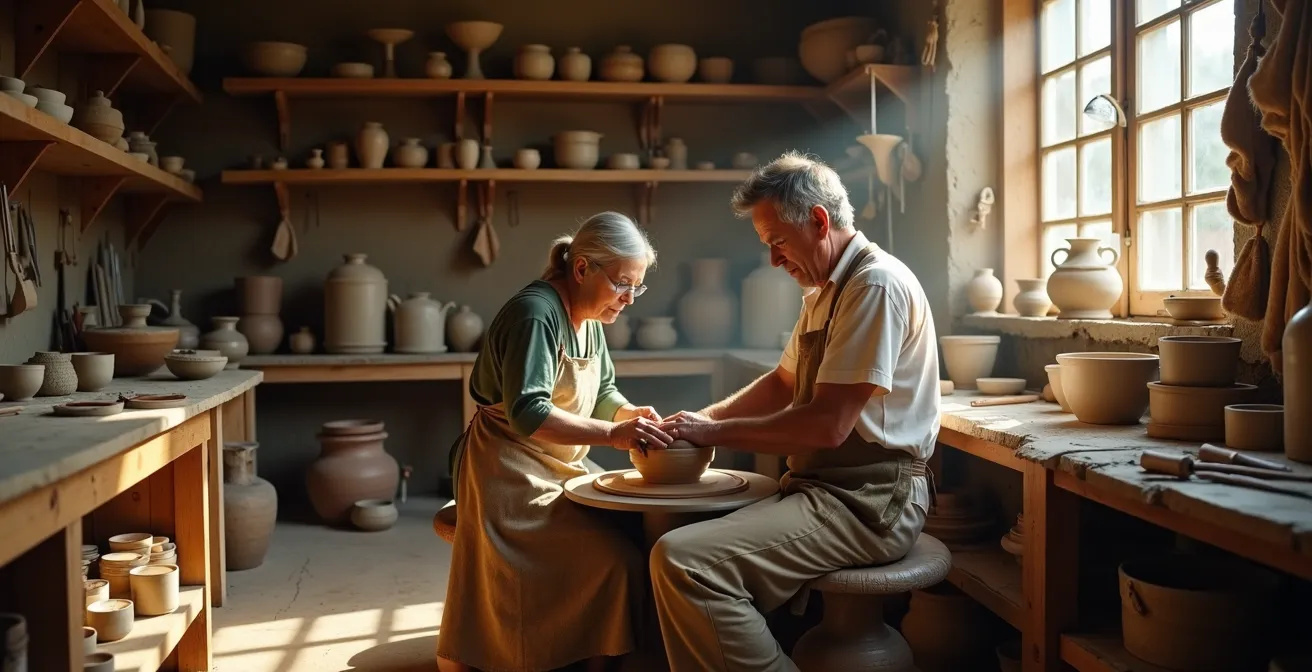
Contrary to popular belief, a truly authentic craft experience isn’t something you can simply buy; it’s a space you must earn by showing respect, understanding, and ethical awareness.
- Authenticity is found in an artisan’s commitment to knowledge transmission and community standing, not just their storefront.
- Ethical appreciation involves learning the story and context behind a design, not just copying the pattern.
Recommendation: Shift your mindset from being a consumer of a class to becoming a temporary, respectful apprentice in a living, creative space.
The allure of learning a traditional craft on your travels is powerful. The idea of shaping clay on a potter’s wheel in a sun-drenched village or weaving a textile with threads dyed from local plants speaks to a deeper desire for connection and authenticity. We, as creative travelers, don’t just want a souvenir; we want to touch the soul of a place, to learn with our hands, and to bring home a story embedded in an object we helped create. This journey is about making pottery, yes, but also about understanding the heritage of textiles or the delicate art of jewelry making.
Many guides will point you toward the most popular workshops, suggesting you “read reviews” or “look for good deals.” But this often leads to polished, tourist-centric experiences that are more performance than practice. These instructors are skilled at teaching, but are they the cultural custodians you’re seeking? This approach often misses the point entirely. The real value isn’t just in the skill learned, but in the person from whom you learn it, the context of their studio, and the lineage of their craft.
But what if the key wasn’t finding the best-marketed class, but earning your place in a genuine workshop? This guide adopts a different perspective. It’s built on the idea that a meaningful exchange is a reciprocal one. We will explore how to distinguish a master artisan from a tourist instructor, understand the unspoken etiquette of a creative space, and navigate the delicate line between appreciation and appropriation. This is about transforming a simple holiday activity into a profound act of cultural immersion and ethical support.
This article provides a framework for the discerning traveler to find and engage with these keepers of tradition. We will cover the essential steps, from identifying true mastery to ensuring the precious piece you create makes it home in one piece, all while fostering a respectful and memorable connection.
Summary: A Traveler’s Guide to Authentic Craftsmanship and Ethical Learning
- How to Distinguish a Master Artisan from a Tourist Instructor?
- How to Ship Your Fragile Pottery Home Without It Breaking?
- Can You Learn a Craft Without Speaking the Artisan’s Language?
- Appreciation or Theft: When Is It Okay to Copy Traditional Designs?
- Half-Day or Week-Long: How Long to Actually Master a Basic Skill?
- How to Visit Artist Studios Without Being a Nuisance?
- Architecture Tour or Solo Walk: Which Reveals Hidden Details?
- How to Access Authentic Cultural Performances Not Made for Tourists?
How to Distinguish a Master Artisan from a Tourist Instructor?
The first and most critical step is discerning true mastery from a polished performance. A “tourist instructor” may be an excellent teacher, but a master artisan is a cultural custodian, a link in a chain of knowledge transmission that often spans generations. The distinction lies not in the quality of their English or the slickness of their website, but in their standing within their own community and their dedication to the craft itself. A master’s workshop feels different; it’s a place of production, not just demonstration, filled with well-worn tools, works in various stages of completion, and the quiet hum of focused creativity.
Look for evidence that goes beyond tourist testimonials. Are they members of a formal craft guild or cooperative? These organizations often have rigorous vetting processes. For instance, only 25% of applicants achieve Master Artisan status on their first attempt with the Pennsylvania Guild of Craftsmen, highlighting the high bar for recognition. Does the artisan train local apprentices? The act of passing skills to the next generation is a profound indicator of a master’s role in their community. Their reputation among peers is far more telling than their rating on a travel site.
To verify their standing, look for signs of peer recognition, such as participation in juried art shows rather than just tourist markets. Research their lineage; many artisans are proud to share the story of how they learned from a parent or grandparent. This isn’t just a business for them; it’s an identity. Choosing to learn from such an individual is the first step in a reciprocal exchange, where your fee supports not just a person, but the preservation of a tradition.
How to Ship Your Fragile Pottery Home Without It Breaking?
After the profound experience of creating a piece under the guidance of a master, the next challenge is a practical one: getting your fragile creation home safely. The heartbreak of unpacking a suitcase to find a pile of ceramic shards is a real risk. The key is to think like a museum curator, not a holiday packer. Your hand-thrown bowl or delicate sculpture is not just a souvenir; it’s a vessel of memory and effort that deserves meticulous care.
Forget simply wrapping it in a sweater. The professional standard for highly fragile items is the double-boxing method. This technique, used by shipping experts, provides a crucial buffer against the impacts and vibrations of transit. First, the item is carefully wrapped in multiple layers of cushioning material like bubble wrap. It’s then placed inside a small, sturdy box, with more packing material filling any empty space to prevent movement. This smaller box is then placed inside a larger, stronger shipping box, with at least two inches of cushioning material on all sides—bottom, top, and all four sides. This “box-in-a-box” system creates a suspension that absorbs shocks from the outside, protecting the delicate object within.
This paragraph introduces the concept of packing your precious craftwork with care. The illustration below breaks down the essential layering and protection involved in the highly effective double-boxing technique.
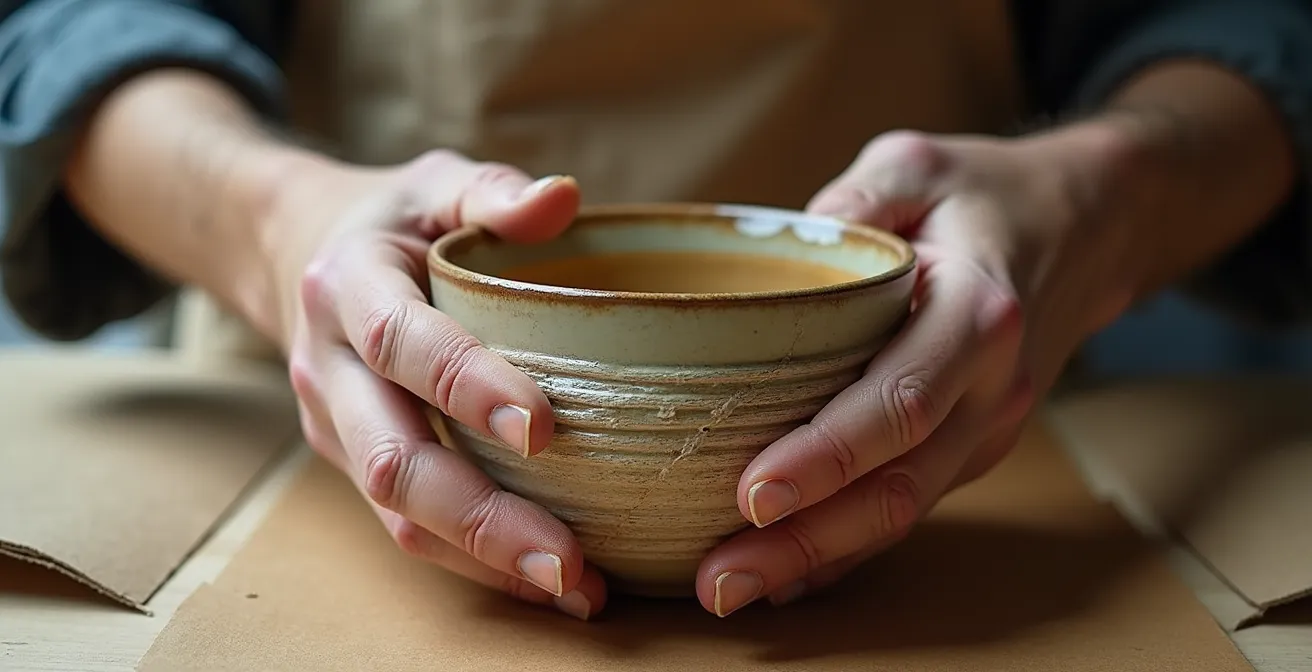
As you can see, the process involves multiple layers of protection. While it may seem excessive, this level of care is the difference between a cherished keepsake and a travel tragedy. Many artisans can provide packing materials or recommend a local shipping service that is accustomed to handling delicate crafts. Investing in proper packing is the final act of respect for your work and for the artisan who taught you.
Can You Learn a Craft Without Speaking the Artisan’s Language?
The fear of a language barrier can be a significant deterrent for travelers seeking authentic experiences. How can you possibly learn the nuances of a craft if you can’t communicate verbally? The truth is, the workshop has its own universal language. It’s a language spoken through gesture, demonstration, and the shared tactile experience of materials. A master artisan can often communicate more with their hands in thirty seconds than an interpreter could explain in five minutes. The way they correct the pressure of your fingers on the clay or adjust the tension of a thread on a loom transcends spoken words.
Indeed, the absence of a shared spoken language can sometimes be an advantage. It forces you to quiet your mind and heighten your other senses. You learn to watch more intently, to feel more deeply, and to trust the process of imitation and absorption. This non-verbal dialogue fosters a unique and powerful connection. As the team at Lokal Travel notes in their guide, by engaging in this way, “not only do you get to grasp the nuances of their craft, but you also become part of a legacy, carrying forward an age-old tradition.” You are participating in a chain of knowledge that has always relied more on showing than telling.
To bridge the small gaps, a little preparation goes a long way. Learning a few key terms can show respect and facilitate the process. This doesn’t require fluency, just a handful of essential words related to the craft.
- Pottery: ‘wedge’ (to prepare clay), ‘glaze’ (the surface coating), ‘bisque’ (the first firing), and ‘kiln’ (the oven).
- Weaving: ‘warp’ (vertical threads), ‘weft’ (horizontal threads), ‘heddle’ (the device that separates threads), and ‘shuttle’ (the tool that carries the weft).
- Metalwork: ‘forge’ (to heat and shape), ‘anneal’ (a heat treatment to soften metal), ‘quench’ (rapid cooling), and ‘patina’ (the surface coloring).
This shared vocabulary, however small, becomes the foundation for a rich, non-verbal conversation, proving that the most profound lessons are often learned in silence.
Appreciation or Theft: When Is It Okay to Copy Traditional Designs?
As you immerse yourself in a craft, you will inevitably be exposed to traditional patterns, motifs, and designs that are deeply woven into the local culture. They are beautiful, compelling, and you will feel an urge to use them in your own work. This is where the creative traveler must tread most carefully. The line between cultural appreciation and cultural appropriation is a fine one, and it is defined by context, credit, and compensation. Appreciation honors the source and recognizes its value, while appropriation takes without permission or understanding, often for commercial gain.
The core issue is that many of these designs are not the intellectual property of a single person. As the World Intellectual Property Organization (WIPO) explains, it is often difficult to identify the original creators of “traditional cultural expressions” because they are communally developed and held over generations. This is a complex legal area, as an analysis on the applicability of IP systems to cultural heritage highlights.
It is difficult, if not impossible, however to identify the creators of TCEs [traditional cultural expressions], and hence the rights holders and beneficiaries in TCEs, because TCEs are communally created and held and/or because the creators are simply unknown and/or unlocatable.
– World Intellectual Property Organization (WIPO)
This does not mean the designs are free for the taking. It means the responsibility to act ethically falls squarely on you. The respectful approach is to learn the story behind the motif. Ask your artisan mentor: What does this pattern represent? When is it used? Is it sacred? Is it specific to a certain family or village? This act of inquiry shifts your role from a taker to a student. The goal should be to understand the “grammar” of the design language, not just to copy a “sentence” you find attractive.
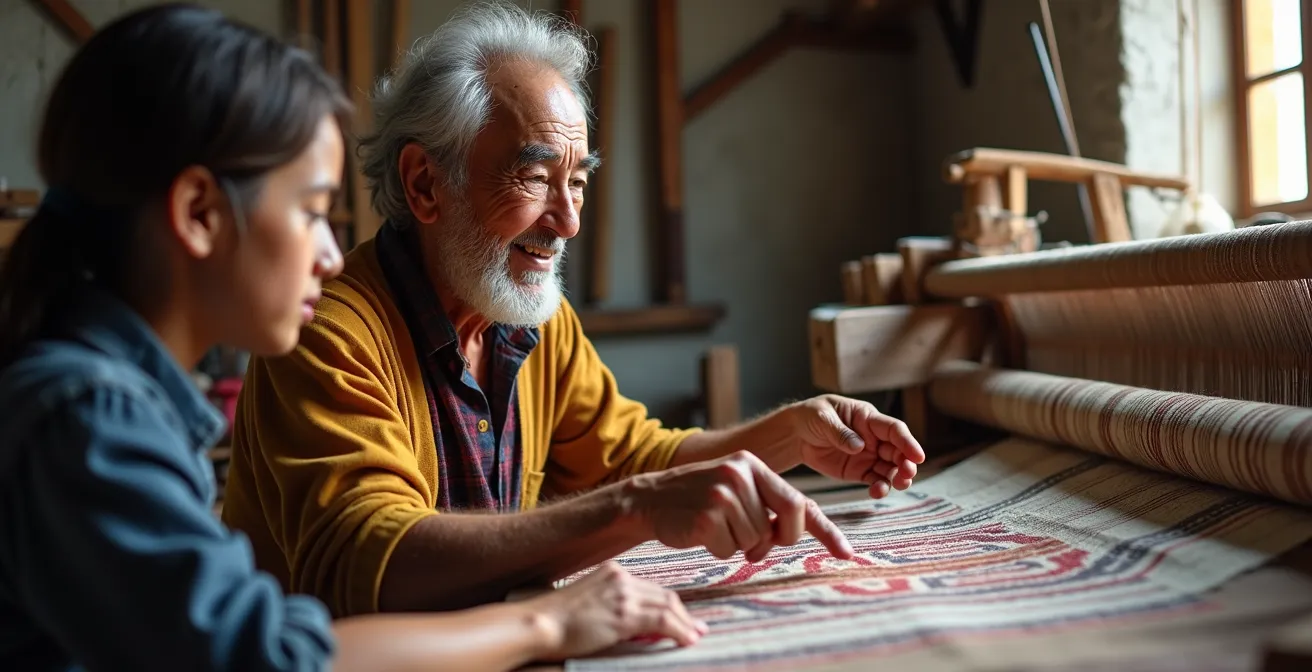
The artisan is your guide to understanding the story and meaning behind traditional designs. This interaction is key to ethical appreciation, as shown below.
The CULTURAL INTELLECTUAL PROPERTY RIGHTS INITIATIVE®
To combat extractive behavior, formal initiatives are emerging. The CULTURAL INTELLECTUAL PROPERTY RIGHTS INITIATIVE® was created to help establish and protect the rights of artisans who are the custodians of traditional designs and techniques. It champions a world where these communities can control and benefit from their own cultural heritage, pushing back against the fashion industry and others who have historically appropriated these designs without credit or compensation. Supporting artisans who are part of such movements reinforces the value of their cultural custodianship.
Half-Day or Week-Long: How Long to Actually Master a Basic Skill?
One of the biggest disconnects between expectation and reality in craft workshops is time. We see a finished product—a perfectly symmetrical bowl or an intricately woven scarf—and underestimate the hours, days, and years of practice required to achieve that result. A three-hour “taster” session is a wonderful way to connect with a material and an artisan, but it is not a path to mastery. Setting realistic expectations is an act of respect for the craft and the artisan’s lifetime of experience.
A short, half-day workshop should be viewed as an introduction, a chance to feel the texture of the clay or understand the mechanics of a loom. You will learn the ‘what’, but not necessarily the ‘how’. A full-day workshop allows you to begin tackling the first major hurdle, like centering clay on a wheel or completing a small, simple project with significant guidance. It’s only within a multi-day or week-long immersion that you can begin to build muscle memory, develop some independence, and start to understand the nuances of the process, such as the basics of glazing or designing your own small piece.
The following table provides a realistic look at what you can expect to achieve in various crafts depending on the duration of your workshop. This data, based on an analysis of common workshop outcomes, helps ground your ambitions in reality, ensuring you leave with a sense of accomplishment rather than frustration.
| Duration | Pottery | Weaving | Leatherwork |
|---|---|---|---|
| 3 Hours | Feel clay texture, understand basic wheel mechanics | Learn threading basics, understand loom setup | Cut and stitch simple keychain |
| 1 Day | Center clay on wheel, attempt first cylinder | Complete small sampler piece | Create simple wallet with guidance |
| 5 Days | Throw small bowls independently, understand glazing basics | Design and complete small textile piece | Complete belt or small bag with decorative elements |
Ultimately, the goal is not to “master” a skill in a week. The goal is to gain a profound appreciation for what it takes to achieve mastery. This humility is a cornerstone of the reciprocal exchange. You are not just paying for a lesson; you are paying for a glimpse into a world of deep knowledge, and that perspective is more valuable than any single object you create.
How to Visit Artist Studios Without Being a Nuisance?
Beyond a formal workshop, you may have the opportunity to visit an artisan’s studio. This is a privilege, an invitation into a personal and functional creative space, and it comes with a distinct set of unwritten rules. An artisan’s studio is not a public gallery or a shop. It is their office, their laboratory, and often, a sanctuary. Showing up unannounced or treating it like a tourist attraction is the quickest way to be a nuisance and disrespect the artisan’s focus and workflow. The key is to remember you are a guest in a working environment.
The most fundamental rule of creative etiquette is to always schedule a visit in advance. Artisans work on tight schedules, often dictated by kiln firings, drying times, or intense periods of concentration. An unexpected interruption can ruin hours of work. Once there, ask for permission before touching anything—tools, materials, and especially finished pieces. Your curiosity is welcome, but focus your questions on the creative process and techniques rather than immediately asking about prices, which can make the interaction feel purely transactional.
A successful visit is a value exchange. While a purchase is the most direct way to show support, it’s not the only way. If you don’t buy anything, consider leaving a tip for the time and knowledge they’ve shared. A small, thoughtful gift from your home country can also be a wonderful gesture of appreciation. And if you take photos (with explicit permission), share them respectfully on social media with proper credit to the artisan. This helps amplify their work to a new audience. By following these simple rules, you transform your visit from a potential interruption into a welcome and mutually enriching encounter.
Your Studio Visitor’s Code of Conduct Checklist
- Schedule Appointments: Always contact the artisan in advance to arrange a time that works for them. Never show up unannounced.
- Ask Before Touching: Respect the workspace. Ask for permission before handling tools, materials, or any finished or in-progress artwork.
- Focus on Process: Guide your questions toward the artisan’s technique, inspiration, and creative journey, rather than leading with “How much is this?”
- Demonstrate Value Exchange: If you’re not making a purchase, show your appreciation for their time by leaving a tip or bringing a small, thoughtful gift.
- Practice Photo Etiquette: Always ask for permission before taking photographs. If you share them online, give full credit and tag the artisan.
Architecture Tour or Solo Walk: Which Reveals Hidden Details?
Once you’ve spent time in an artisan’s workshop, something magical happens: you start to see the world differently. Your eyes are trained to notice details you previously overlooked. A guided architecture tour can provide historical context, but a solo walk, armed with your newfound “artisan’s eye,” can reveal the hidden soul of a city. The city itself becomes the largest workshop, a living museum of craft displayed on its buildings. You’re no longer just looking at a pretty iron balcony; you’re seeing the hammer marks, the forged welds, and the signature curl of the blacksmith who made it.
This material-focused discovery is a form of deep travel. You begin to connect the dots between the crafts you see in the workshop and their application in the built environment. That hand-painted tile from the ceramicist’s studio? You now recognize it in a faded mosaic on a church facade. The joinery techniques from the woodcarver’s shop? You spot them on a centuries-old door. This changes a simple walk into an active scavenger hunt for craftsmanship.
To turn your next city walk into a craft-focused exploration, try this approach:
- Track the wrought iron work on balconies and gates. Note the different forging techniques and decorative patterns from one street to the next.
- Identify hand-carved wooden details on doors and window frames. Look for the subtle tool marks that distinguish them from machine-made elements.
- Examine tilework patterns. Can you distinguish between hand-painted, unique tiles and mass-produced modern replacements?
- Study the local masonry styles. Observe how local stone is cut, fitted, and finished. Many masons and artisans leave a subtle signature or mark on their work.
This solo exploration, guided by an appreciation for materials and technique, often reveals more about the authentic, lived-in history of a place than any formal tour. It’s a testament to how learning a craft gives you a new lens through which to see the world.
Key takeaways
- True mastery is proven by community standing and knowledge transmission, not by tourist reviews.
- Ethical craft tourism requires setting realistic expectations about time and respecting the intellectual property of traditional designs.
- The ultimate value of a workshop is not the object you create, but the new, more detailed way you learn to see the world.
How to Find Cultural Performances That Are Truly for the Community?
The same principles of authenticity that guide you to a master artisan’s workshop can also lead you to genuine cultural performances. Just as there are “tourist trap” workshops, there are countless performances staged exclusively for visitors—polished, shortened, and stripped of their original context. These can be entertaining, but they lack the spirit and energy of an event that is by and for the local community. Accessing these authentic experiences requires moving away from the tourism infrastructure and tuning into the local rhythm.
The most powerful tool you have for this is the relationship you’ve already built with your artisan mentor. Ask them directly what community events are happening during your visit. They can tell you about a local musician’s performance in a small cafe, a religious festival in the town square, or a community play at the local center—events that are rarely, if ever, advertised to tourists. This is another facet of the reciprocal exchange; your genuine interest in their craft opens a door to their culture.
If you’re on your own, you can learn to spot the signs. Check municipal notice boards for flyers written primarily in the local language. Is the event tied to a specific date on the cultural or religious calendar, or is it a generic “Tuesday night folk dance”? Look at the audience: is it predominantly local families or busloads of tourists? The absence of souvenir stands and staged photo opportunities is a very good sign. An event with free or donation-based admission for the community is far more likely to be authentic than one with tiered, tourist-priced tickets. By applying this filter, you can find yourself in the midst of a truly immersive cultural moment, one that feels discovered, not consumed.
By shifting your approach from that of a consumer to that of a respectful student, you do more than just learn a skill. You participate in the preservation of heritage, support a local economy in a meaningful way, and create memories that are deeply embedded in a sense of place and connection. The first step is to begin your search not for a class, but for a master worth learning from.