
The aesthetic allure of an infinity pool masks specific, engineered dangers that standard parental supervision is ill-equipped to handle.
- The “vanishing edge” is a form of perceptual deception that critically impairs a child’s ability to judge depth and boundaries, leading to falls.
- Their complex circulation systems create unique sanitary and structural failure points not found in conventional pools, posing both health and physical risks.
Recommendation: As a pool safety inspector, my advice is to treat infinity pools not as an amenity, but as a piece of heavy machinery. You must verify the presence of secondary barriers, understand the pool’s specific depth profile, and never allow a child’s fascination with the edge to go unchecked.
The image is iconic: a shimmering sheet of water extending seamlessly to the horizon, a symbol of ultimate luxury and relaxation. For parents, however, this breathtaking view is often paired with a knot of anxiety. The conventional wisdom is to simply “watch your children,” a valid but dangerously incomplete piece of advice when dealing with infinity pools. The allure for a child is immense, an endless ocean to explore, but the risks are far more complex than those of a standard backyard pool.
As a safety inspector, my role is to look past the beauty and analyze the mechanics of risk. The danger of an infinity pool isn’t just the water; it’s the design itself. It’s a system engineered to create a powerful optical illusion, an illusion that can be fatal for a mind that cannot yet distinguish between a clever trick of the light and a life-threatening drop. This guide does not offer simple supervision tips. Instead, it provides a technical breakdown of the inherent dangers—perceptual, hydrodynamic, and behavioral—that every parent must understand before letting their child near a vanishing edge.
This analysis will deconstruct the specific hazards associated with infinity pools, moving from the visual tricks that cause accidents to the hidden mechanical and structural vulnerabilities. By understanding these engineered risks, you can make a truly informed decision about your family’s safety.
Summary: Why Are Infinity Pools the Most Dangerous Feature for Children?
- How the “Edge” Illusion Causes Vertigo and Accidents?
- Why Infinity Pool Water Is Harder to Keep Sanitary Than Regular Pools?
- The Energy Cost of Infinity Pools: Are They Eco-Friendly?
- How to Get the “Empty Pool” Photo Without Waking Up at 5 AM?
- Which Floor Level Offers the Best Infinity Effect?
- The Selfie Mistake at Edge Cliffs That Costs Lives Every Year
- How to Ensure Your Rental Estate Is Paparazzi-Proof?
- How to Access Private Beaches Legally Without Staying at the Resort?
How the “Edge” Illusion Causes Vertigo and Accidents?
The primary danger of an infinity pool is a deliberate feature of its design: perceptual deception. The vanishing edge works by allowing water to flow over a weir into a lower catch basin, creating the illusion that the water extends to the horizon. For an adult brain, it’s a fascinating visual trick. For a child, whose depth perception and risk assessment skills are still developing, it’s a dangerously confusing signal. This lack of a clear visual boundary can induce a form of vertigo and spatial disorientation, making it difficult to judge the pool’s actual edge.
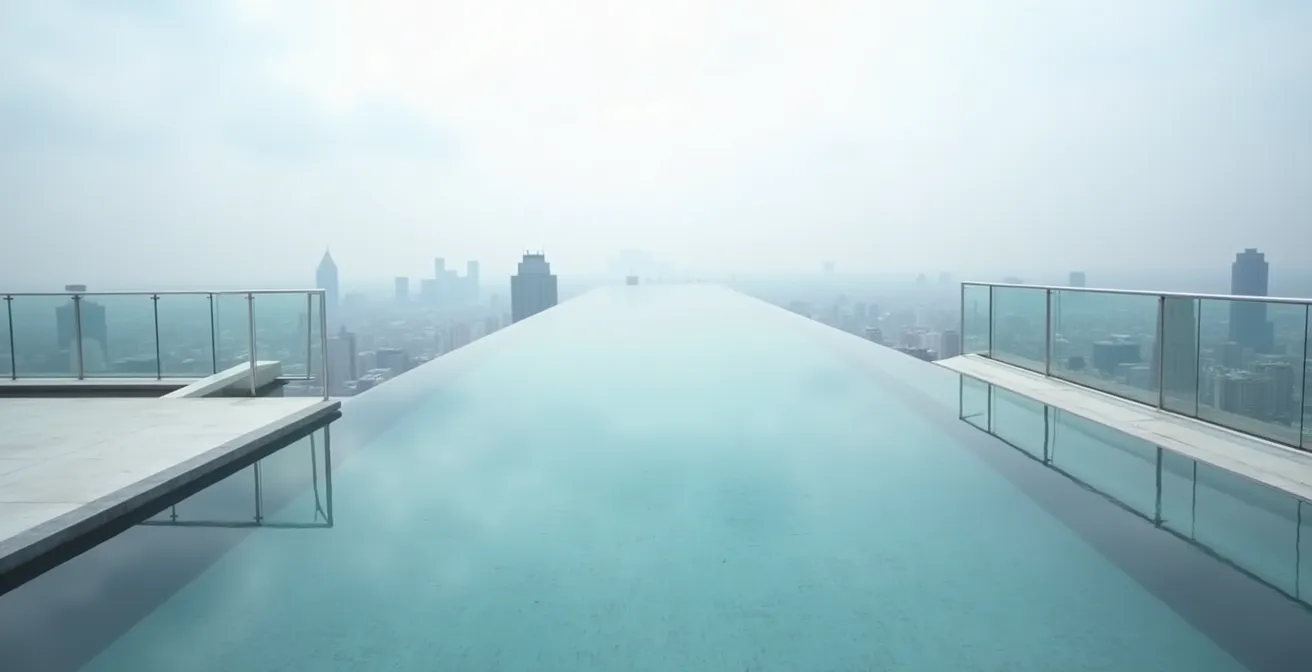
This visual confusion is not a trivial matter. The absence of a coping or a raised deck edge removes the most fundamental tactile and visual cue of a pool’s boundary. A child, drawn to the seemingly endless water, may not register the transition from the pool floor to the weir edge, leading to slips and falls into the catch basin. While these basins are usually shallow, the fall itself can cause injury. This risk is magnified for non-swimmers and toddlers. Indeed, pool safety experts confirm that 75% of pool drownings involve children under 5 years old, an age group particularly susceptible to this kind of perceptual error.
This engineered illusion is precisely what makes these pools uniquely hazardous, as explained by industry safety analysts. The Cutters Pools Safety Report notes the following:
The optical illusion created by the vanishing edge can sometimes make it difficult to gauge the depth of the pool. Swimmers, especially beginners, may misjudge the depth, increasing the risk of accidental slips or falls.
– Cutters Pools Safety Report, Pool Safety Analysis
This is not a failure of supervision; it is a failure of design to account for the cognitive development of its most vulnerable users. The “lure of the edge” is a powerful, built-in hazard.
Why Infinity Pool Water Is Harder to Keep Sanitary Than Regular Pools?
Beyond the immediate physical danger of the edge, infinity pools present a significant, often overlooked, hydrodynamic vulnerability related to sanitation. A conventional pool is a relatively closed system. An infinity pool, by contrast, is an open one. The water continuously flows over the edge into a catch basin or “trough” that is often exposed to the open air. This basin collects not only the pool water but also leaves, dust, bird droppings, and other environmental contaminants before the water is pumped back into the main pool. This creates a persistent contaminant loop.
This design places a much higher load on the filtration and sanitation systems. While a standard pool’s skimmers handle surface debris effectively, an infinity pool’s catch basin acts as a giant, low-lying skimmer for the surrounding environment. If the filtration and pump systems are not oversized, impeccably maintained, or running near-continuously, the water quality can degrade rapidly. This can lead to higher concentrations of bacteria and pathogens, increasing the risk of recreational water illnesses for all swimmers, especially children who are more likely to swallow water.
Furthermore, the complexity of these systems introduces more points of potential failure. A breakdown in the circulation system doesn’t just mean a dirty pool; it can lead to catastrophic structural failure. A stark example of this is the 2022 incident at a luxury resort.
Case Study: Sandals Royal Curacao Infinity Pool Structural Failure
Shortly after its grand opening, the bi-level infinity pool at the Sandals Royal Curacao resort experienced a major structural failure. According to an investigation by Pool Magazine, the glass panel structure of the pool collapsed, causing the sudden release of water and injuring several guests who were in the water at the time. The incident forced the immediate closure of the pool for extensive repairs and highlighted critical concerns about the material stress and maintenance demands inherent to complex glass-paneled infinity pool designs.
This incident serves as a critical warning: the engineering that creates the beauty also creates unique and severe failure modes. An improperly maintained system is not just a health risk; it’s a structural one.
The Energy Cost of Infinity Pools: Are They Eco-Friendly?
From a safety inspector’s perspective, high operational costs are a direct threat to safety. When maintenance budgets are strained, safety-critical tasks are often the first to be deferred. Infinity pools are notoriously expensive to operate, primarily due to their massive energy consumption. The constant pumping of water over the edge and the increased surface area for heat loss and evaporation make them far less efficient than conventional pools. This isn’t just an environmental concern; it’s a safety one.
The core of the inefficiency lies in three areas: pump runtime, heat loss, and water evaporation. To maintain the “infinity” effect, the circulation pump must run almost continuously, often 24 hours a day. As water cascades over the edge, it is aerated, which dramatically increases the rate of evaporation and causes a significant cooling effect. This, in turn, requires more energy from the heater to maintain a comfortable temperature. An underfunded operator may be tempted to reduce pump runtime or lower heater settings, compromising both the water’s sanitation and the pool’s structural integrity if systems aren’t designed for intermittent use.
The following table, based on data from pool engineering experts, starkly illustrates the difference in operational demands. As shown in a comparative analysis by Sublime Pools & Spa, the resource requirements are substantially higher for infinity designs.
| Feature | Infinity Pool | Regular Pool |
|---|---|---|
| Pump Runtime | Near-continuous (20-24 hours) | 8-12 hours daily |
| Water Evaporation Rate | 40-60% higher due to edge cascade | Standard evaporation only |
| Heat Loss | Significant via waterfall cooling effect | Surface evaporation only |
| Filtration Load | Higher due to open catch basin exposure | Closed system, lower contamination |
In short, the answer is no; infinity pools are not eco-friendly. Their high energy and water consumption create a significant environmental footprint. For parents, the critical takeaway is that this high cost creates an economic pressure that can lead to compromised maintenance schedules, directly impacting the safety and sanitation of the water your children swim in.
How to Get the “Empty Pool” Photo Without Waking Up at 5 AM?
This question, while common among travelers seeking the perfect social media post, reveals a dangerous mindset from a safety perspective. The desire for an “empty pool” photograph often drives individuals to take risks they otherwise wouldn’t. As an inspector, my answer is simple: you shouldn’t prioritize the photo over safety. Attempting to use a pool outside of its designated operating hours is a significant hazard.
Waking up at 5 AM or staying late after the pool has officially “closed” means you are likely to be alone. There will be no lifeguards on duty, and in many cases, fewer staff members in the vicinity to respond to an emergency. For a family with children, this is an unacceptable risk. A slip, a fall, or a moment of disorientation at the pool’s edge can become a tragedy when there is no one around to help. The very emptiness that makes the photo appealing is what makes the situation so dangerous.
Furthermore, during off-hours, certain safety and operational systems may be running on a reduced cycle or be shut down entirely for maintenance. Pool lighting may be off, making it harder to judge depth and see obstacles. The circulation system might be in a backwash cycle or turned off, leading to stagnant water. The pursuit of an aesthetic ideal—the pristine, empty pool—directly conflicts with the layered safety protocols that make a commercial pool reasonably safe during peak hours. The “perfect shot” is never worth compromising your child’s well-being.
Instead of seeking an empty pool, the responsible action is to use it during normal hours when staff are present and all safety systems are fully operational. The presence of other people is not a nuisance; it is an essential part of the safety net.
Which Floor Level Offers the Best Infinity Effect?
The effectiveness of the infinity illusion is directly tied to the pool’s elevation relative to the horizon it’s meant to blend with. From a design standpoint, the “best” effect is achieved when the pool’s water level is perfectly aligned with the distant view, such as the ocean or a city skyline. This typically requires a mid-to-high-level placement. However, from a safety standpoint, higher is not better. The greater the height, the more severe the potential consequences of a barrier failure and the more psychologically intimidating the drop-off becomes.
An optimal design, like that of the pool at the Caruso hotel in Ravello, Italy, often involves a mid-level placement. This allows the water to meet the Mediterranean horizon effectively without creating an excessive or terrifying drop. More importantly, well-designed pools at any level must incorporate secondary and tertiary safety systems. The Caruso pool, for instance, reportedly features safety nets just below the vanishing edge—a crucial feature that is often invisible in marketing photos but is vital for mitigating the risk of a fall into the trough.
However, even with such measures, parents must be aware of another critical factor influenced by the infinity design: variable and often deep water. To create a smooth, reflective surface that enhances the illusion, infinity pools are often deeper than conventional leisure pools, with depths quickly dropping to over six feet just beyond the entry steps. For a child, this sudden change in depth is a significant drowning hazard. The visual appeal of the surface gives no indication of the danger lurking just a few feet from the shallow area. Before entering any infinity pool, it is your responsibility as a parent to physically check the depth profile yourself and establish strict boundaries for your children.
The “best” infinity effect is therefore a compromise between aesthetics and robust, multi-layered safety engineering. The visual success of the illusion should never be the sole metric of a pool’s quality.
The Selfie Mistake at Edge Cliffs That Costs Lives Every Year
The hazardous behavior encouraged by the “lure of the edge” is not limited to residential pools; it is a widespread phenomenon amplified by social media’s obsession with dramatic photo opportunities. The edge of an infinity pool has become analogous to a cliff edge, a place where people take reckless chances for a memorable selfie. This trend has had fatal consequences in natural settings and is leading to a growing number of serious incidents at resorts and on cruise ships.
Modern cruise ships, in their quest for “wow factor” amenities, have installed infinity pools on high decks, dozens of stories above the ocean. This combination of a perceived “safe” environment with a thrilling, cliff-like drop is a recipe for disaster. Passengers, feeling a false sense of security, climb on railings, lean out over the edge, or perform stunts for photos, completely underestimating the danger. While a fall from a railing might only lead to the catch basin in a land-based resort, on a cruise ship, it can mean a fall of multiple stories into a restricted area or, worse, overboard.
This isn’t a hypothetical risk. In recent years, cruise safety reports document multiple incidents of passengers falling from or over the railings of infinity-edge pools while attempting to take photos. Videos have gone viral showing individuals losing their balance while performing a risky pose on the pool’s edge, only narrowly avoiding a catastrophic fall thanks to a secondary maintenance catwalk. These incidents are stark reminders that the psychological pull of the edge can override common sense.
For parents, the lesson is clear: you must teach your children that the edge of an infinity pool is a hard boundary, not a playground or a photo prop. The desire to capture a thrilling moment on camera is creating a culture of recklessness that has turned these luxury features into documented safety hazards.
How to Ensure Your Rental Estate Is Paparazzi-Proof?
While physical safety is the primary concern, the design of infinity pools—often positioned for maximum visibility and stunning views—creates a secondary risk: a lack of privacy. For families at a high-end rental or resort, particularly those with a public profile, the very features that make the property desirable also make it vulnerable to unwanted observation from paparazzi, drones, or even just neighboring properties with a clear line of sight.
Ensuring your pool area is “paparazzi-proof” requires a proactive, multi-layered approach to security and privacy that goes beyond a simple fence. It involves analyzing all potential vantage points and implementing strategic barriers that block sightlines without completely sacrificing the aesthetic. Modern privacy solutions are sophisticated and can be integrated seamlessly into a luxury environment. A comprehensive strategy involves both technological and physical barriers to create a truly private sanctuary for your family.
If privacy is a significant concern during your stay, it is essential to either verify the existing measures with the property owner or consider implementing temporary ones. The goal is to create an environment where your family can relax without the worry of being watched or photographed.
Action Plan: Securing Your Pool Area from Unwanted Intrusion
- Analyze Vantage Points: Conduct a thorough “angle of attack” analysis from all potential observation points, including public roads, adjacent buildings, and high ground. Use this to identify critical weak spots in your privacy screen.
- Implement Vertical Landscaping: Use tall, dense plantings like bamboo or strategically placed trees to create natural, aesthetically pleasing visual barriers that block sightlines from a distance.
- Install Strategic Screens: Utilize pergolas, retractable screens, or decorative panels to obstruct specific lines of sight without creating a “fortress” feel. Laser-cut metalwork can provide privacy while still allowing light and air to pass through.
- Deploy Drone Detection: For high-risk properties, install acoustic drone detection systems. These systems provide an early warning of approaching aerial drones, giving you time to seek cover before photos or videos can be taken.
- Review and Adapt: Privacy is not static. Regularly review your measures, especially as surrounding landscapes or buildings change, to ensure your private spaces remain secure from prying eyes.
Protecting your family’s privacy is an extension of protecting their overall well-being. A secure environment is one where you can truly relax.
Key Takeaways
- Perceptual Deception is Inherent: The vanishing edge is designed to trick the eye, critically impairing a child’s ability to perceive boundaries and depth, making it a built-in fall hazard.
- Sanitary Systems are Vulnerable: The open-air catch basin creates a “contaminant loop,” increasing the load on filtration and posing a higher risk of waterborne illness if maintenance is not perfect.
- Behavioral Risks are Magnified: The “lure of the edge,” amplified by social media’s quest for dramatic photos, encourages reckless behavior that has led to documented falls and injuries.
How to Access Private Beaches Legally Without Staying at the Resort?
While navigating the engineered environment of a resort, it’s also important to understand the legal boundaries of the natural environment, particularly beaches. Many luxury resorts with infinity pools are situated on what appear to be private beaches. However, in many jurisdictions, beach access is a public right, and “private” beaches are not as exclusive as they seem. Understanding your legal rights can allow you to enjoy these beautiful coastlines without being a guest of the adjoining property.
The key legal principle in many coastal areas is the Public Trust Doctrine. This doctrine generally holds that the land below the mean high tide line—the area of wet sand left by the receding tide—is public property held “in trust” for all citizens. This means if you can legally access this area of wet sand, you are legally allowed to be there. The challenge, of course, is getting there without trespassing on the privately-owned dry sand portion of the beach or the resort’s property.
There are several legitimate methods for accessing these public areas. The most direct way is to find a designated public access point, which may be a path or a small park located some distance from the resort. Researching local municipal or county records can sometimes reveal forgotten public footpaths or historic rights-of-way that cut through private property. Another common strategy is to become a legitimate patron of the resort; making a reservation at a beachfront restaurant or bar often grants you legal visitor status, from which you can then access the public wet sand area.
Knowing your rights is crucial. While you must never trespass on clearly marked private property, you should also not be intimidated or turned away from public land. Understanding the distinction between the private dry sand and the public wet sand is the key to legally enjoying some of the world’s most beautiful shorelines.
Therefore, as a parent and a consumer, your duty of care extends to active inquiry. Before booking, question the resort’s management directly about their specific child safety protocols for their infinity pools. Ask about secondary barriers, alarm systems on access doors, and the depth profile of the pool. Treat this beautiful amenity with the caution and respect you would any piece of potentially dangerous machinery.
Frequently Asked Questions about Why Are Infinity Pools the Most Dangerous Feature for Children?
What is the Mean High Tide Line principle?
The area below the mean high tide line (wet sand) is considered public land under the Public Trust Doctrine, allowing legal access if you can reach it from a public entry point without trespassing on dry sand.
How can I find public easements to beaches?
Research local county or municipal records online for forgotten public footpaths or historic rights of way that legally grant public access through what appears to be private property.
Can dining at a resort restaurant grant beach access?
Making a legitimate reservation at a resort’s public restaurant grants you legal visitor status, often allowing access to adjacent public beach areas (wet sand) from the property.