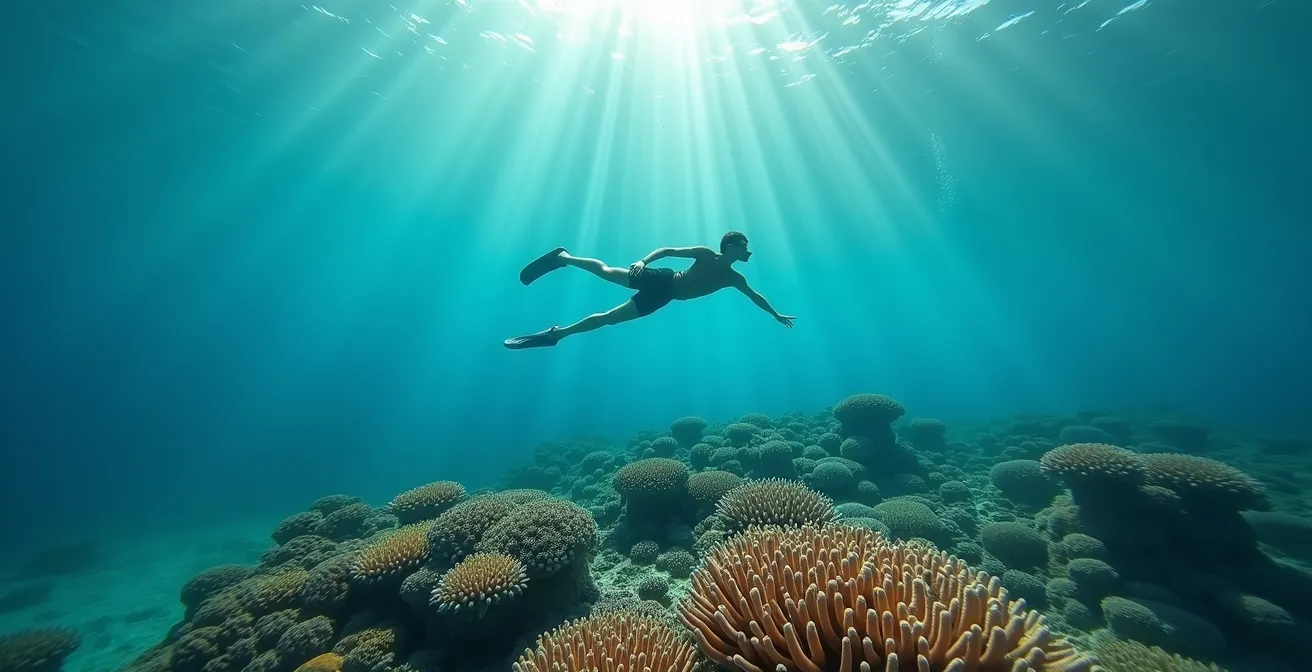
Protecting a coral reef isn’t about following a list of rules; it’s about understanding that you are swimming inside a fragile, living animal.
- Your sunscreen can act like a chemical poison, turning coral’s own defences against itself and causing bleaching.
- A single touch or misplaced fin kick can shatter decades of growth and expose the entire colony to fatal diseases.
Recommendation: Treat the reef not as a destination, but as a living creature. Master your buoyancy, choose mineral-based sunscreens, and adopt the mindset of a silent observer to become a guardian, not a threat.
The feeling is universal: the gentle pull of the current, the muffled silence of the underwater world, and the sudden explosion of color as a coral reef comes into view. It’s an underwater metropolis, teeming with life. But there’s a devastating disconnect between our sense of wonder and our actions. We see a vibrant, rocky landscape, but we fail to recognize it for what it truly is: a vast, fragile colony of tiny, living animals called polyps.
The common advice is well-intentioned but dangerously superficial: “don’t touch,” “wear reef-safe sunscreen.” These rules are treated like museum etiquette, but they barely scratch the surface of the biological crisis unfolding with every tourist-filled boat. The issue isn’t just about avoiding direct contact; it’s about understanding the complex, symbiotic relationships that a single, seemingly innocent action can shatter. It’s about the invisible chemical warfare waged by our sun protection and the cumulative stress of thousands of visitors.
This guide takes a different approach. As a marine biologist, my mission is to pull back the curtain and reveal the ‘why’ behind the rules. We will move beyond the checklist and delve into the science of the reef’s fragility. What really happens when oxybenzone washes off your skin? Why is standing on a patch of coral a death sentence for an entire colony? By understanding the biology of this breathtaking ecosystem, you transform from a passive tourist into a conscious guardian, armed with the knowledge to protect the very wonder you came to witness.
This article will guide you through the critical knowledge needed to interact with the reef responsibly. We will explore the hidden dangers in your beach bag, the essential skills for navigating this delicate environment, and how to choose operators who share a commitment to conservation, ensuring these underwater cities can thrive for generations to come.
Summary: How to Snorkel a Coral Reef Without Killing It?
- Why Your “Regular” Sunscreen Bleaches Coral in Minutes?
- The “One Touch” Rule: Why Standing on Coral Is a Death Sentence?
- How to Check if Your Tour Boat Uses Mooring Buoys?
- The Ecological Harm of Feeding Fish Bread for Instagram Photos
- How to Spot Camouflaged Marine Life Without Touching Anything?
- Why Touching Ancient Frescoes Causes Irreversible Damage Over Time?
- The “Plastic-Free” Hotel That Still Uses Single-Use Toiletries
- How to Swim with Marine Life Without Harassing or getting Hurt?
Why Your “Regular” Sunscreen Bleaches Coral in Minutes?
The term “bleaching” is a tragically gentle word for a violent biological process. Coral gets its vibrant color from microscopic algae called zooxanthellae, which live in a symbiotic relationship within the coral’s tissue. The algae provide the coral with up to 90% of its energy through photosynthesis, and in return, the coral provides shelter. When you apply a chemical sunscreen containing ingredients like oxybenzone and octinoxate, you introduce a poison into this delicate partnership.
As you swim, these chemicals wash off your skin and are absorbed by the coral. A recent Stanford study revealed a horrifying biochemical cascade: while oxybenzone is designed to dissipate UV light as heat on human skin, coral metabolizes it into a substance that becomes a potent toxin when exposed to sunlight. The coral’s own defense mechanism is turned against it, creating damaging radicals that stress the polyps. In a panic response, the coral expels its life-sustaining zooxanthellae, losing its color and primary food source. It is left a ghostly white, starving and vulnerable to disease.
The scale of this problem is staggering. It’s estimated that up to 6,000 tons of sunscreen wash through U.S. reef areas every year. The solution is to completely abandon chemical sunscreens for non-nano mineral alternatives containing zinc oxide or titanium dioxide. These ingredients form a physical barrier on your skin and do not trigger the same deadly reaction in corals. Opting for UV-protective rash guards is an even better way to minimize your chemical footprint entirely.
The “One Touch” Rule: Why Standing on Coral Is a Death Sentence?
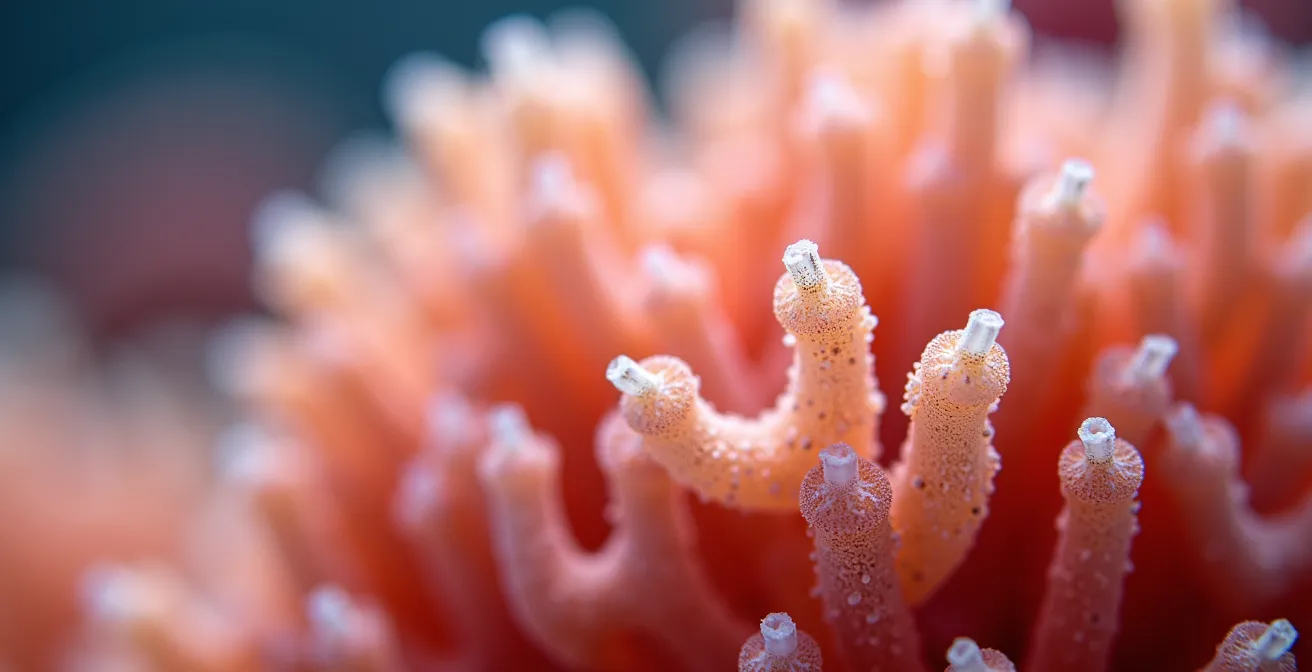
Imagine the reef not as a rock garden, but as a bustling city built from the fragile skeletons of millions of tiny, interconnected animals. Each coral polyp is a soft-bodied creature, protected by a thin layer of living tissue and a delicate mucous membrane. This membrane is its first line of defense against infection and parasites. When you touch, stand on, or even graze the coral with a fin, you are committing an act of devastating destruction.
This single point of contact can scrape away that protective mucous layer, leaving the entire colony vulnerable to disease. Worse, the pressure from a hand or fin can crush hundreds of individual polyps, killing them instantly. As breaking a single finger of coral wipes out years or even decades of slow, patient growth in a matter of seconds. What appears to be a minor bump is, at a microscopic level, a catastrophic event for the colony.
The key to avoiding this is mastering conscious buoyancy. This isn’t just about “watching your fins”; it’s about controlling your body in the water with precision. Practice floating effortlessly on the surface. If you need a break, float on your back or find a clear, sandy patch to stand on—but only after checking carefully for hidden creatures like stingrays. Keep your knees bent and close to your body if you need to tread water in shallow areas. This prevents your fins from dangling and causing accidental damage to the living architecture below you.
How to Check if Your Tour Boat Uses Mooring Buoys?
Your responsible journey to the reef begins long before you get in the water. The choice of your tour operator is one of the most significant environmental decisions you will make. A boat anchor, weighing hundreds or even thousands of pounds, can pulverize an area of coral that took centuries to grow. A responsible operator will never, under any circumstances, drop anchor directly onto a reef. Instead, they use mooring buoys—permanently anchored lines with a floating buoy on top that boats can tie up to without ever touching the seafloor.
Before booking a tour, ask directly: “Do you use mooring buoys at all of your snorkel sites?” Their answer is a powerful indicator of their environmental commitment. An operator who prioritizes reef health will be proud to confirm this practice. Beyond anchoring, a pre-snorkel briefing is another critical green flag. A good guide will educate passengers on reef etiquette, safety, and the local ecosystem. They act as stewards, not just tour guides.
The following table, based on guidelines from conservation bodies like the NOAA’s Florida Keys National Marine Sanctuary, provides clear signals to look for when choosing an operator. Look for certifications like “Blue Star,” which designates operators committed to sustainable practices.
| Green Flags (Choose These) | Red Flags (Avoid These) |
|---|---|
| Uses mooring buoys instead of anchors | Drops anchor directly on reef |
| Provides pre-snorkel environmental briefing | No safety or environmental briefing |
| Enforces no-touch coral policy | Guide handles marine life for photos |
| Has Blue Star or Green Fins certification | No environmental certifications |
| Limits group sizes (guide-to-snorkeler ratio) | Overcrowded tours with minimal supervision |
| Bans single-use plastics on board | Provides disposable water bottles |
The Ecological Harm of Feeding Fish Bread for Instagram Photos
The temptation to lure a school of vibrant sergeant majors closer with a piece of bread for that perfect photo is strong, but it is an act of profound ecological disruption. Fish and other marine life have highly specialized diets that are integral to the health of the entire reef ecosystem. Feeding them human food, especially processed items like bread, is akin to feeding a wild lion a diet of candy. It offers poor nutritional value and can cause serious digestive problems.
More importantly, it alters their natural behavior in ways that can be catastrophic for the reef. For example, many species of parrotfish and surgeonfish spend their days grazing on algae that grow on the coral. This constant “cleaning” is essential, as it prevents the fast-growing algae from smothering and killing the slow-growing coral polyps. When these fish learn to associate humans with easy handouts, they abandon their critical sanitation duties. The algae then grows unchecked, and the reef slowly suffocates.
This artificial feeding also creates unnatural aggregations of fish, increasing the risk of disease transmission and altering the delicate predator-prey balance. It makes them more aggressive and dependent on tourists, abandoning their roles in the intricate food web. In essence, feeding the fish disrupts the biological functions necessary to preserve the coral. The best way to interact is to observe from a distance, allowing them to perform the vital tasks that keep their home, and your snorkel site, beautiful and alive.
How to Spot Camouflaged Marine Life Without Touching Anything?
The most magical moments on a reef often involve spotting a creature that was hiding in plain sight. Octopuses that mimic the texture of a rock, scorpionfish that blend perfectly with the algae, and flounder that disappear into the sand are masters of camouflage. The urge to poke or lift a rock to get a better look is a natural curiosity, but it’s a destructive one. The key to discovery is not to interfere, but to refine your powers of observation—to learn to see like a marine biologist.
The first step is to move slowly and deliberately. Sudden movements send vibrations through the water that will frighten most creatures into deeper hiding. Float calmly, breathe slowly, and let your eyes do the work. Instead of scanning the whole reef at once, focus on small sections. Look for anomalies: a texture that doesn’t quite match, a pattern that seems out of place, or, most tellingly, the distinct outline of an eye on what appears to be a flat surface. Watch for subtle movements; a “rock” that seems to breathe might just be a well-camouflaged stonefish.
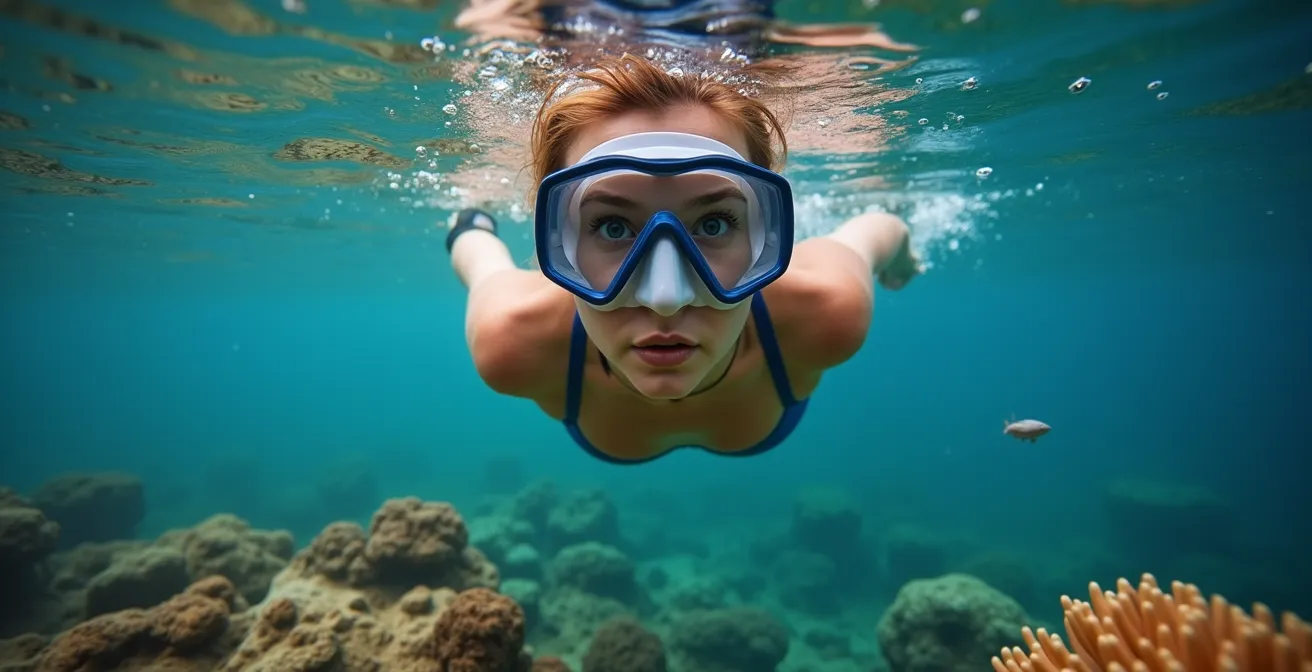
Adopting these observation techniques not only increases your chances of spotting incredible wildlife but also fundamentally changes your relationship with the reef. You become a patient guest in their world, not an intrusive force. The thrill of discovery is far more profound when you earn it through quiet observation rather than disruptive interaction.
Action Plan: Marine Biologist Observation Techniques
- Move slowly and quietly to avoid frightening creatures away.
- Scan for patterns that don’t fit the surrounding environment.
- Look for the outline of eyes on seemingly flat surfaces.
- Check under ledges from a safe, buoyant distance.
- Watch for movement in ‘rocks’ that might be camouflaged fish.
- Observe color changes in what appears to be coral or rock.
Why Touching Ancient Frescoes Causes Irreversible Damage Over Time?
Imagine visiting an ancient temple and seeing every tourist run their hands over a 1,000-year-old fresco. The oils and acids from a single touch are minuscule, but multiplied by thousands of visitors, they cause the vibrant pigments to fade and the plaster to crumble. This is the perfect analogy for what is happening to our coral reefs. A single snorkeler’s misplaced fin kick or sunscreen-laced skin seems insignificant, but when multiplied by millions of visitors each year, it creates a massive, cumulative wave of destruction.
The science of this cumulative impact is sobering. We’ve seen how chemical sunscreens trigger bleaching, and it’s estimated that reefs absorb 4,000 to 6,000 tons of sunscreen annually worldwide. Each touch damages the coral’s protective layer. Each boat anchor dropped carelessly shatters a piece of a centuries-old structure. Each piece of bread fed to a fish contributes to an imbalance in the ecosystem. None of these actions alone would kill a reef, but together they create a constant state of stress from which the coral has no time to recover.
This is why individual responsibility is not just a nice idea; it is the only path to a solution. Every decision you make—the sunscreen you buy, the tour you book, the way you move your body in the water—is a vote for either the reef’s destruction or its preservation. As the Snorkeling Report Editorial Team powerfully stated:
By breaking a single finger of coral, years or even decades of growth are wiped out in a few seconds.
– Snorkeling Report Editorial Team, 10 Tips for Eco and Reef-Friendly Snorkeling
The reef is not a renewable resource. It is a living, historical monument, and it requires us to treat it with the same reverence and care we would give to the world’s greatest cultural treasures.
Key Takeaways
- A coral reef is a living animal colony, not a rock; its fragility is biological, and every interaction matters.
- Chemical sunscreens (oxybenzone) are metabolized by coral into light-activated toxins, causing bleaching. Always use non-nano mineral sunscreens.
- Mastering buoyancy is a critical skill to prevent physical contact, which can shatter decades of coral growth in an instant.
The “Plastic-Free” Hotel That Still Uses Single-Use Toiletries
In the world of eco-tourism, “greenwashing”—the practice of making misleading claims about environmental practices—is a pervasive threat. You might choose a hotel that proudly advertises itself as “plastic-free” only to find a bathroom full of single-use plastic toiletry bottles. Similarly, a sunscreen might be labeled “reef-safe” as a marketing term with no legal definition, while still containing harmful chemicals. Distinguishing genuine commitment from clever marketing is a crucial skill for a responsible traveler.
The most reliable way to cut through the noise is to look for third-party, internationally recognized certifications. For dive and snorkel operators, the gold standard is Green Fins, an initiative backed by the UN Environment Programme. It provides the only internationally recognized environmental standards for the industry, with members undergoing annual assessments and training to measurably reduce their negative impacts. Likewise, the Blue Star program in Florida recognizes operators who are committed to education and conservation. These are not self-awarded badges; they represent a proven commitment to sustainable practices.
Be wary of vague claims like “eco-friendly” or “green” without specific, verifiable actions to back them up. A truly sustainable operator will be transparent about their practices, from their waste management policies to their use of mooring buoys and their commitment to environmental education. The table below helps differentiate legitimate certifications from empty marketing slogans.
| Certification/Claim | Verification Method | Red Flags |
|---|---|---|
| Green Fins Certified | UN Environment partnership, annual assessments | No certification number or verification |
| Blue Star Designation | Official park concessionaire verification | Self-declared without documentation |
| ‘Reef-Safe’ Sunscreen | Check for oxybenzone/octinoxate free formulation | Marketing term with no legal definition |
| Global Sustainable Tourism Council | Third-party audited standards | Vague ‘eco-friendly’ claims without specifics |
Checklist: Your Eco-Operator Audit
- Points of Contact: Check the operator’s website, brochures, and directly email or call them.
- Collect Evidence: Look for logos of certifications like Green Fins or Blue Star. Ask about their specific policies on anchoring, sunscreen, and group size.
- Verify Coherence: Do their advertised “eco” values match their practices? (e.g., claiming to be plastic-free while offering bottled water).
- Assess Authenticity: Is their certification number verifiable on the certification body’s website? Or is it a generic “eco” logo they made themselves?
- Plan your Choice: Prioritize operators with verifiable, third-party certifications over those with vague, self-made claims.
How to Swim with Marine Life Without Harassing or getting Hurt?
Observing a sea turtle gliding through the water or a majestic ray soaring over the sand is the highlight of any snorkel trip. The instinct to get closer is powerful, but chasing, cornering, or touching marine life is not only stressful and harmful to the animal, but it can also be dangerous for you. The guiding principle for all wildlife encounters is simple: observe, don’t interact. You are a visitor in their home.
A simple but effective guideline is the “10-Foot Bubble Rule.” Maintain an imaginary bubble of at least 10 feet (3 meters) around yourself and every animal you encounter. Never block an animal’s path or its escape route to the surface. If an animal approaches you, remain as still as possible and let it pass on its own terms. Your goal is to be a ghost in their environment—float by, observe, and leave no trace of your passing. This passive approach will ironically lead to much better and longer encounters, as the animals will not view you as a threat.
Learning to read animal body language is also key. Signs of stress include rapid swimming, abrupt changes in direction, or sudden color changes. If you see this behavior, you are too close. Increase your distance immediately. The need for this education is critical; studies show that an astonishingly high number of divers make harmful contact with the reef. For instance, one report highlighted that 88 percent of divers make harmful contact with the reef at least once during a dive, underscoring the gap between intention and impact. By maintaining your distance and respecting their space, you ensure the encounter is a positive one for both you and the marine life.
Your journey from a curious visitor to a conscious guardian of the reef is now complete. You understand that the reef is not an inanimate playground but a living, breathing city of unimaginable fragility. You know that your choices, from the bottle of sunscreen you pack to the way you float in the water, have profound consequences. Carry this knowledge with you on every adventure. Share it with others. Be the voice for the silent, vibrant world beneath the waves, ensuring it continues to inspire awe and wonder for generations to come. The first step towards protecting our oceans begins with your next snorkel.