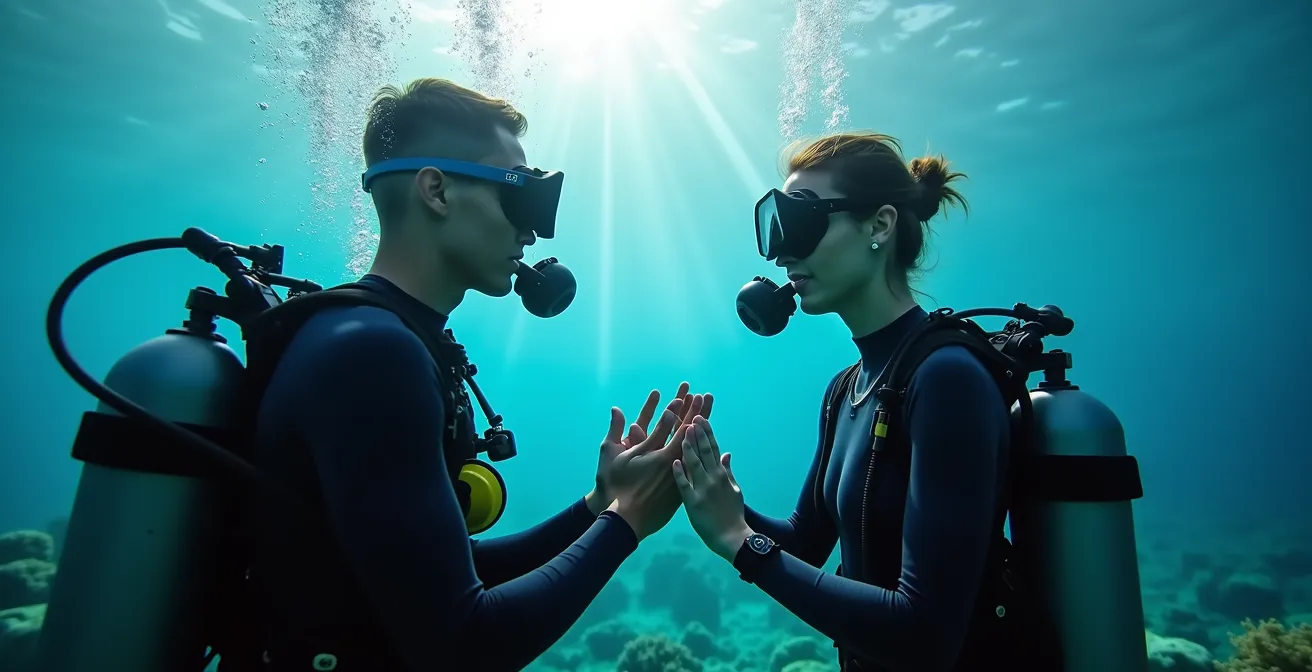
Trusting a dive shop’s logo or online reviews is not enough to guarantee your safety underwater.
- Safety is rooted in physics and physiology—unforgiving laws you must understand before descending.
- Your most important new skill is learning to be a ‘safety auditor,’ not just a passive student.
Recommendation: Adopt a ‘verify, don’t trust’ mindset. This guide provides the non-negotiable checks you must perform before entrusting a dive center with your life.
The dream is alluring: trading a sterile classroom for a sun-drenched beach, learning to breathe underwater with vibrant fish as your classmates. Getting scuba certified abroad seems like the ultimate vacation upgrade. Many will tell you to simply look for a reputable agency logo, like PADI or SSI, and check a few online reviews. While this is a starting point, it is dangerously insufficient. As a Master Instructor, I’ve seen firsthand how easily standards can slip in pursuit of a quick tourist dollar.
The most significant risks in diving are rarely the sharks you see in movies. They are the invisible threats: contaminated air, a poor understanding of gas laws, or equipment that is one dive away from failure. True safety isn’t about trusting a brand; it’s about developing a safety auditor mindset. It’s about understanding the non-negotiable principles of physics and physiology that govern your survival at depth. You must become an active participant in your own safety, not a passive customer.
This guide is not a list of friendly tips. It is a set of strict, professional-grade checks. We will move beyond the superficial to give you an instructor’s eye for detail, empowering you to vet a dive operation, understand the real risks, and make an informed decision that prioritizes your life over convenience.
This article will provide you with a framework for assessing critical safety factors. By understanding these points, you can transform from a hopeful tourist into a discerning, safety-conscious diver.
Summary: How to Get Scuba Certified Abroad Without Compromising Safety?
- Why You Must Wait 24 Hours Before Flying After Diving?
- How to Check if a Dive Shop’s Air Compressor Is Clean?
- Try-Dive or Full Course: Which Is Better for a Short Trip?
- How to Manage Panic Triggers When You Are 15 Meters Down?
- How a Poorly Fitted Mask Can Ruin Your Entire Dive?
- Why Rushing to 3,000 Meters Is a Recipe for Disaster?
- Why You Can’t Be Repatriated Until You Are “Fit to Fly”?
- How to Snorkel on a Coral Reef Without Killing It?
Why You Must Wait 24 Hours Before Flying After Diving?
This is not a guideline; it is a fundamental rule dictated by physics. While you dive, the increased ambient pressure causes your body tissues to absorb inert nitrogen from the air you breathe. This creates a “physiological debt” of nitrogen that you must repay. Your body slowly and safely off-gasses this excess nitrogen once you are back at surface pressure. This process takes time. Flying exposes you to a lower-pressure environment inside the aircraft cabin (equivalent to an altitude of 6,000-8,000 feet), which can cause the residual nitrogen in your tissues to come out of solution too quickly, forming bubbles.
These bubbles are the direct cause of Decompression Sickness (DCS), or “the bends,” a potentially fatal condition. The 24-hour surface interval is a strictly enforced safety margin designed to give your body ample time to clear this nitrogen debt. While some dive computers may suggest shorter intervals, the professional standard for repetitive or multi-day diving is an unwavering 24 hours. The risk is real; even with a 12-24 hour wait, research shows a small but present danger, confirming that 0.004% of divers develop DCS under these conditions. Cutting this interval short is gambling with your health for the sake of a few hours.
How to Check if a Dive Shop’s Air Compressor Is Clean?
The air in your tank is your lifeline. Contaminated air, filled with carbon monoxide from engine exhaust or oil particulates from a poorly maintained compressor, can be tasteless and odorless. At depth, its toxic effects are magnified, leading to impaired judgment, nausea, blackouts, and even death. Do not be shy about auditing a dive shop’s air-fill station. A professional operator will respect your diligence; a defensive one is a major red flag. Your audit must be direct and methodical.
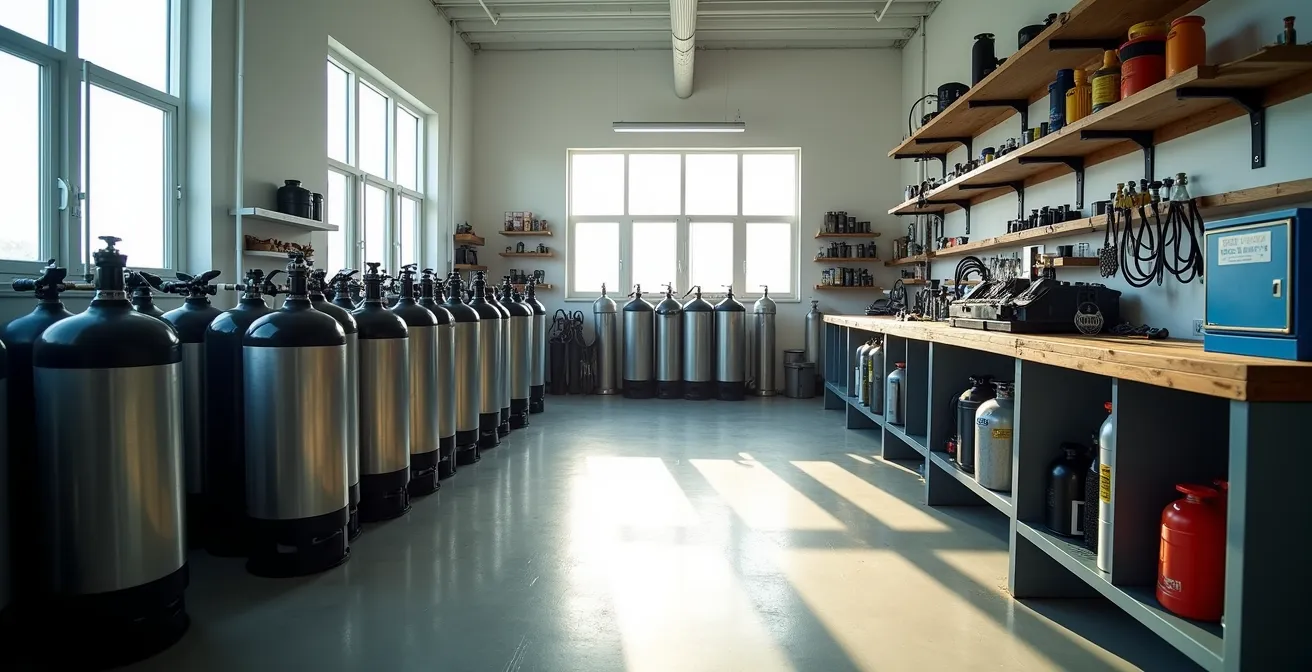
A pristine, organized shop like the one pictured is often a strong indicator of professional maintenance standards. Use this visual benchmark when you inspect a potential dive center. You are looking for evidence of a rigorous maintenance culture. Here are the specific points you must verify:
- Air Quality Certificate: Ask to see their most recent air quality test certificate. It should be from a certified lab and no more than a few months old.
- Compressor Intake Location: Physically locate the air intake for the compressor. It must be far away from any engine exhausts (boats, generators, cars) or paint fumes.
- General Shop Cleanliness: A messy, disorganized shop is a warning sign of a poor maintenance culture that likely extends to the compressor.
- Filter Change Log: Ask when the compressor filters were last changed. A professional shop will have a logbook and will answer without hesitation.
- Equipment Condition: Look at the rental equipment. Is it stored neatly, clean, and in good repair? This reflects the shop’s overall attitude toward safety.
Try-Dive or Full Course: Which Is Better for a Short Trip?
This choice determines whether you are having a temporary experience or earning a permanent qualification. A “try-dive,” or Discover Scuba Diving (DSD), is a supervised tour. You learn a handful of basic skills and are then guided by an instructor at all times, typically to a maximum depth of 12 meters. It is an excellent way to see if you enjoy breathing underwater, but it is not a certification. You leave with memories, not a license.
A full Open Water Diver course, by contrast, is an intensive educational program. It requires a minimum of 3-4 days and involves classroom theory, confined water (pool) skill development, and four open water dives. You learn not just how to dive, but how to handle emergencies, plan your own dives, and be a self-sufficient diver. You can fail a scuba course, and a good instructor will not certify a student they deem unsafe. Certification is earned, not guaranteed. The table below outlines the critical differences.
This data from PADI clearly shows the trade-off between a brief experience and a comprehensive education in a full Open Water Diver course.
| Aspect | Discover Scuba (DSD) | Open Water Course |
|---|---|---|
| Duration | Half day to 1 day | 3-4 days minimum |
| Maximum Depth | 12 meters/40 feet | 18 meters/60 feet |
| Independence | Must dive with instructor | Can dive with buddy |
| Skills Learned | Basic breathing, clearing | Full emergency procedures |
| Certification | Experience certificate only | Worldwide recognized license |
| Future Diving | Need instructor every time | Dive anywhere independently |
For a short trip, a DSD can be a fantastic and safe adventure. But do not mistake it for a certification. If you want the freedom to dive with a buddy anywhere in the world, you must invest the time in a full course.
How to Manage Panic Triggers When You Are 15 Meters Down?
As the official PADI guidelines state, the foundational rule of diving is to breathe continuously. This is not just for physiological reasons but for psychological ones as well.
The first rule of scuba diving is to breathe continuously and never hold your breath. Keep breathing normally throughout your dive, and you’ll also feel calmer and use less gas.
– PADI Safety Guidelines, PADI Golden Rules of Scuba Diving
Panic underwater is rarely a sudden event. It is the end point of a contamination cascade: a series of small, manageable problems that compound until they become overwhelming. A small mask leak leads to frantic clearing, which elevates breathing rate, which affects buoyancy, which can cause disorientation, which finally triggers panic. The hardest part of scuba certification is not a physical skill; it is mastering the mental discipline to break this cascade before it starts. If you feel anxiety building, you must immediately execute a drilled, reflexive procedure.
This is not a suggestion; it is a command protocol you must internalize:
- Stop: Cease all movement, especially finning. Movement feeds panic. Become still.
- Breathe: Focus exclusively on taking one slow, deep breath in, and one slow, complete breath out. Do not hold it. Repeat. This is your primary task.
- Think: Make eye contact with your buddy or instructor. Signal “OK” if you are managing, or the signal for “problem” if you need assistance.
- Act: Once calm, address the original, small problem. If needed, slowly ascend a few meters while maintaining full control and continuous breathing. Never bolt for the surface.
How a Poorly Fitted Mask Can Ruin Your Entire Dive?
A diving mask that does not seal perfectly to your face is not a minor annoyance; it is a primary safety hazard and the start of the contamination cascade. The constant need to clear water from the mask is a significant distraction. It diverts your mental energy from the most critical tasks of diving: monitoring your depth, your air supply, and your buoyancy. This distraction often leads to poor buoyancy control, causing you to ascend or descend unintentionally, and an increased breathing rate that depletes your air supply far more quickly.
Case Study: The Cascade Effect of a Leaking Mask
Diving safety reports highlight that a significant portion of incidents are linked to preventable equipment issues. An analysis of diving fatalities revealed that equipment problems were a contributing factor in many cases. A leaking mask initiates a cascade of negative events: the diver becomes fixated on clearing water, neglecting buoyancy. This leads to rapid breathing, a spike in air consumption, and a feeling of being overwhelmed, which can quickly escalate into a full-blown panic response underwater.
The solution is a proper fit test, which must be done before you even consider buying or renting a mask. Place the mask on your face without using the strap. Inhale slightly through your nose. If the mask has a good seal, it will stay on your face without you holding it. This is non-negotiable. The image below shows what a perfect seal should look like—complete, even contact between the silicone skirt and your skin.

A single, persistent water drip can be the first domino to fall in a serious incident. Do not compromise on mask fit. It is as important as your regulator.
Why Rushing to 3,000 Meters Is a Recipe for Disaster?
The same physics that govern the no-fly rule apply to terrestrial altitude. The “physiological debt” of nitrogen your body carries after a dive is sensitive to any significant drop in ambient pressure. Many popular diving destinations are located near mountains, and tourists are often tempted to go for a scenic mountain drive or take a cable car up to a viewpoint the day after diving. This is a critical error. Ascending to high altitudes too soon after a dive is equivalent to getting on a plane; it can trigger Decompression Sickness.
The risk is not theoretical. Official regulations are in place for this exact reason. For instance, FAA guidelines mandate that divers must wait a minimum of 24 hours after any dive before ascending to altitudes above 8,000 feet (approximately 2,438 meters). Many experts recommend an even more conservative approach, especially after repetitive or deep dives. Rushing from the reef to a mountain peak is one of the most common and dangerous mistakes a traveling diver can make. You must plan your itinerary with this pressure gradient in mind.
Action Plan: Safe Altitude Exposure After Diving
- Schedule all diving activities for the beginning of your trip, leaving a clear buffer of at least 24-48 hours at the end.
- Plan any mountain excursions, high-altitude drives, or ziplining for the days *before* you start diving, not after.
- Wait a minimum of 12 hours before driving to any altitude above 2,000 feet (610 meters) after a single, no-decompression dive.
- Wait a full 18-24 hours before ascending above 2,000 feet after multiple dives or multi-day diving.
- Strictly avoid all cable cars, mountain summit drives, and trips in unpressurized aircraft for at least 24 hours after your last dive.
Why You Can’t Be Repatriated Until You Are ‘Fit to Fly’?
In the unfortunate event of a diving accident requiring medical attention, the logistical challenges become immense, especially in a foreign country. If you are diagnosed with Decompression Sickness, the immediate treatment is recompression in a hyperbaric chamber. But the journey home is far from simple. You cannot simply get on the next flight. Flying with any residual symptoms of DCS would be extremely dangerous, as the lower cabin pressure could cause a severe relapse. This is why a “fit to fly” certificate, issued by a qualified hyperbaric doctor, is mandatory.
This process can be long and stressful. Dive physicians often advise patients to wait 72 hours or more after their final hyperbaric treatment—and only once they are completely symptom-free—before being cleared to fly. This is where organizations like the Divers Alert Network (DAN) become critical. Their emergency hotline assists with managing injured divers, helping to determine if recompression is necessary, locating the nearest facility, and arranging patient transport when medically advisable.
Emergency Protocol: The Role of DAN
The Divers Alert Network (DAN) maintains a 24-hour emergency consultation service (+1-919-684-9111). When a diver is injured abroad, DAN’s medical team coordinates with local physicians to ensure proper care. They are instrumental in the decision-making process for recompression and evacuation. Critically, they emphasize that any symptomatic diver must be fully evaluated *before* any exposure to altitude, as commercial aircraft cabins are pressurized to a level (6,000-8,000 ft equivalent) that can gravely worsen a diver’s condition.
This reality underscores the importance of both comprehensive dive insurance and adhering to every safety protocol to avoid an accident in the first place. Being stranded in a foreign country, unable to fly, awaiting medical clearance is a nightmare that proper training and caution can prevent.
Key Takeaways
- Physics is non-negotiable: The laws of pressure and gas absorption dictate your safety rules. They cannot be bent for convenience.
- You are your own primary safety auditor: Your most important skill is the ability to critically assess equipment, procedures, and your own physical state.
- Environmental respect is a direct measure of skill: Excellent buoyancy control and a no-touch policy are the hallmarks of a competent, safe diver.
How to Snorkel on a Coral Reef Without Killing It?
The final mark of a truly competent diver—or even a snorkeler—is their interaction with the marine environment. It is a language, and good buoyancy is its grammar. As the most fundamental environmental guideline from PADI states, your impact should be zero.
This is arguably the most important rule of scuba diving for ocean conservation: do not touch marine life. Reef ecosystems are fragile, and even the lightest touch can be harmful.
– PADI Environmental Guidelines
This principle is even more critical for snorkelers who spend their time directly above delicate, shallow reefs. The damage caused by thousands of clumsy kicks, standing on coral to adjust a mask, or touching an organism for a photo is catastrophic. A skilled water enthusiast is recognized by their grace and control. They maintain a respectful distance, moving with deliberate, minimal impact. Your goal is to be a silent observer, leaving no trace of your presence.
To achieve this, you must adopt these eco-conscious practices:
- Master Buoyancy: For snorkelers, this means never standing on or pushing off from the reef. Float horizontally at all times.
- Use Proper Kicks: Use slow, deliberate frog kicks or small flutter kicks from the knee, not giant, splashing kicks from the hip that stir up sediment and risk hitting coral.
- Protect Your Skin and the Reef: Wear a rash guard or wetsuit for sun and sting protection. If you must use sunscreen, ensure it is certified “reef-safe” and free of oxybenzone and octinoxate.
- Secure Your Gear: Ensure any cameras, snorkels, or other gear are tightly secured and not dangling where they can drag across the reef.
- Maintain Distance: Stay at least one meter (three feet) away from all coral and marine life. Never chase or corner an animal. Observe from a respectful distance.
- Take Only Pictures, Leave Only Bubbles: This is an absolute rule. Never touch, take, or collect anything, living or dead, from the reef.
Your ability to explore the underwater world comes with a profound responsibility to protect it. A careless moment can destroy decades of coral growth.
Your training is not an item on a vacation checklist; it is an investment in your survival and in the preservation of the world you wish to explore. Choose your instructor and dive center with the same seriousness you would a surgeon. Your life, and the life of the reef, depends on it.