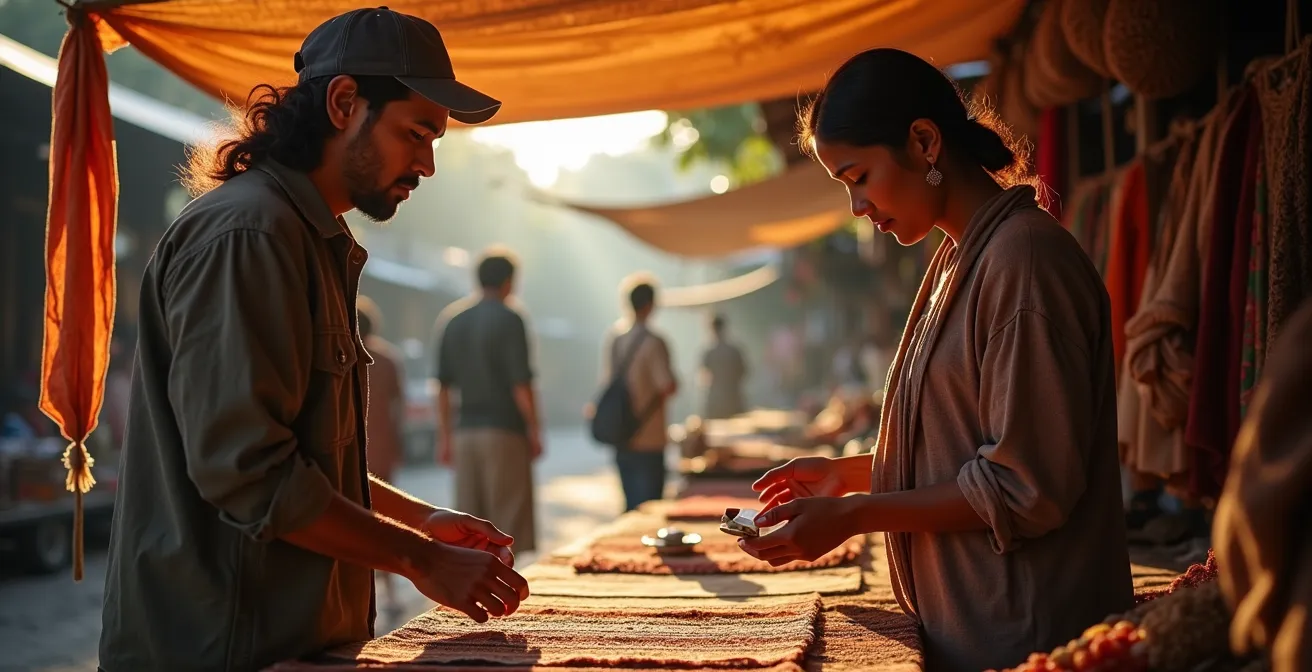
True cultural immersion isn’t about ticking off a checklist of ‘authentic’ activities; it’s about shifting your mindset from a transactional tourist to a relational observer.
- Effort in language, not perfection, opens doors to genuine conversation and shows respect.
- Even from a hotel, you can find deeper insight than a poorly chosen homestay by strategically using “third places” like local cafés or markets.
Recommendation: The key is to practice intentional vulnerability and mindful observation, turning every interaction into an opportunity for respectful connection.
For many ethical travelers, the ultimate goal is not just to see new places but to truly connect with them. You’ve followed the standard advice: you learned to say “hello,” you ventured to a non-tourist restaurant, and you bought souvenirs from a local artisan. Yet, at the end of the day, a subtle feeling of being an outsider remains. You’ve had transactions, but not conversations. You’ve observed, but not participated. This gap between the desire for authentic connection and the reality of surface-level tourism is a common frustration.
Most travel guides focus on a checklist of actions, treating cultural immersion as a product to be consumed. They suggest staying in a homestay or visiting a remote village, but often fail to explain the underlying principles that make these experiences meaningful. The result is that many travelers, despite their best intentions, remain spectators, separated from the local life by an invisible wall. They collect experiences but miss the connections they truly crave.
But what if the key to immersion wasn’t in *what* you do, but in *how* you perceive your role as a visitor? The secret lies in shifting from a tourist’s transactional mindset to a cultural anthropologist’s observational one. It’s about understanding the unspoken “cultural grammar” that governs interactions, from tipping etiquette to the proper way to enter a sacred space. True immersion is an art of respectful curiosity and intentional vulnerability.
This guide will explore the practical strategies to dismantle that invisible wall. We will delve into why simple conversations fail, how to use language as a bridge rather than a barrier, and how to participate in local life—be it in a family home or a bustling festival—without feeling like an intruder. By focusing on the ‘why’ behind the customs, you can transform your travels from a series of snapshots into a tapestry of meaningful human experiences.
To help you navigate this path, this article is structured to build your immersion skills step by step. Follow along to discover how to see, listen, and engage with the world in a more profound and respectful way.
Summary: How to Experience True Cultural Immersion Without Being Intrusive?
- Why Do 80% of Tourists Fail to Have a Real Conversation with Locals?
- How to Learn the “Magic Words” of Any Language in 2 Hours?
- Homestay or Hotel: Which Offers Better Insight into Local Life?
- The Etiquette Mistake That Can Get You Expelled from a Sacred Site
- How to Join a Local Festival Without Looking Like a Spectator?
- When Translation Apps Fail: Avoiding Cultural Insults in Translation
- Why Tipping Is Insulting in Japan but Mandatory in the USA?
- How to Participate in Domestic Traditions Without Being Intrusive?
Why Do 80% of Tourists Fail to Have a Real Conversation with Locals?
The desire for authentic connection is nearly universal among modern travelers. In fact, research shows that 85% of travelers want to deeply explore local culture, and 78% seek vacations that actively support local communities. Yet, a vast majority return home without having had a single, meaningful conversation that goes beyond ordering food or asking for directions. The fundamental barrier is not language proficiency or a lack of opportunity; it’s the persistence of a transactional mindset. As tourists, we are often conditioned to interact with locals as service providers: the taxi driver, the shopkeeper, the waiter. These interactions are built around an exchange of money for a good or service, which naturally closes the door to deeper connection.
To break this pattern, one must consciously shift to a relational mindset. This involves seeing the person behind the role and initiating contact that is not based on a transaction. A simple way to start is by breaking the conventional script. Instead of immediately asking, “How much is this?,” try opening with a genuine compliment about the craftsmanship or asking about the origin of the item. This signals that you are interested in more than just the price tag. Non-verbal cues are equally powerful. Making eye contact, offering a genuine smile, and adopting patient, open body language communicate respect and a willingness to engage on a human level.
Showing vulnerability is another key to unlocking real conversations. Admitting your language limitations while still making an effort—”I’m sorry, my [local language] is not very good, but I am trying to learn”—can be a powerful icebreaker. It transforms you from a demanding tourist into a humble learner, a role that people are often happy to support. The goal is to move from questions of utility (“Where is the bus stop?”) to questions of humanity (“What’s your favorite local dish to cook at home?”). It is in these moments, when the transaction is forgotten, that true conversation begins.
How to Learn the “Magic Words” of Any Language in 2 Hours?
The common advice to “learn a few local phrases” is often misinterpreted. The goal isn’t to achieve fluency or even conversational perfection. From a cultural perspective, the true magic lies in the effort, not the expertise. Making an attempt to speak the local language, however flawed, is a powerful act of respect. It demonstrates that you see the local culture as valuable and are willing to step out of your comfort zone to connect with it. This act of intentional vulnerability can instantly change the dynamic of an interaction.
As one guide on cultural immersion notes, this effort is a key that unlocks deeper experiences. When you try to communicate in the local tongue, you signal an eagerness to engage on a more personal level.
When you make an effort to communicate in the local language, you demonstrate respect for the culture and an eagerness to engage on a deeper level. It can serve as an icebreaker, initiate conversations, and lead to unique experiences that might not be possible otherwise.
– Attempt Adventure, Cultural Immersion Guide
So, what are these “magic words”? They are not just “please” and “thank you,” but functional phrases designed to invite interaction and show humility. In two hours, you can easily master a handful of these powerful tools:
- Vulnerability Phrases: Focus on learning “How do you say…?”, “Can you help me?”, and “I’m learning your language.” These phrases immediately position you as a student, not a demanding tourist.
- The Compliment-Question Combo: Pair a genuine compliment with a question. For example, “This food is delicious! Is it a local specialty?” This opens a conversation rather than ending it.
- Courtesy Essentials with Correct Tone: Practice “Please,” “Thank you,” and “Excuse me,” paying attention to the local tone and formality. In some cultures, these words are delivered with a slight bow or specific gesture.

This approach moves beyond simple vocabulary. By focusing on phrases that show respect and invite partnership, you transform language from a mere tool of transaction into a bridge for genuine human connection. The “magic” isn’t in the words themselves, but in the respect and vulnerability they convey.
Homestay or Hotel: Which Offers Better Insight into Local Life?
For travelers seeking deep cultural insight, the choice of accommodation is often presented as a simple dichotomy: the authentic homestay versus the sterile hotel. While a homestay offers a direct window into domestic life, it is not a guaranteed path to immersion. A hotel, conversely, is not necessarily a barrier to it. The reality is more nuanced; the quality of insight depends less on the type of lodging and more on the traveler’s strategy and mindset. Both options offer unique, albeit different, opportunities for connection.
A homestay provides an unparalleled opportunity to observe the rhythms of family life, share meals, and learn about traditions firsthand. However, it requires a significant degree of adaptability, as you must align with the family’s schedule and respect their private space. A hotel provides privacy and freedom, allowing you to process your experiences and explore at your own pace. While direct family interaction is absent, a hotel can serve as a base for diverse encounters with a wider range of locals, from the concierge to the owners of nearby businesses. The following comparison highlights these trade-offs.
This table, based on an analysis of cultural travel styles, breaks down the different types of insight each accommodation provides.
| Aspect | Homestay | Hotel |
|---|---|---|
| Type of Insight | Deep observation of domestic life | Broader interactions in public spaces |
| Cultural Exchange | Direct family interactions, shared meals | Multiple brief encounters with various locals |
| Privacy & Recharge | Limited personal space | Private retreat to process experiences |
| Local Knowledge Access | Intimate family stories & traditions | Diverse perspectives from staff & nearby venues |
| Flexibility | Adapt to family schedule | Freedom to explore at own pace |
The “Third Place” Strategy for Hotel-Based Immersion
Even when staying in a hotel, you can achieve deep immersion by adopting the “third place” strategy. Coined by sociologist Ray Oldenburg, a third place is a location outside of home (first place) and work (second place) where community is built. For a traveler, this means becoming a “regular” at a local spot. By frequenting the same coffee shop, market stall, or small restaurant, you shift from an anonymous tourist to a familiar face. This consistency builds a sense of belonging and opens the door to genuine recognition and conversation. Soon, the barista knows your order, and a simple transaction evolves into a shared moment of community, proving that deep connection can be found beyond the walls of a homestay.
The Etiquette Mistake That Can Get You Expelled from a Sacred Site
Entering a temple, mosque, or other sacred site is an invitation into the spiritual heart of a culture. However, it is also where the unspoken rules of cultural grammar are most potent. A single misstep—born of ignorance, not malice—can cause deep offense and, in some cases, lead to being asked to leave. For instance, in Japan, a bow is the standard greeting, while in Thailand, the ‘wai’—a prayer-like gesture—is used to show respect. Confusing these gestures is a minor error, but other mistakes, like wearing shoes in a forbidden area or photographing a ceremony, are considered profound signs of disrespect. These rules are rarely written on a sign; they are learned through observation.
The most effective tool for navigating these situations is not a guidebook, but your own power of perception. Before you even cross the threshold of a sacred site, you must pause and shift from tourist to anthropologist. This requires a moment of intentional, focused observation to decode the local customs in real time. This simple yet powerful technique can prevent nearly all major etiquette blunders.
To avoid being the “clueless tourist,” implement the 60-Second Scan Rule upon arrival at any sensitive location. This involves a deliberate pause to observe and absorb the environment before acting:
- Stop and Watch: Stand at the entrance for one full minute and simply observe. Don’t rush in.
- Follow the Shoes: Note precisely where locals are removing and placing their footwear. Do exactly as they do.
- Match the Volume: Listen to the ambient sound. Are people silent, whispering, or speaking in low tones? Match your volume or go even quieter.
- Identify Boundaries: Watch where people are and are not going. If locals avoid a certain area, consider it off-limits, even if there are no ropes or signs.
- Mirror Body Language: Observe the posture of worshipers. Are they bowing, kneeling, or standing respectfully? Mirroring these actions shows deep respect.
- Check for Cameras: If no local person is taking photos, put your phone away. The best picture is the one you store in your memory, not the one that causes offense.
This practice transforms you from a passive consumer of a site into an active and respectful participant in its sanctity. It is the ultimate expression of the principle: “When in doubt, observe.”
How to Join a Local Festival Without Looking Like a Spectator?
Local festivals are a vibrant display of a culture’s heritage, joy, and community spirit, which is why they are a major draw for travelers. In fact, recent analysis shows that participation in cultural tours and festivals is a key component of the heritage tourism market, with 55.62% of this tourism sector involving immersive experiences with local traditions. However, there’s a fine line between appreciative attendance and intrusive tourism. Many travelers find themselves on the sidelines, camera in hand, feeling more like spectators at a zoo than participants in a celebration. The key to crossing this line is to find a way to contribute, no matter how small, and shift your role from consumer to contributor.
This does not mean crashing the main event. Instead, it’s about finding a “micro-role” that allows you to engage respectfully. This requires a bit of research and observation. Before you go, spend 15 minutes online learning about the festival’s meaning and history. Knowing the ‘why’ behind the celebration allows you to ask informed questions (“I read that the lanterns represent ancestral spirits, is that correct?”) instead of generic ones (“What’s happening?”). This immediately elevates your interaction.
Once there, your goal is to transition from spectator to participant through small, intentional actions:
- Arrive Early: Show up before the crowds to observe the setup. You might see opportunities to offer simple help, like holding something for a vendor, which instantly changes your status.
- Buy a “Participation Prop”: At a water festival like Songkran in Thailand, buying a water gun from a local vendor is your ticket to participate. At a kite festival, buy a small kite. This prop signals your intent to join in, not just watch.
- Support the Smallest Vendors: Purchase food, drinks, or crafts from the smaller, family-run stalls rather than the large, commercial ones. This is a direct and appreciated form of contribution.
- Help with Cleanup: Even a small gesture like picking up a few discarded items and finding a trash bin shows respect for the community and the shared space.
By adopting a micro-role, you are no longer just taking pictures; you are adding value to the event. This small shift in behavior is the difference between watching a culture and respectfully engaging with it.
When Translation Apps Fail: Avoiding Cultural Insults in Translation
In the modern traveler’s toolkit, translation apps seem like a magical solution to communication barriers. They are incredibly useful for transactional needs, like reading a menu or asking for a price. However, relying on them for nuanced interaction is fraught with peril. These apps are masters of literal translation but are completely blind to tone, context, and non-verbal cues—the very elements that constitute the majority of human communication. A phrase that is grammatically correct can come across as demanding, rude, or even insulting when delivered without the proper cultural softeners.
For example, an app might translate “I want water” correctly, but in many cultures, this direct demand sounds abrupt and impolite. A local would use a softer, more indirect phrase accompanied by respectful body language. The app doesn’t teach you to make eye contact, to use a questioning intonation, or to deliver the phrase with a slight bow or a gesture of politeness. This is where technology fails and human awareness must take over. The goal is to use the app as a supplement, not a substitute, for mindful communication.
To use technology respectfully, integrate it with non-verbal signals of politeness. The ‘Translate, Turn, Talk’ method is a simple way to do this. First, get the phrase you need from your app. Second, put your phone down or turn the screen away. This is a crucial step that re-establishes human connection. Third, make eye contact and speak directly to the person. This small sequence prioritizes the person over the device. To further soften your delivery:
- Use Universal Politeness Gestures: Accompany your spoken words with open palms, a slight nod or bow, and a warm, patient facial expression.
- Add a Questioning Tone: Even if the phrase is a statement, adding a slight upward inflection can make it sound like a polite request rather than a demand.
- Practice Aloud: Before using a key phrase, say it out loud a few times. This helps you get comfortable with the sounds and deliver it with more confidence and a natural tone.
- Know Your Formality: Apps often miss the distinction between formal (‘vous’ in French) and informal (‘tu’) address. A quick search beforehand on when to use formal language is a sign of deep respect.
By supplementing technology with these human touches, you can avoid the common pitfalls of digital translation and ensure your attempts to communicate are received as the respectful gestures you intend them to be.
Why Tipping Is Insulting in Japan but Mandatory in the USA?
Of all the elements of cultural grammar, tipping is one of the most confusing and high-stakes. In the USA, not leaving a 15-20% tip is seen as rude and deprives a service worker of a significant portion of their income. In Japan, leaving cash on the table can be perceived as an insult, implying that the employer does not pay their staff a fair wage and that the service was not already included as a matter of professional pride. This stark difference is not arbitrary; it stems from deeply rooted and opposing cultural philosophies about service, value, and social harmony.
In individualistic cultures like the United States, service is often viewed as a performance-based transaction. A tip is a direct, monetary reward for excellent individual effort. It incentivizes the worker and is an expected part of the economic exchange. In collectivist cultures like Japan, the philosophy is entirely different. Excellent service is considered a standard part of one’s duty (omotenashi), an expression of honor and pride included in the price. The focus is on the harmony of the team and the reputation of the establishment, not individual reward. Tipping disrupts this harmony by singling out one person and suggesting the standard service was somehow deficient.
Understanding this fundamental difference in worldview is key to showing gratitude appropriately. The following table, based on an analysis of different service philosophies, illustrates the cultural divide.
| Aspect | Japan | USA |
|---|---|---|
| Service Philosophy | Duty and honor included in price | Performance-based reward system |
| Cultural Framework | Collectivist – group harmony priority | Individualistic – personal incentive |
| Tipping Implication | Insults both employee and employer | Essential income supplement |
| Alternative Appreciation | Bow, specific compliment, return visit | Cash tip 15-20% minimum |
| Social Dynamic | Maintains equality among service team | Rewards individual excellence |
So, how do you show appreciation in a non-tipping culture? The methods are relational, not transactional. Offer a specific, sincere compliment to the staff member and, if appropriate, their manager. Become a repeat customer, as loyalty is a highly valued form of praise. Leave a positive online review for the establishment. In some contexts, a small, thoughtfully chosen gift (omiyage) from your home country may be appropriate, but it should be presented as a gesture of friendship, not a payment. These actions honor the cultural framework of collective pride and build a much stronger connection than cash ever could.
Key Takeaways
- The primary barrier to genuine connection is a transactional mindset, not a language barrier; shifting to a relational approach is essential.
- Mindful observation, such as using the ’60-second scan’ at sacred sites, is more effective for navigating etiquette than memorizing a list of rules.
- Showing gratitude and respect is not universal; it goes beyond tipping and must be adapted to the local ‘cultural grammar’ to be meaningful.
How to Participate in Domestic Traditions Without Being Intrusive?
The deepest level of cultural immersion often involves being invited into a private space, whether it’s a family dinner, a religious ceremony, or a community gathering. This is a tremendous honor and a sign that you have successfully moved beyond the role of a tourist. The growing desire for such experiences is clear, as over 60% of cultural tourists now prefer multi-day immersive trips designed for deeper engagement. However, this is also the moment of greatest potential intrusion. The key to participating respectfully is to maintain a mindset of being a humble guest and an attentive observer, always prioritizing the host’s comfort over your own curiosity.
Your role is not to be an entertainer or the center of attention, but to be an appreciative and low-impact presence. When invited into a home, always ask, “How can I help?” Even if your offer is politely declined, the gesture itself shows you do not expect to be passively served. Pay close attention to the small details of domestic life. Where do people sit? Who is served first at a meal? How are elders addressed? These are the subtle threads of a culture’s social fabric. Your ability to notice and gently adapt to these norms is the highest form of respect you can show.
Never assume that your cultural norms are universal. What is polite in one country may be rude in another. For example, finishing everything on your plate can be a compliment in one culture but an insult in another, implying your host did not provide enough food. When in doubt, the best strategy is to wait, watch, and follow the lead of others. Ask clarifying questions in a humble manner, such as, “This is my first time experiencing a traditional tea ceremony. Could you guide me on the proper etiquette?” This shows vulnerability and a sincere desire to honor their traditions. To ensure your approach is always respectful, it is helpful to perform a personal audit before and during your trip.
Action Plan: Your Cultural Immersion Audit
- Points of Contact: Before your trip, list all planned interactions where you will connect with locals (e.g., market vendors, homestay hosts, restaurant staff, festival-goers).
- Gathering Intel: For each point of contact, research and inventory what you know about the local etiquette (greetings, tipping, photo-taking, dress code). Identify your knowledge gaps.
- Coherence Check: Compare your planned behavior with what you’ve learned about the culture’s core values (e.g., respect for elders, community vs. individuality). Does your approach align or clash?
- Beyond Transaction: For each type of interaction, prepare one unique, non-transactional question or compliment. How can you create a memorable, human moment?
- Integration Plan: Create a short, actionable list to fill your knowledge gaps: three “magic words” to practice, one specific non-verbal cue to observe, and one “third place” to visit regularly.
Your next trip is an opportunity. Don’t just see the world; connect with it. Start planning your journey not by what you’ll do, but by how you’ll listen, observe, and engage with the people who call it home.