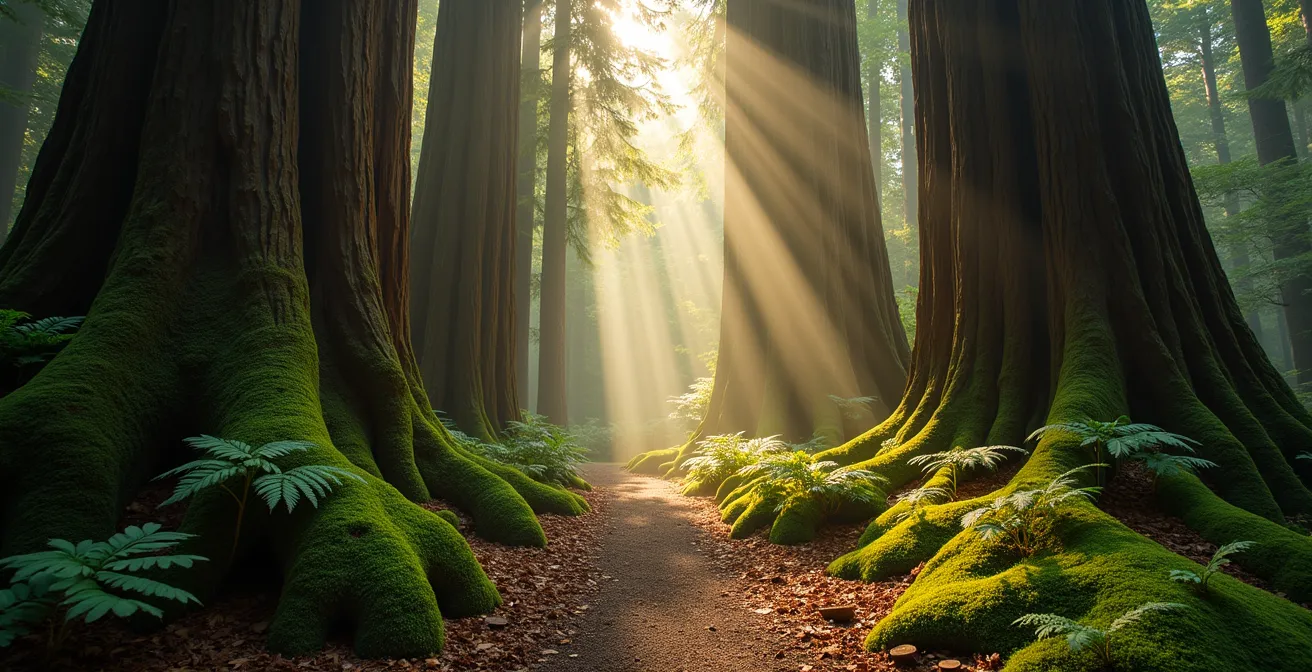
In summary:
- True Shinrin-Yoku is an “ecological dialogue,” not just a walk; it involves understanding the forest as a single living system.
- Ancient forests release medicinal chemical compounds (phytoncides) that are scientifically proven to boost immune function and lower stress.
- The practice requires sensory immersion and profound respect for the ecosystem, including staying on marked trails to protect its fragile underground life.
- Benefits like reduced cortisol can be measured in as little as 15-40 minutes, but 2-hour sessions offer deeper, lasting effects.
In our hyper-connected, fast-paced world, a quiet but persistent ache for stillness and meaning grows. Many of us feel a disconnect from the natural world and, consequently, from ourselves. We seek a reset, a way to quiet the noise and find a deeper sense of well-being. Often, the advice is simple: go for a walk in the woods, turn off your phone, and breathe. While well-intentioned, this advice barely scratches the surface of a practice that is thousands of years old in spirit, yet perfectly suited for our modern ailments: Shinrin-Yoku, or forest bathing.
This is not merely about recreation or exercise. It is a profound act of communion. But what if the true key to unlocking the deepest benefits of Shinrin-Yoku lies not in what we *do* in the forest, but in how we *perceive* it? What if we shifted our perspective from seeing a collection of trees to engaging in a conscious dialogue with a single, ancient, living organism? This guide moves beyond the platitudes. We will explore the forest as an atmospheric apothecary, a living mind, and a sacred space for healing. We will learn to listen to its language, from the chemical signals in the air to the silent wisdom beneath our feet.
To begin this sensory immersion, the following video offers a 360-degree glimpse into the forest’s embrace. Consider it a visual meditation, an invitation to prime your senses before we step onto the path together.
This article is structured to guide you, step-by-step, into the heart of this practice. We will explore the science, the philosophy, and the practicalities of engaging in a true ecological dialogue with ancient forests for your health and spiritual renewal.
Summary: Your Path to Deep Forest Connection
- How Trees Release Chemicals That Boost Your Killer T-Cells?
- How to Find Forests Without Road Noise for True Immersion?
- Do You Need a Guide to Walk in the Woods?
- Why Walking Off-Trail Compresses Soil and Kills Roots?
- How Long Must You Stay Under the Canopy to Lower Cortisol?
- Why Sea Air Reduces Stress Hormones Within 30 Minutes?
- Why Your Lungs Work More Efficiently Above 1,000 Meters?
- Why Is Mountain Air Considered a Cure for Chronic Fatigue?
How Trees Release Chemicals That Boost Your Killer T-Cells?
When you enter an ancient forest, the very air you breathe is transformed into an atmospheric apothecary. This isn’t poetry; it’s biochemistry. Trees, especially conifers and other old-growth species, constantly release aromatic, volatile organic compounds called phytoncides. These are the essential oils of the forest, a core part of its immune and communication system, used to ward off pests and disease. When we inhale this air, we are breathing in the forest’s own medicine. These compounds, which include terpenoids like alpha-pinene and limonene, have a direct and measurable effect on our physiology.
The primary benefit is a significant boost to our immune system. Scientific studies have shown that after spending time in a forest environment, people show a marked increase in the number and activity of their Natural Killer (NK) cells. These are a type of white blood cell crucial for our innate immunity, responsible for seeking out and destroying virally infected cells and early-stage cancer cells. The phytoncides effectively signal our bodies to ramp up their defenses. This isn’t a placebo effect; it’s a direct chemical interaction between the forest’s living system and our own, a clear example of the profound ecological dialogue at the heart of Shinrin-Yoku.
By simply being present and breathing deeply, you are participating in a symbiotic relationship, receiving the gift of enhanced immunity directly from the ancient trees around you.
How to Find Forests Without Road Noise for True Immersion?
A true Shinrin-Yoku experience is a deep sensory immersion, and one of the most intruded-upon senses in modern life is hearing. The constant hum of anthropogenic noise—traffic, construction, sirens—keeps our nervous systems in a low-grade state of alert. To truly enter an ecological dialogue, you must first be able to hear the forest’s subtle language: the rustle of leaves, the call of a bird, the sound of silence itself. Finding an acoustic refuge is therefore not a luxury, but a necessity for the practice.

As this view suggests, the very topography of the land can create natural sound barriers. Deep valleys and dense ridges act as buffers, absorbing and deflecting distant noises, creating pockets of profound tranquility. Finding these spaces requires a more intentional approach than simply driving to the nearest park. It is a modern pilgrimage in search of quiet.
To locate your own acoustic refuge, consider these steps:
- Use topographical maps to identify valleys and ridges that might offer natural sound-blocking from nearby roads or towns.
- Research noise pollution maps, often available from environmental agencies, to find areas designated as low-noise zones.
- Visit forests during off-peak hours, such as early weekend mornings or weekday afternoons, to minimize human-generated noise.
- Seek out forests with a rich natural soundscape (biophony), like a babbling brook or abundant birdsong, which can effectively mask more distant noises.
- Choose sites further from urban centers, as the density of ambient noise pollution drops significantly with distance.
When you finally stand in a space free from the hum of civilization, your body registers the change immediately. Your shoulders drop, your breathing deepens, and your mind begins to open to the subtle symphony of the woods.
Do You Need a Guide to Walk in the Woods?
Anyone can walk in the woods, but engaging in a deep ecological dialogue is a skill that can be cultivated. While a guide is not strictly necessary to enjoy nature, a certified Forest Therapy Guide can transform a simple walk into a profound, healing experience. Their role is not to lead a hike or identify plants, but to be a facilitator of connection. They are trained to open the doors of perception, helping you move from your thinking mind to your sensing body.
A guide does this by offering a series of gentle “sensory invitations.” These are simple prompts designed to help you engage with the forest through all your senses in a slow, mindful, and deliberate way. An invitation might be to notice the different textures of bark on several trees, to listen for the furthest and closest sounds, or to observe the slow, deliberate movement of a single leaf in the wind. These invitations break the habitual patterns of a goal-oriented mindset and foster a state of relaxed, open awareness. For those struggling with anxiety, grief, or mental chatter, this guidance can be invaluable.
I went into this guided forest bathing experience with anxiety, anger, and fear. The guide led us into both inner and outer worlds, encouraging curiosity. They offered sensory ‘invitations’ and prompts that helped me transition from a thinking mind to a sensing body. I walked out of the beautiful woods more grounded, with a fresh, open heart, relieved of pain and filled with comfort and hope.
– Kessi, Kessi World
A guide also holds the space, ensuring a sense of safety and permission to be fully present without judgment. As expert Anna Marie Nachman explains, their role goes even deeper, translating the hidden language of the ecosystem.
A certified guide doesn’t just show the way; they reveal the hidden language of the ancient forest, explaining the relationships between species, the role of nurse logs, and the function of the mycelial network, turning a walk into a deep ecological dialogue.
– Anna Marie Nachman, Certified Forest Therapy Guide, Penn State Shinrin-Yoku Program
Ultimately, a guide helps you learn the language of the forest so that, eventually, you can continue the conversation on your own, having been taught how to listen.
Why Walking Off-Trail Compresses Soil and Kills Roots?
The invitation of Shinrin-Yoku is to connect, but this connection must be rooted in profound respect. In an ancient forest, the ground beneath your feet is not inert dirt; it is the living, breathing skin and mind of the ecosystem. To step off the designated path is to unknowingly cause significant, and sometimes irreparable, harm. The forest floor is a delicate, complex tapestry of life, and our weight is a destructive force in this fragile world.

What we see as soil is a thriving community. It includes cryptogamic crusts of moss and lichen that retain water and fix nitrogen, as well as the intricate, lace-like web of mycorrhizal fungi. This fungal network, sometimes called the “Wood Wide Web,” is the forest’s subterranean mind. It is a communication and nutrient-sharing system that connects the roots of individual trees into a unified, cooperative superorganism. A single footstep can compress the soil, breaking these delicate fungal threads and crushing the root systems of small plants, effectively silencing a part of the forest’s dialogue.
The Vulnerability of the Forest Floor
Forest ecology studies, like those analyzing cryptogamic soil crusts, reveal how fragile these systems are. These living crusts, which can take decades to form, are crucial for the forest’s health, helping with water retention and nutrient cycling. They are instantly destroyed by a single human footstep. Deeper down, the soil compaction from off-trail walking severs the delicate mycorrhizal networks that function as the forest’s primary communication system, connecting trees and facilitating nutrient exchange. As this field of research shows, what feels like an innocent shortcut is, in reality, a damaging act to the forest’s neural network.
Staying on the trail is therefore the most fundamental act of respect you can offer the forest. It is an acknowledgment that this is the home of another, and we are but humble guests. This discipline doesn’t limit the experience; it deepens it. It teaches us to find wonder and connection within established boundaries, a powerful lesson to carry back into our own lives.
By honoring the path, you are protecting the very living system from which you seek healing, completing the circle of a truly reciprocal relationship.
How Long Must You Stay Under the Canopy to Lower Cortisol?
One of the most celebrated benefits of forest bathing is its powerful effect on stress reduction. The primary biomarker for stress in the body is the hormone cortisol. Elevated cortisol levels, a product of our chronic fight-or-flight lifestyles, are linked to a host of health issues. The good news is that the forest environment is a potent and fast-acting antidote. The question is, how long does it take for the magic to work?
The answer is, less time than you might think. Scientific research consistently shows that measurable physiological changes begin to occur very quickly. Studies indicate that even 15 to 20 minutes of mindful presence in a forest setting can start to lower cortisol levels, reduce blood pressure, and slow the heart rate. The combination of inhaling phytoncides, taking in the green and blue hues of nature, and absorbing the fractal patterns of leaves and branches sends a powerful signal to our parasympathetic nervous system to “rest and digest.”
While the initial benefits are rapid, the depth and duration of the effects are dose-dependent. Research from the home of Shinrin-Yoku confirms that a session of around 40 minutes achieves a significant cortisol drop for most individuals. However, to achieve the most profound and lasting benefits, experts like Dr. Qing Li, a leading researcher in the field, recommend a 2-hour session. An immersion of this length allows the body to fully absorb the atmospheric compounds and allows the mind to quieten to a much deeper level. The positive effects of a two-hour forest bath, including boosted immune function and reduced stress hormones, have been shown to persist for up to seven days afterward.
Don’t be discouraged if you only have 20 minutes; that short immersion is still a powerful gift to your nervous system. When you have more time, embrace a longer session and allow the forest to work its deep, slow medicine upon you.
Why Sea Air Reduces Stress Hormones Within 30 Minutes?
While the forest holds a unique chemical signature, it is part of a larger family of therapeutic landscapes. Its coastal cousin, the seaside, offers its own powerful form of healing, often called thalassotherapy. The calming effect of the ocean is not merely psychological; like the forest, its benefits are rooted in the very air you breathe. The air at the coast is rich in negative ions, created by the constant crashing of waves. These invisible molecules are believed to increase the flow of oxygen to the brain, resulting in decreased drowsiness, increased mental energy, and a greater sense of well-being.
This ionized air, combined with significantly lower levels of allergens and pollutants, creates a clean, restorative breathing environment. Much like in a forest, the air is not empty but filled with beneficial elements. Sea spray carries minute traces of salt, magnesium, and other marine minerals that have anti-inflammatory effects on the respiratory system. The rhythmic, predictable sound of the waves—a form of natural “pink noise”—has a profoundly calming effect on the nervous system, quickly lowering cortisol and promoting a meditative state. For many, this combination of sensory inputs can induce a state of relaxation within 30 minutes of arrival.
Both forest and sea offer a potent escape from the over-stimulating, polluted air of urban environments, inviting our bodies to return to a state of natural equilibrium.
Why Your Lungs Work More Efficiently Above 1,000 Meters?
Ascending into the mountains introduces another powerful variable into the therapeutic equation: altitude. As you climb above 1,000 meters (approximately 3,300 feet), the air becomes thinner, meaning there is lower air pressure and less oxygen available with each breath. This state is known as mild hypoxia. In response, your body initiates a remarkable series of adaptations to become more efficient at using the oxygen it receives. It is a gentle, natural form of athletic training for your respiratory and circulatory systems.
Initially, your breathing and heart rate may increase slightly. Over a short period of acclimatization, your body begins to produce more red blood cells and hemoglobin, the protein that carries oxygen in your blood. This increases the oxygen-carrying capacity of your entire system. Your lungs literally learn to work more efficiently, extracting more oxygen from every single breath. This physiological strengthening is a core reason why mountain retreats have been a staple of restorative health practices for centuries.
When this altitude effect is combined with a forest environment, a unique synergy occurs. Research into high-altitude forest therapy reveals what is termed a “dual adaptation response.” Your body is strengthened by the mild stress of the altitude, while simultaneously your more efficient lungs are better able to absorb the beneficial phytoncides released by the mountain trees. It is a compounding of benefits that cannot be achieved in a forest at sea level.
The pure, clean air of high altitudes, with far lower levels of particulate matter and allergens, further allows the respiratory system to receive the forest’s chemical gifts without interference.
Key takeaways
- Shinrin-Yoku is an “ecological dialogue,” treating the forest as a unified living system, not just a place.
- The practice has measurable physiological benefits, including boosted immunity from phytoncides and reduced cortisol from sensory immersion.
- True connection requires profound respect, which includes staying on trails to protect the forest’s fragile “subterranean mind.”
Why Is Mountain Air Considered a Cure for Chronic Fatigue?
For those struggling with chronic fatigue, the unique environment of a high-altitude forest can feel like a sanctuary. The condition is often linked to mitochondrial dysfunction—the tiny power plants within our cells simply aren’t producing enough energy. The combination of mountain air and forest bathing directly addresses this at a cellular level. The state of mild hypoxia encountered at altitude acts as a powerful signal for the body to improve its energy production systems.
In response to the lower oxygen levels, the body is stimulated to increase mitochondrial production and efficiency. This process, known as mitochondrial biogenesis, essentially builds a more robust energy network within your cells. For a person with chronic fatigue, this can feel like a slow reawakening of the body’s vital force. This effect is coupled with the stress-reducing, anti-inflammatory, and immune-boosting properties of the forest’s phytoncides. The mountain forest environment provides a holistic therapy: it helps reduce the systemic stress that taxes the body while simultaneously building its capacity for energy production.
However, this therapy must be approached with gentleness and deep listening to one’s own body. For someone with depleted energy reserves, the goal is restoration, not exertion. Strenuous hiking would be counterproductive. Instead, the practice involves slow, mindful walking and periods of quiet rest under the canopy, allowing the body to acclimatize and receive the dual benefits of altitude and forest without becoming overwhelmed.
Action Plan: Mountain Forest Bathing for Chronic Fatigue
- Begin with gentle, 20-minute sessions at a comfortable altitude to allow for gradual acclimatization.
- Focus on slow, mindful walking on flat trails, avoiding strenuous hiking that could cause exhaustion.
- Practice simple breathing exercises, such as inhaling for a count of two and exhaling for a count of four, to calm the nervous system.
- Schedule your sessions during the warmest parts of the day, when the air is calmer and phytoncide release is often at its peak.
- Listen to your body, monitor energy levels closely, and adjust the duration of your sessions. The goal is restoration, not depletion.
The path to recovery is a slow and gentle one. Begin your practice today by finding a quiet green space, and simply allow yourself to be present, to breathe, and to begin the dialogue. Your journey back to wholeness starts with a single, mindful step onto the forest path.