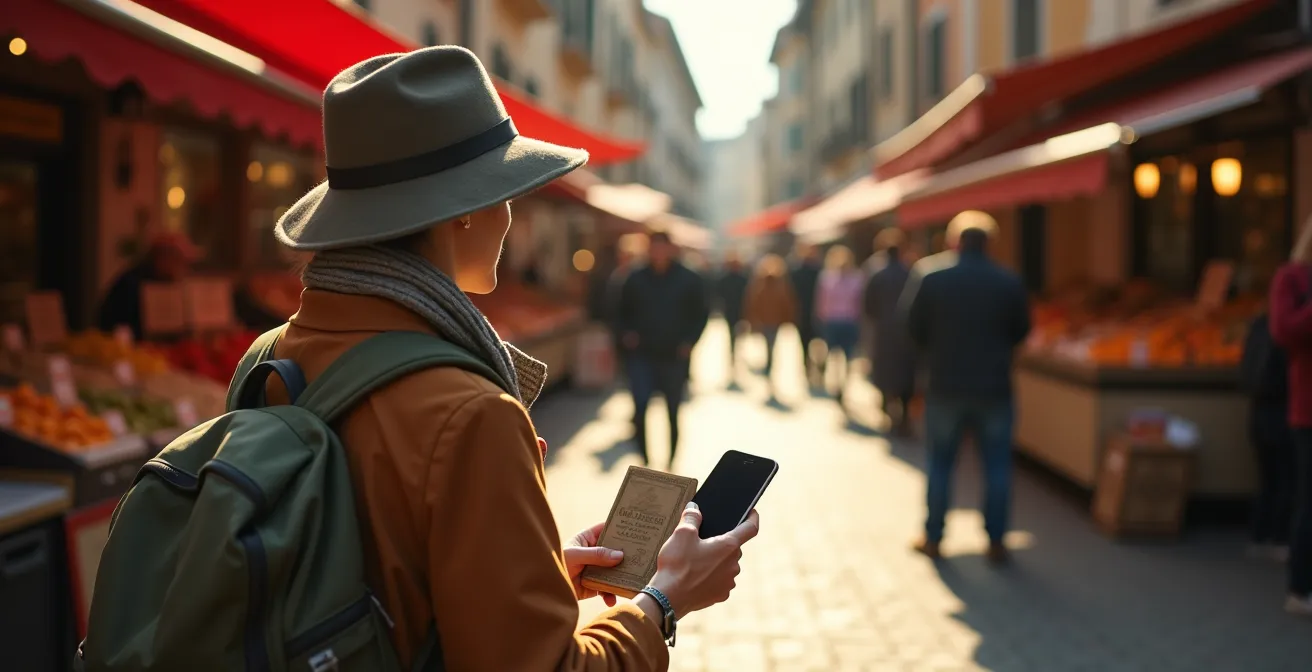
The key to meaningful travel connection isn’t choosing between translation apps and language basics; it’s mastering a hybrid strategy that uses technology to create authentic human openings.
- Technology is a powerful tool for logistics and emergencies but can create social friction—the “digital third wheel” effect.
- Learning a few “magic words” and non-verbal cues provides low-friction entry points for genuine interaction that apps cannot replicate.
Recommendation: Shift your mindset from using an app to get an answer to using it as a catalyst to start a real conversation.
The modern traveler stands at a digital crossroads. In one hand, a smartphone with an app that promises to instantly decode the world; in the other, a desire for the authentic, human connection that makes travel transformative. Many who lean heavily on technology report a paradoxical feeling: they are more capable than ever of navigating foreign lands, yet feel more isolated from the people within them. The conversation becomes a transaction, mediated through a glowing screen, and the potential for spontaneous, serendipitous connection dwindles.
The common advice is to ditch the tech and learn the language. But this presents a false dichotomy. For most travelers on a limited timeframe, fluency is an unrealistic goal. The real challenge isn’t about choosing technology or human effort, but about integrating them. The most effective communicators don’t see their phone as a crutch, but as one tool in a much larger toolkit of observation, humility, and strategic language use. They understand that technology’s role isn’t to replace interaction, but to facilitate it.
This guide reframes the debate. Instead of asking “apps or basics?” we will explore a Hybrid Communication Strategy. We will analyze the specific pitfalls and strengths of translation technology—from avoiding cultural gaffes to managing battery life—and then outline a high-impact method for learning the essential human-centric phrases that open doors. The goal is to transform your device from a barrier into a bridge, enabling you to build the genuine connections you travel for.
To navigate this complex topic, this article breaks down the strategic use of both technology and human skills. The following sections will guide you through the nuanced world of modern travel communication, helping you forge deeper, more meaningful connections on your journeys.
Summary: A Traveler’s Guide to Hybrid Communication
- When Translation Apps Fail: Avoiding Cultural Insults in Translation
- Which Translation App Works Best Without Data in Rural Areas?
- How to Use AR Camera Translation to Read Menus Instantly?
- Voice Mode or Typing: Which Is Less Awkward in Conversation?
- How Translation Apps Drain Battery and How to Mitigate It?
- How to Survive the First 24 Hours in a Country Where You Don’t Speak the Language?
- How to Learn the “Magic Words” of Any Language in 2 Hours?
- How to Experience True Cultural Immersion Without Being Intrusive?
When Translation Apps Fail: Avoiding Cultural Insults in Translation
The greatest weakness of a translation app is its complete lack of cultural context. It translates words, not intent, humor, or hierarchy. A phrase that is perfectly benign in English can become offensive or nonsensical when translated literally, creating social friction instead of connection. These tools cannot grasp idioms, historical sensitivities, or the subtle power dynamics embedded in language. Relying on an app for anything more than simple, factual exchanges is a significant social risk.
The danger lies in the assumption that a correct translation is a good translation. Without understanding the underlying cultural norms, you risk speaking to an elder with the informality reserved for a child, or using a phrase that has a disastrous secondary meaning. These blunders, while unintentional, can immediately shut down the potential for a genuine connection, reinforcing the image of the clueless tourist.
Case Study: Dolce & Gabbana’s 2018 China Campaign Failure
A prime example of literal translation backfiring spectacularly is Dolce & Gabbana’s 2018 ad campaign in China. The company released a video showing a Chinese model struggling to eat Italian food with chopsticks, while a patronizing male voiceover gave her instructions as if she were a child. The language used was seen as condescending and the entire concept relied on stereotypes, leading to immediate and widespread backlash, including boycotts from consumers and denunciations from celebrities. The campaign was a masterclass in how a lack of cultural nuance can turn a marketing effort into an international incident, demonstrating that communication without cultural understanding is worse than no communication at all.
The key takeaway is to treat app translations with profound skepticism. Use them for nouns (“train station,” “water”) but avoid them for concepts involving social interaction, humor, or respect. The risk of an app-generated cultural insult far outweighs the convenience it offers in these delicate situations.
Which Translation App Works Best Without Data in Rural Areas?
When you venture beyond the city limits and the reach of reliable Wi-Fi, your reliance on cloud-based translation apps can become a critical vulnerability. The most sophisticated AI is useless without a data connection. Therefore, the “best” app for rural or remote travel is not necessarily the one with the most features, but the one with the most robust and comprehensive offline functionality. Apps like Google Translate and Microsoft Translator allow you to download entire language packs beforehand, ensuring you have a basic safety net even when completely off-grid.
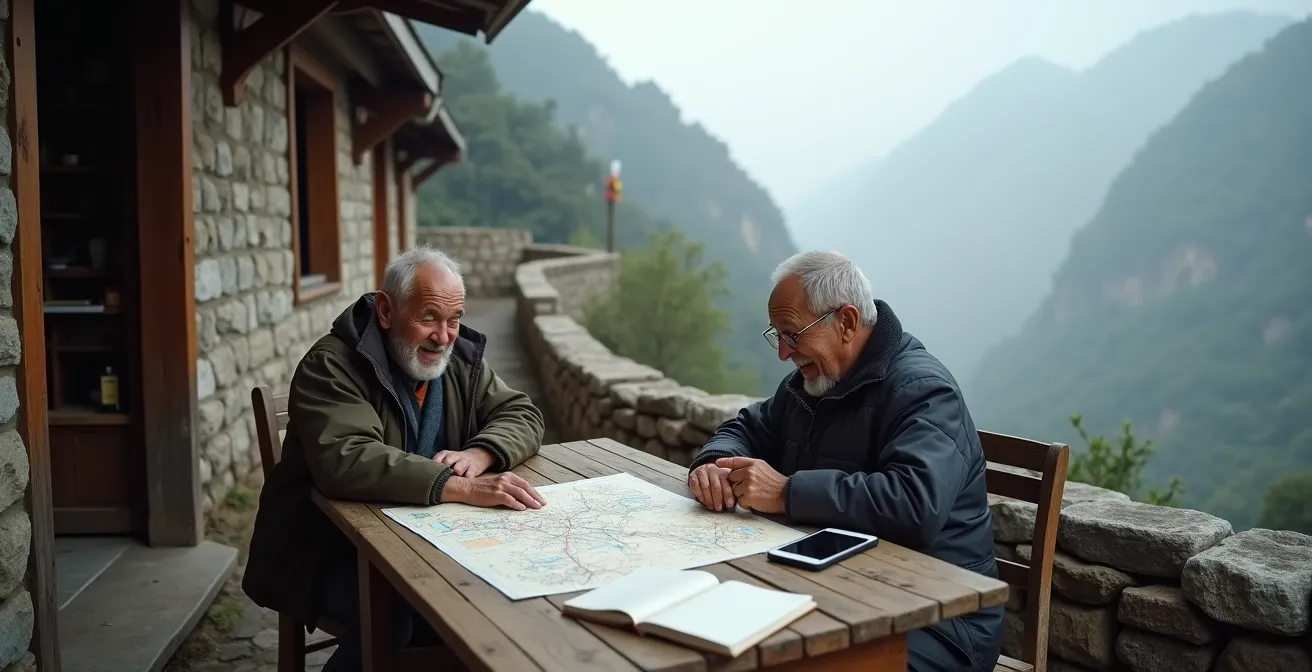
However, even the best offline app is not a panacea. Offline processing is often less accurate than its online counterpart and can drain your phone’s battery more quickly. This is where a hybrid approach becomes essential. Your offline app should be viewed as one tool in a broader, non-digital communication kit. A pocket notebook with key phrases, a hand-drawn map, and a willingness to use gestures are often more effective and reliable in remote settings. These analog tools are battery-free and can foster a more direct, collaborative form of communication with locals, turning a moment of confusion into one of shared problem-solving.
Before any trip to a rural area, your preparation should include downloading the relevant offline language pack, fully charging a portable power bank, and packing a physical notebook. This combination ensures you have multiple layers of support, freeing you from the anxiety of losing your digital lifeline and allowing you to engage more confidently with the world around you.
How to Use AR Camera Translation to Read Menus Instantly?
Augmented Reality (AR) camera translation is one of the most practical applications of this technology for travelers. Pointing your phone’s camera at a menu, sign, or product label and seeing the text magically transform into your native language can feel like a superpower. It’s particularly useful in situations where typing out unfamiliar characters is impossible, such as in a restaurant with a complex menu or navigating a train station with foreign script. This feature can dramatically reduce logistical friction and ordering anxiety.
To use it effectively, simply open an app like Google Translate or Microsoft Translator, select the camera mode, and ensure your source and target languages are correctly set. Hold your camera steady and aim it at the text. The app will overlay the translation directly onto your screen. For best results, ensure there is good lighting and that the text is flat and clearly printed. Shaky hands, poor lighting, or stylized fonts can significantly reduce accuracy.
While incredibly useful, it’s important to understand the limitations of different apps. Not all apps support the same number of languages for camera translation, and some have better offline capabilities than others. A comparative analysis shows significant differences in features and performance.
| App | Camera Translation Languages | Offline Camera | Key Limitation |
|---|---|---|---|
| Google Translate | 94 languages (Android) | Yes (limited) | Misses cultural context |
| Microsoft Translator | 70+ languages | Yes | Requires good lighting |
| Apple Translate | 11 languages | Yes | iOS only |
| Papago | 13 languages | No | Asian languages focus |
Ultimately, AR translation is a tool for understanding, not for conversation. Use it to decipher the menu, then put your phone away and use a simple point or a learned phrase like “This one, please” to interact with the staff. This balances technological efficiency with human respect.
Voice Mode or Typing: Which Is Less Awkward in Conversation?
Choosing between an app’s voice mode and typing mode is a crucial act of social awareness. Neither is universally better; the “less awkward” choice depends entirely on the context of the interaction and the environment. Voice mode is fast and hands-free, making it ideal for quick, transactional exchanges in a noisy environment like a market stall. However, the robotic voice output can be jarring and impersonal, creating what one expert calls a “digital third wheel” in the conversation.
As a travel communication expert noted in AFAR Magazine, this dynamic can fundamentally alter the nature of the exchange. The focus shifts from the two people to the device between them.
The phone creates a strange three-way conversation between you, your device, and the local person, which can feel impersonal and disjointed
– Travel communication expert, AFAR Magazine Travel Guide
Typing mode, while slower, offers a surprising social advantage. In a quieter setting like a shop or hotel desk, turning the screen towards the other person invites them to participate in the act of communication. It creates a shared focal point and turns the exchange into a collaborative effort to understand each other. This simple act can transform the interaction from a sterile transaction into a moment of shared problem-solving and human connection. This is a perfect example of Contextual Modality Switching—consciously choosing your tech’s mode to fit the social situation.
Action Plan: Choosing Your Translation Method
- Assess the environment: Is it loud and transactional (voice) or quiet and personal (typing)?
- Keep it simple: Formulate short, clear sentences. Apps fail with complex grammar and nuance.
- Show, don’t just tell: If typing, turn your screen to the other person to create a shared space.
- Use voice for speed: In a busy market, quick voice translations for numbers or simple questions are efficient.
- Use typing for connection: In a relaxed setting, typing allows for pauses and collaborative correction, fostering a better rapport.
The most socially intelligent travelers assess the “social volume” of their surroundings before ever pulling out their phone. They understand that the goal isn’t just to be understood, but to communicate in a way that is respectful and appropriate for the situation.
How Translation Apps Drain Battery and How to Mitigate It?
Translation apps, especially those using camera or continuous voice recognition, are among the most power-hungry applications on a smartphone. They engage the processor, microphone, and screen simultaneously, leading to a rapid and often surprising drain on your battery. For a traveler, a dead phone isn’t just an inconvenience; it can be a serious safety issue, leaving you without maps, contacts, or your primary communication tool. Understanding why and how this drain happens is the first step toward mitigating it.
The main culprits are CPU-intensive processing for translation algorithms and constant use of hardware like the camera and microphone. Even in offline mode, the processor is working hard to run the downloaded language models. This is a key reason why some frequent travelers opt for dedicated translator devices. Independent research on translation device performance shows that these gadgets can last anywhere from 6 to 180 hours, as they are optimized for a single task and don’t run a host of background processes like a smartphone.
For those sticking with their phone, a multi-pronged mitigation strategy is essential. First, enable your phone’s dark mode; on OLED screens, this can provide significant power savings. Second, pre-download offline language packs to avoid using power-draining cellular data for translations. Most importantly, reduce your dependency on the app. Use it for targeted, essential tasks, not as a constant conversational crutch. Supplementing the app with a physical notebook for common phrases or questions is the most effective battery-saving technique of all, as it requires zero power.
How to Survive the First 24 Hours in a Country Where You Don’t Speak the Language?
The first 24 hours in a new country can be a disorienting mix of excitement and anxiety. When you don’t speak the language, every simple task can feel like a monumental challenge. The key to survival—and to setting the stage for a successful trip—is not to frantically translate everything, but to slow down, observe, and focus on small, successful human interactions. Your primary goal is not mastery, but confident navigation and a single moment of connection.
Resist the urge to stay glued to your phone. Instead, find a public café or park bench. Spend the first hour simply watching and listening. Observe how people greet each other, the rhythm of their interactions, and their use of gestures. This period of observation is invaluable; it provides a cultural and linguistic baseline that no app can offer. It also helps you shift from a state of anxious doing to one of calm being, which makes you far more approachable.
For your first interactions, focus on achieving one small success. This could be buying a coffee using a practiced phrase and a smile, or successfully asking for directions using a combination of a place name and a questioning expression. Carry a small notepad with universal symbols (a bed for hotel, a fork/knife for food, a toilet symbol) as a non-verbal backup. This approach embraces vulnerability and humility as communication tools. People are often more willing to help someone who is visibly trying and open than someone who is hidden behind a device.
How to Learn the “Magic Words” of Any Language in 2 Hours?
While fluency is a long-term goal, acquiring a small set of high-impact “magic words” is achievable in just a couple of hours and can radically transform your travel experience. These are not just the standard “please” and “thank you,” but interaction-inviting phrases that show curiosity and warmth. They are the keys that unlock doors to more meaningful conversations, creating low-friction openings for connection that a translation app can never replicate. Research has shown that learning to ask “What is your name?” and then using that person’s name creates a far stronger bond than any mediated translation.
The goal of the 2-hour formula is not to learn grammar, but to memorize a handful of functional, modular phrases that spark positive reactions. Focus on words that express appreciation and curiosity, as these invite a response. This method prioritizes pronunciation and tone over vocabulary size, as a warmly spoken “Delicious!” is more powerful than a perfectly translated but robotic sentence.
Here is a simple formula to learn your “magic words” in a short amount of time:
- Interaction-Inviting Words: Learn phrases that express positive emotion, like ‘Delicious!’, ‘Beautiful!’, and the question ‘What is this?’. These show engagement with your surroundings.
- The Name Question: Master how to ask, ‘What is your name?’ and ‘My name is…’. Using someone’s name is a universal sign of respect.
- Core Courtesies with Tone: Practice ‘Please’ and ‘Thank you’ relentlessly, focusing on matching the local tone and warmth. A smile is a crucial part of the pronunciation.
- Basic Numbers & Pointing: Learn to count from 1 to 10. Combined with pointing, this can handle almost any transaction in a market or shop.
By focusing your energy on this small but powerful lexicon, you signal to locals that you see them as people to connect with, not as obstacles to be navigated. This simple investment of time yields an exponential return in the quality of your interactions.
Key Takeaways
- True connection comes from a hybrid strategy, using tech for logistics and human skills for interaction.
- Context is king: Choose your communication mode (voice, text, or no tech) based on the social environment.
- Learning a few “magic words” that invite interaction is more valuable than having a large, app-based vocabulary.
How to Experience True Cultural Immersion Without Being Intrusive?
True cultural immersion is the holy grail of travel, yet it’s often misunderstood as simply “living like a local.” In reality, it’s a delicate balance of engagement and respect, of participation and observation. The most enriching experiences come not from trying to blend in, but from interacting authentically as a curious and respectful visitor. The hybrid communication strategy is the key to achieving this balance, allowing you to navigate efficiently while creating space for genuine human connection.
The first principle of non-intrusive immersion is to lead with the human, support with the tech. Start every interaction with eye contact, a smile, and one of your learned “magic words.” Only use your translation app as a secondary tool if the initial attempt fails. This simple sequencing signals respect and shows that your first instinct is to connect with the person, not the device. It changes the dynamic from “I need something from you” to “I’d like to try and communicate with you.”
The second principle is to use your technological tools to learn, not just to translate. Use the AR camera to learn the names of new foods, then try to say the word yourself next time. Use the app to look up a word you hear frequently, expanding your own vocabulary. This transforms the app from a crutch into a personalized language-learning tool. By seeing technology as a bridge to your own understanding, you empower yourself and reduce your dependency on it over time. This approach allows you to step beyond mere communication and begin to build real connections, appreciating the rich tapestry of another culture from a place of genuine curiosity.
By adopting this balanced, hybrid mindset, you move beyond the limitations of both pure technology and pure linguistic effort. You become a more adaptable, respectful, and connected traveler, equipped to turn any interaction into an opportunity for genuine discovery. Start practicing this hybrid strategy on your next journey to transform your travel experience.
Frequently Asked Questions on Translation Apps and Language Learning
Should I rely on translation apps from the moment I arrive?
It’s wise to be prepared, but not to be dependent. Before you depart, download any necessary language packs for offline use and test the app’s features. Ensure your device is fully charged. However, upon arrival, try to observe and use basic human skills first. The app should be your backup, not your first resort.
What’s the minimum vocabulary needed for the first day?
Focus on five high-leverage phrases: ‘Hello,’ ‘Thank you,’ ‘Please,’ ‘Where is…?’ and ‘How much?’. These, combined with universal gestures and a positive attitude, can successfully handle the majority of your immediate needs while showing respect and effort.
How do I handle emergencies without language skills?
Preparation is key. Save local emergency numbers in your phone. Keep your accommodation’s address written down in both English and the local language. Most importantly, learn the words for ‘help’ and ‘hospital’ in the local language. In a true emergency, these two words can be life-saving.