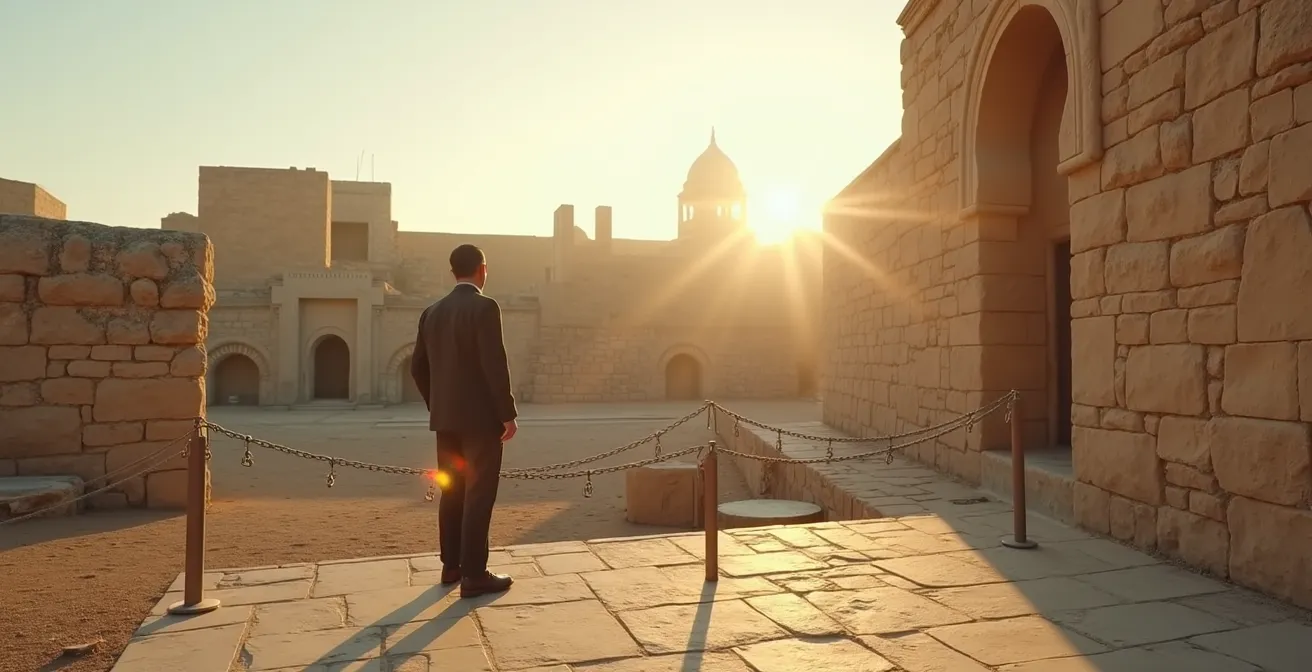
The greatest threat to ancient sites isn’t time; it’s the cumulative impact of well-intentioned but uninformed visitors.
- Your touch, your path, and even your sunscreen have measurable, destructive consequences on fragile materials.
- Strategic planning allows you to avoid crowds not just for comfort, but to minimize concentrated wear on irreplaceable heritage.
Recommendation: Shift your perspective from that of a passive tourist to an active preservationist. Every choice you make on-site is an act that either degrades or helps protect our shared history for future generations.
Standing within the ruins of a once-great civilization is a profoundly moving experience. You can almost feel the echoes of history in the air, a tangible connection to a distant past. The natural impulse is to reach out, to touch a 2,000-year-old stone, to feel its texture. The common advice is a simple list of prohibitions: don’t touch, don’t use flash, stay on the path. While correct, this advice fails to capture the fundamental truth of heritage preservation.
The real challenge isn’t malicious damage; it’s the slow, invisible erosion caused by millions of seemingly harmless actions. This is the concept of the conservation footprint—the cumulative effect of every visitor. But what if the key to responsible tourism wasn’t just a list of rules, but a completely different mindset? What if, instead of just seeing a site, you learned to see it through the eyes of a conservationist, understanding the invisible forces of decay and preservation at play?
This guide is designed to equip you with that mindset. It moves beyond the basic “what not to do” and delves into the “why,” explaining the science behind the rules and offering strategies for turning your visit into a conscious act of guardianship. We will explore the tangible impact of your presence, from the chemical reactions caused by a single touch to the economic forces behind the souvenir trade, empowering you to become a protector of the very history you’ve traveled so far to experience.
This article provides a detailed framework for becoming a more conscious heritage traveler. The following sections will guide you through the critical aspects of responsible visitation, from understanding material fragility to navigating cultural nuances.
Contents: A Preservationist’s Approach to Ancient Sites
- Why Touching Ancient Frescoes Causes Irreversible Damage Over Time?
- How to Beat the Heat and Crowds at Open-Air Archaeological Sites?
- Audio Guide or Guidebook: Which Is Better for Complex Ruins?
- The Souvenir Trap: How to Spot Fake “Ancient” Coins Sold by Hawkers?
- How to Navigate Massive Ruins Without Missing the Key Highlights?
- How to Visit Exclusive Sites Privately by Booking “After Hours”?
- The “One Touch” Rule: Why Standing on Coral Is a Death Sentence?
- How to Experience True Cultural Immersion Without Being Intrusive?
Why Touching Ancient Frescoes Causes Irreversible Damage Over Time?
The “do not touch” rule is the most common and most ignored directive at heritage sites. To a visitor, a single, fleeting touch on a vast stone wall or ancient painting seems insignificant. From a conservationist’s perspective, it is an act of micro-destruction with permanent consequences. Human skin is not clean; it is coated in a complex film of oils, salts, and acids. When you touch a surface, you transfer this film. On a porous material like plaster, fresco, or sandstone, these substances are absorbed deep into the structure.
This visual helps to understand the delicate nature of these surfaces. What appears robust is, on a microscopic level, a fragile matrix vulnerable to chemical change.
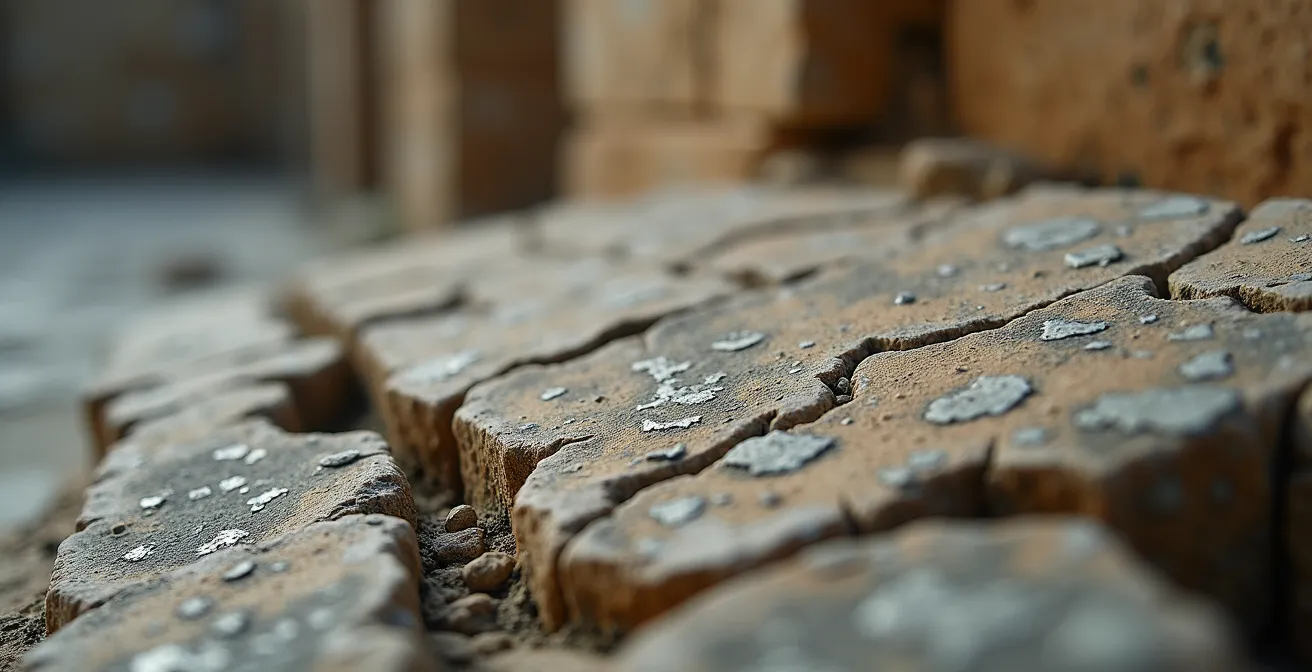
Over time, these organic deposits attract dust, promote mold growth, and can cause irreversible staining. The salts can crystallize within the material, causing the surface to flake and crumble—a process known as efflorescence. Similarly, the intense burst of light from flash photography acts as a catalyst for chemical degradation, causing pigments to fade in a way that is cumulative and irreversible. Each flash is one more step toward a bleached, faded ghost of the original artwork. The difficulty and cost of reversing such damage are astronomical. For instance, a complex project to restore 17th-century frescoes required scientists to deploy specialized bacteria. In this case, Spanish scientists used Pseudomonas bacteria to meticulously consume salt and glue residue without harming the paint—a stark reminder that prevention is infinitely better than a cure that requires microbiological intervention.
How to Beat the Heat and Crowds at Open-Air Archaeological Sites?
Navigating a sprawling archaeological park like Pompeii or Teotihuacan during peak hours can feel more like a battle for survival than a contemplative experience. The intense heat and overwhelming crowds not only diminish the enjoyment but also concentrate visitor impact on the most popular areas. A preservationist’s approach involves strategic planning based on visitor flow dynamics, not just personal comfort. The goal is to distribute your presence, both in time and space.
Standard advice is to “go early or late.” A more sophisticated strategy involves using digital tools and observing the natural rhythm of the site. The “golden hour”—the first and last hour of sunlight—not only offers the best light for photography but also coincides with the departure of large tour groups. This is the ideal time to experience the site’s true atmosphere.
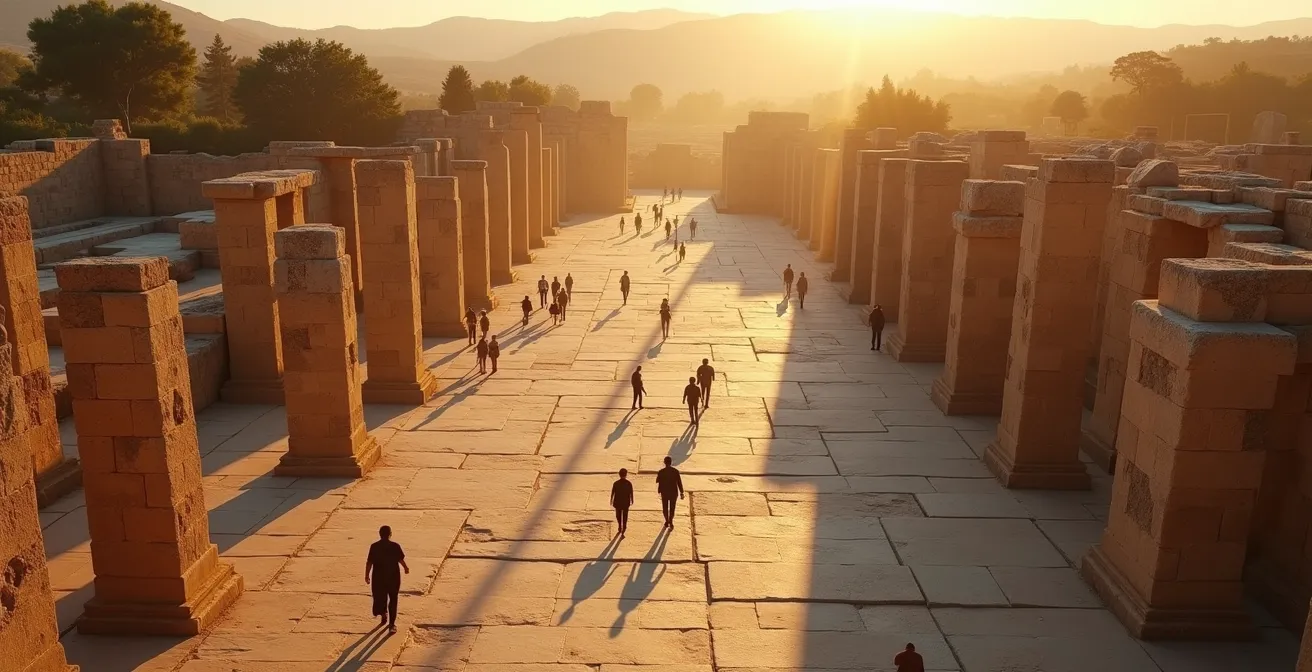
As the image suggests, understanding how light and shadow move across a site can help you plan a route that is both more comfortable and less crowded. Before your visit, analyze a satellite map to identify shaded pathways, covered structures, or natural features that offer respite from the sun. To avoid the human traffic jams that form at the entrance, consider starting your tour from the furthest point of the site and working your way back toward the entrance. This counter-flow strategy often means you experience key monuments in relative solitude. Here are some actionable techniques:
- Book timed tickets online in advance to guarantee entry during shoulder hours.
- Use satellite map views to identify shaded areas and plan your route accordingly.
- Visit during the last 90 minutes before closing when tour groups have departed.
- Start from the furthest point and work backwards against the typical visitor flow.
- Take advantage of early morning or late afternoon ‘golden hour’ lighting for photography.
Audio Guide or Guidebook: Which Is Better for Complex Ruins?
Confronted with a vast, complex ruin, the choice of interpretive tool—audio guide or physical guidebook—can fundamentally shape your understanding and experience. Neither is inherently superior; the best choice depends on your learning style and your goals as a conscious traveler. An audio guide offers a hands-free, immersive experience, allowing you to look at the structures while listening to a curated narrative. It excels at bringing specific points of interest to life with stories and context. However, it often locks you into a linear path, discouraging the personal exploration that can lead to wonderful discoveries.
A guidebook, on the other hand, provides complete freedom. It offers comprehensive overviews, detailed maps, diagrams, and historical timelines that you can study before your visit. This pre-visit preparation is a core tenet of responsible tourism, as it allows you to arrive on-site with a foundational knowledge, making your time there more efficient and meaningful. The main drawback is the need to constantly look down, breaking your visual connection with the site itself. A hybrid approach, where you study a guidebook beforehand and use an audio guide for specific highlights, often offers the best of both worlds. The following table, based on information from historical education resources, breaks down the key differences to help you decide.
As a comparative analysis of interpretive tools shows, each format serves a different purpose in a visitor’s educational journey.
| Feature | Audio Guide | Guidebook | Hybrid Approach |
|---|---|---|---|
| Hands-free exploration | ✓ Full mobility | ✗ Requires handling | ✓ Strategic use |
| Depth of information | Point-specific details | Comprehensive overview | Both levels |
| Visual aids | Limited/none | Maps, diagrams, photos | Full visual support |
| Flexibility | Linear path suggested | Complete freedom | Customizable journey |
| Pre-visit preparation | Not available | Can study beforehand | Academic immersion possible |
The Souvenir Trap: How to Spot Fake “Ancient” Coins Sold by Hawkers?
The desire to take home a piece of history is understandable, but it fuels a destructive trade. The “ancient” coins, pottery shards, or statuettes sold by hawkers near major archaeological sites are almost universally fakes. In the rare case that they are authentic, purchasing them encourages the looting of undiscovered sites, which destroys invaluable historical context forever. A preservationist’s approach is to practice authentic patronage: supporting the site’s official museum shop or licensed artisans, where proceeds fund conservation, rather than contributing to illicit trade.
However, curiosity often gets the better of us. Learning to distinguish a fake from a genuine artifact is a valuable skill, not to purchase it, but to understand the craft of deception and educate fellow travelers. Modern fakes are often made using molds, which leave tell-tale signs. Authentic ancient coins, for example, were struck by hand and thus have unique imperfections and off-center strikes. Fakes often look too perfect or, conversely, have identical “damage” patterns across multiple pieces, betraying their mass-produced origin. The patina—the surface layer that develops over centuries—is another key indicator. An artificial patina often looks powdery or can be rubbed off, whereas a genuine patina is hard and integrated into the metal.
Your 5-Point Field Check for Spotting Fake Artifacts
- Casting Seams: Examine the edge of the object closely. A tiny, raised line is a dead giveaway that it was made in a modern mold.
- Wear Patterns: Look at how the object is worn. Authentic pieces show uneven, natural wear on high points, while fakes often have uniform, artificially-abraded surfaces.
- Patina Test: Gently rub the surface with a cloth. If a powdery green or brown residue comes off, it’s likely a modern chemical treatment to simulate age.
- Uniformity Flaws: If a seller has a whole tray of “artifacts,” look for identical “damage” marks, cracks, or chips. This indicates mass production, not unique historical weathering.
- The Ethical Alternative: The most responsible action is to refuse to engage. Purchase certified replicas from official museum shops instead; this directly supports the preservation of the site.
How to Navigate Massive Ruins Without Missing the Key Highlights?
Massive archaeological complexes like the Roman Forum, Angkor Wat, or Chichen Itza can be overwhelming. Without a clear plan, visitors often wander aimlessly, succumbing to “ruin fatigue” and missing key structures. The conservationist’s goal is to navigate a site with intention, ensuring a comprehensive experience while minimizing backtracking and unnecessary foot traffic, which contributes to trail erosion. One of the most effective strategies for this is the “hub and spoke” method.
This method involves identifying a central, major monument (the hub) and planning a series of targeted excursions (the spokes) to surrounding points of interest before returning to the hub. This prevents you from getting lost in a maze of smaller structures and ensures you dedicate focused time to the most significant areas. The hub could be a major temple, a forum, or a central plaza. Your spokes should be thematically or geographically clustered groups of smaller ruins. For instance, one spoke might be “the residential quarter,” while another might be “the ceremonial procession way.” This approach transforms a potentially chaotic wander into a structured and rewarding exploration.
Case Study: The Hub and Spoke Method in Rome
The Colosseum and Roman Forum complex is a prime example of where this method excels. The Colosseum, the largest amphitheater in the Roman Empire that could hold between 50,000 and 80,000 spectators, serves as the unmistakable central hub. After exploring it, a visitor can make a targeted excursion (a “spoke”) to the nearby Forum, which was the heart of Roman public life, to see the Senate House and the Temple of Vesta. Then, another spoke could lead up to the Palatine Hill to explore the imperial palaces, before ending the day with a clear sense of having covered all major zones logically.
How to Visit Exclusive Sites Privately by Booking “After Hours”?
For many conscious travelers, the ultimate experience is to witness a world-famous heritage site in silence, free from the daytime crowds. “After-hours” or private tours offer this unique opportunity. Far from being a mere luxury, these exclusive visits are often a critical component of a site’s financial sustainability. The significantly higher fees charged for this privileged access are frequently channeled directly into conservation and research projects that would otherwise be underfunded. When you book a reputable after-hours tour, you are not just buying solitude; you are becoming a direct patron of preservation.
Finding these opportunities requires proactive research. They are rarely advertised on mainstream booking platforms. The best approach is to contact the site’s official management body, its “Friends of…” association, or the archaeological foundation that oversees it. Specialized academic travel agencies are another excellent resource. When inquiring, always ask what percentage of the tour fee is allocated to conservation efforts. A transparent and reputable operator will be proud to provide this information. This model of high-value, low-impact tourism is a cornerstone of modern heritage management, and national programs often build on this idea. For example, various preservation initiatives have established frameworks across the United States to formalize heritage tourism as a tool for economic development and conservation funding.
Key Takeaways
- Every Touch Has a Cost: Understand that your physical presence, from skin oils to sunscreen, has a tangible and cumulative chemical impact on fragile ancient materials.
- Your Path Is a Tool: Strategically planning your route and timing using methods like counter-flow and “hub-and-spoke” minimizes your impact and enhances your experience.
- Your Money Is a Vote: Choosing to buy from official museum shops or booking conservation-focused tours is an act of “authentic patronage” that directly funds preservation.
The “One Touch” Rule: Why Standing on Coral Is a Death Sentence?
While many of the world’s most fragile historic sites are on land, some of the most endangered lie beneath the waves. Coral reefs are living, breathing underwater cities built by millions of tiny animals called polyps. They are not rocks. The “one touch” rule here is absolute because the delicate outer layer of a coral polyp can be easily damaged by a hand, a fin, or by standing on it. This can lead to tissue death and infection, creating a wound that can spread and kill an entire colony that took centuries to grow. This is why maintaining perfect buoyancy control when snorkeling or diving is not just good form; it is an ethical imperative.
Beyond direct physical contact, we inflict immense “micro-destruction” on these ecosystems through chemical pollution. One of the biggest culprits is sunscreen. Many common sunscreens contain chemicals like oxybenzone and octinoxate, which are highly toxic to coral. They can cause bleaching, damage DNA, and disrupt reproduction. According to scientific research, the scale of this problem is staggering; environmental research estimates that 14,000 tons of sunscreen wash into our oceans annually. The responsible choice is to always use “reef-safe” sunscreens that rely on mineral blockers like zinc oxide and titanium dioxide, and to cover up with UV-protective clothing to minimize the amount of sunscreen you need.
Case Study: Hawaii’s Landmark Sunscreen Ban
Recognizing the severe threat, the state of Hawaii took a groundbreaking step in 2018 by passing the first-ever statewide ban on the sale of sunscreens containing oxybenzone and octinoxate. This legislation set a powerful precedent for global conservation. Following Hawaii’s lead, several island nations and territories, including Palau, Bonaire, Aruba, and Key West in Florida, implemented similar bans to protect their own invaluable marine ecosystems. This demonstrates how consumer awareness and policy change can work together to protect fragile natural heritage from invisible chemical threats.
How to Experience True Cultural Immersion Without Being Intrusive?
The ultimate goal of responsible travel is not just to see places but to connect with them. This means engaging with living cultures in a way that is respectful, reciprocal, and non-intrusive. True cultural immersion is not about passively observing people as if they were exhibits in a museum; it is about finding meaningful ways to interact and learn. This requires humility, research, and a willingness to step out of your comfort zone. The most fundamental principle is to remember that you are a guest in someone else’s home.
As the cultural travel experts at Worldpackers advise, preparation is a sign of respect. This extends beyond learning a few words in the local language; it involves understanding social norms, dress codes, and non-verbal etiquette.
Remember you are a guest, so researching cultural norms and traditions beforehand shows respect. This includes dressing appropriately for sacred places, respecting religious practices, and asking before taking photos of people.
– Worldpackers Cultural Travel Guide, Explore the World: Budget-Friendly Cultural Travel Tips
Intentional immersion means moving away from extractive tourism and toward activities that offer a reciprocal value exchange. Instead of simply taking a photo, take a cooking class. Instead of a brief stop at a market, spend time in everyday spaces like parks or local libraries. This shift from observer to participant fosters genuine connection and ensures that your presence is a positive one. The most authentic experiences often happen when you focus on shared human activities rather than transactional tourist attractions. Consider these strategies for a more meaningful engagement:
- Book structured experiences like cooking classes or craft workshops for reciprocal value exchange.
- Spend time in everyday spaces – local supermarkets, public parks, neighborhood libraries.
- Master non-verbal etiquette: research greeting customs, queuing behavior, personal space norms.
- Choose sustainable transportation and eco-friendly accommodations.
- Support local businesses and avoid attractions that exploit cultural sites.
Embrace this conservationist mindset on your next journey. By understanding the “why” behind the rules and making conscious, informed choices, you transform your visit from a passive viewing into an active act of guardianship for future generations.
Frequently Asked Questions about Responsible Heritage Tourism
How can I find after-hours tour opportunities beyond famous sites?
Contact the site’s official ‘Friends of…’ association, archaeological foundations managing the property, or specialized academic travel agencies that arrange exclusive access.
What percentage of after-hours tour fees typically goes to conservation?
This varies by site, but reputable programs allocate 40-70% directly to preservation efforts. Always ask the operator for specific percentages before booking.
Can small groups pool resources for private tours?
Yes, use specialized travel forums to connect with like-minded travelers and form small groups of 6-10 people to share costs while maintaining an intimate experience.