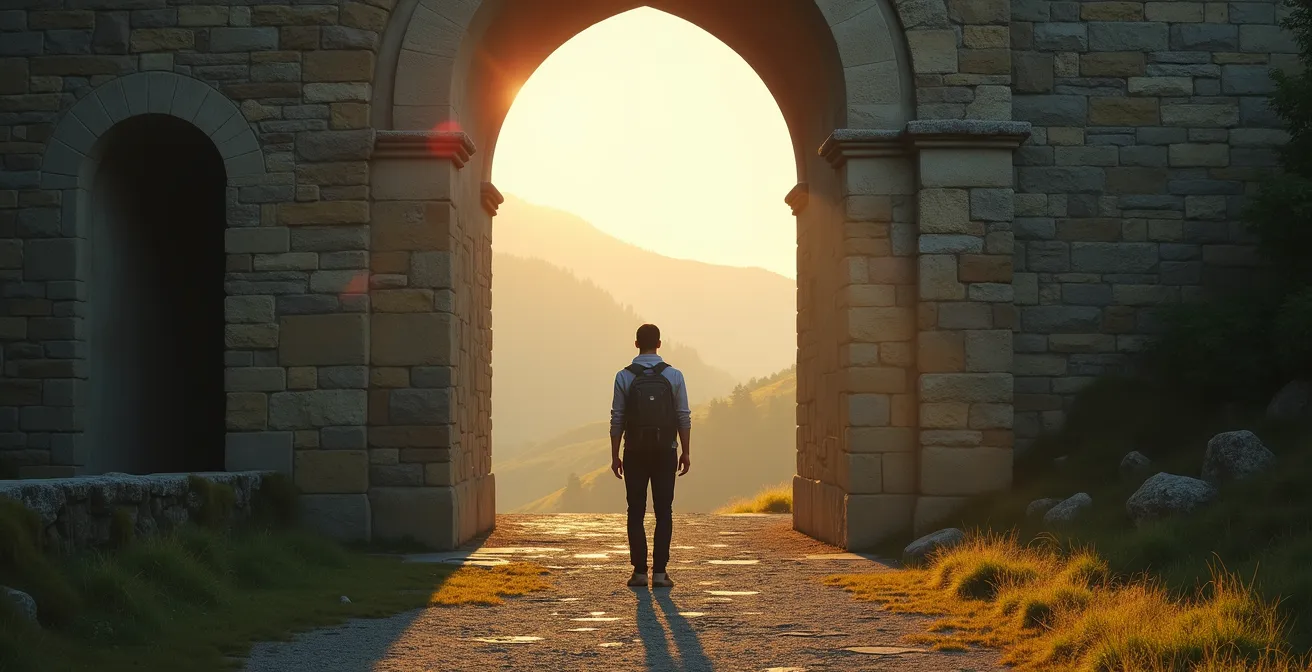
The secret to an unforgettable trip isn’t just finding a unique place to stay; it’s understanding the “community covenant” you’re joining before you book.
- Every alternative lodging—from a silent monastery to a working farm—operates on a set of rules and expectations that define the experience.
- Choosing the right stay means matching your travel style to the right “covenant,” whether it’s one of work, silence, or shared resources.
Recommendation: Instead of just looking for a cool room, research the rhythm of daily life at your potential lodging to ensure the experience aligns with your goals for the trip.
The call of the open road has changed. For a growing number of experience-seekers, the sterile predictability of a hotel room or the transactional nature of a standard vacation rental no longer satisfies the hunger for genuine connection and memorable stories. You’re not just looking for a bed; you’re looking for a narrative. You want to wake up to the sound of monastery bells, the smell of fresh hay on a farm, or the quiet hum of a university campus in summer. This is the world of intentional lodging.
Many guides will point you to the obvious filters on large booking platforms, offering generic advice to “look for something different.” But this approach misses the point entirely. The true value of staying in a castle, a convent, or a cabin isn’t just the unusual architecture; it’s the immersion into a self-contained world with its own pace, rules, and purpose. This is where the real adventure lies, but it’s also where mismatched expectations can lead to disappointment. A romantic vision of a castle stay can quickly crumble when faced with a drafty room and a shared bathroom down a long, cold hall.
But what if the key wasn’t just finding these places, but deciphering their unique “community covenant” beforehand? This guide is built on that very principle. We’re moving beyond a simple list of websites to give you the strategic toolkit to understand the trade-offs, ask the right questions, and choose an alternative lodging that doesn’t just house your body, but enriches your soul. We’ll explore the realities of these stays, from the silent discipline of a monastery to the surprising benefits of a university dorm room.
This article provides a framework for making informed choices, ensuring your quest for unique lodging leads to transformation, not frustration. Here is how we will explore these fascinating alternatives.
Summary: A Scout’s Guide to Alternative Accommodations
- Why Staying in a Monastery Means You Can’t Party Late?
- WWOOFing vs. Paid Farm Stay: Do You Want to Work or Relax?
- How to Book Empty University Dorms for Cheap Summer Travel?
- The Drafty Reality of Staying in a Castle in Winter
- Which Niche Websites List These Alternative Lodgings?
- Guided Retreat or Solo Cabin: Which Is Better for Mental Clarity?
- How to Verify If a Hotel Runs on Solar or Diesel Generators?
- How to Practice Shinrin-Yoku (Forest Bathing) in Ancient Forests?
Why Staying in a Monastery Means You Can’t Party Late?
The allure of staying in a monastery is profound. It promises tranquility, a break from the noise of modern life, and a touch of the sublime. But this peace is not an accident; it’s the product of a highly structured environment. When you book a room, you’re not a typical hotel guest; you are accepting an invitation to temporarily join a community governed by a covenant of contemplation and respect. This means embracing a set of rules designed to protect the serenity for everyone, including the permanent residents. The most common point of friction for travelers is failing to understand that amenities like late-night access are traded for the far rarer amenity of profound silence.
These are not arbitrary restrictions. The curfew, the silent meals, and the modest dress code are all integral parts of the monastic rhythm. They create a container for quiet reflection. As one study on accommodation options points out, monasteries offer peaceful, affordable lodging but come with specific rules, which are the very source of their unique appeal. The experience is about adapting to their world, not bending it to yours. Before you commit, it’s essential to honestly assess if you’re seeking what they offer: a structured, peaceful, and reflective environment, not just a cheap bed in a historic building.
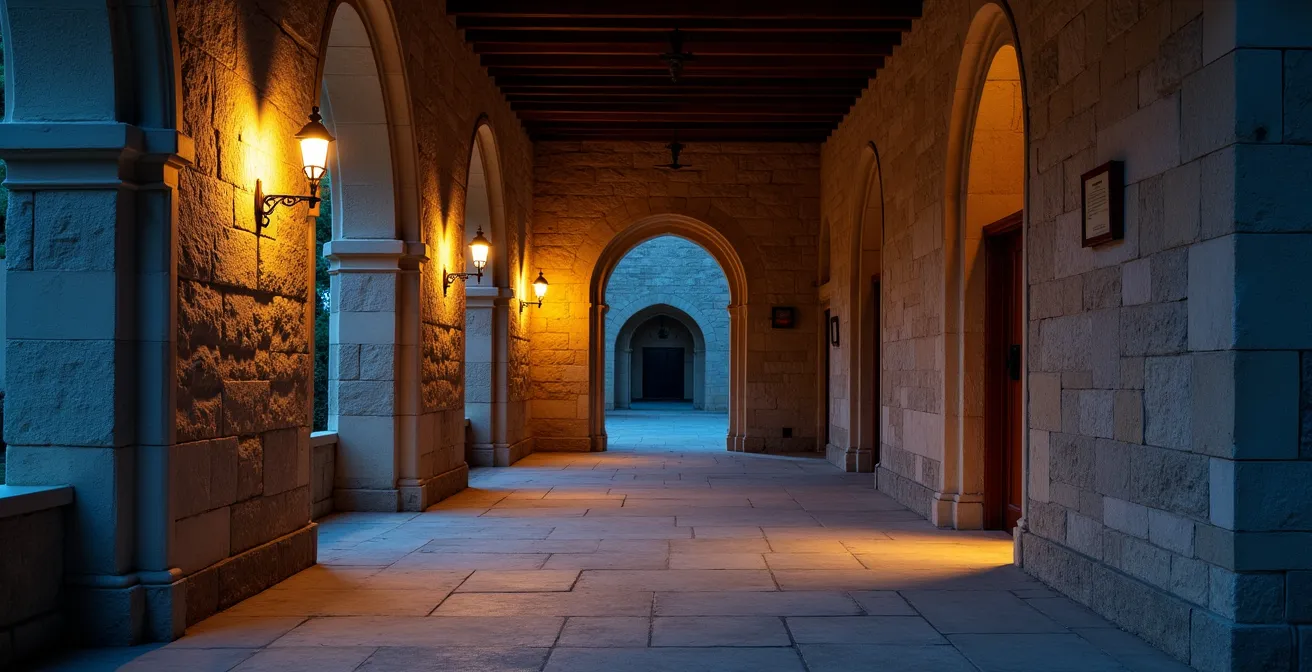
As you can see in the quiet cloister, the atmosphere is built around an evening calm. That closed wooden door isn’t just for show; it represents a real boundary. Understanding and respecting these boundaries is the key to a rewarding monastic stay. This requires a bit of due diligence on your part to ensure the community covenant aligns with your travel intentions.
Your Checklist for Understanding the Monastery Covenant
- Verify curfew times: Most monasteries lock their gates between 9-11 PM with absolutely no exceptions for late arrivals.
- Check meal schedules: Meals are often served at fixed times (e.g., breakfast 7-8 AM) and may be eaten in silence.
- Ask about mandatory participation: Some communities may require or strongly encourage attendance at services like morning prayers.
- Confirm dress codes: Plan to keep shoulders and knees covered in all common areas; shorts and tank tops are generally not permitted.
- Understand noise restrictions: Be prepared for “grand silence” hours, often starting at 9 PM and lasting until the next morning.
Ultimately, a monastery stay is an exchange. You give up a certain amount of personal freedom, and in return, you receive a space meticulously designed for peace and introspection. For the right traveler, it’s a bargain.
WWOOFing vs. Paid Farm Stay: Do You Want to Work or Relax?
The pastoral dream of escaping to the countryside is a powerful one, but “farm stay” is a broad term covering a spectrum of experiences. On one end, you have the work-exchange model, epitomized by organizations like WWOOF (World Wide Opportunities on Organic Farms). On the other, you have the “agriturismo” model: a paid, often luxurious, stay where the farm is a scenic backdrop. The fundamental question you must ask yourself is: Am I looking for a skill-building immersion or a relaxing rural retreat? Your answer will determine which community covenant you should enter, one of labor or one of leisure. There’s no right or wrong choice, but a mismatch can lead to a disastrous holiday.
WWOOFing and similar programs like Workaway are built on a covenant of exchange: you provide 4-6 hours of meaningful labor per day in exchange for room and board. This is not a hotel. It’s a deep dive into the local life, working alongside your hosts and learning practical skills. A paid farm stay, conversely, is a hospitality experience. You are a guest, free to relax, enjoy farm-to-table meals, and perhaps participate in an optional, light activity like feeding a lamb. The growth in this sector is significant, as the alternative accommodation market is projected to reach USD 477.57 billion by 2032, with rural and eco-tourism being major drivers.
This growth means more options, but also a greater need for clarity. Don’t book a WWOOFing experience expecting to lounge by a pool. Conversely, don’t show up at a high-end agriturismo expecting to get your hands dirty unless it’s a structured, paid workshop. The key is to read the fine print and understand the expectations before you commit.
To help clarify your decision, this comparison breaks down the core differences between the models. This data, synthesized from platforms focused on working travel, highlights the distinct value proposition of each.
| Aspect | WWOOFing | Paid Farm Stay | Agritourism Lite |
|---|---|---|---|
| Cost | Free accommodation + meals | $50-200/night | $75-150/night |
| Work Required | 4-6 hours daily | None | Optional 1-2 hours |
| Skills Gained | Organic farming, permaculture | None required | Light farm activities |
| Insurance Coverage | Often not covered | Standard travel insurance | Varies by property |
| Social Immersion | High – work alongside locals | Low – tourist experience | Medium – voluntary participation |
Choosing between these options is a reflection of your travel philosophy. Are you traveling to do, or traveling to be? Answering that question is the first step to finding your perfect place in the country.
How to Book Empty University Dorms for Cheap Summer Travel?
For the resourceful traveler, the end of the academic year signals a massive opportunity. When students pack up and head home, universities across the globe are left with thousands of empty, well-located, and surprisingly comfortable rooms. This opens the door to one of the most overlooked forms of unique lodging: summer-term university housing. The community covenant here is one of practicality and shared resources. You’re not just getting a cheap bed; you’re gaining temporary access to an entire campus ecosystem, an “access-as-amenity” model that traditional hotels can’t match.
The value proposition is immense. As highlighted in travel analyses, guests can tap into subsidized dining facilities, world-class libraries, athletic centers, and prime locations on public transport routes. This is particularly valuable in expensive cities like London, Boston, or Sydney, where a dorm room can cost a fraction of a nearby hotel. The trick is knowing how to find and book them, as they are rarely listed on mainstream travel sites. The key is to bypass the usual channels and go directly to the source, thinking like an academic conference organizer rather than a tourist.
Searching for terms like “conference and visitor housing” or “summer accommodation” directly on university websites is the most effective strategy. This direct approach often yields better rates and more availability. Furthermore, the season extends beyond just the summer break. Consider looking at periods around winter holidays, spring break, and the shoulder seasons between semesters. Broaden your search to include theological colleges and even residential boarding schools, which also rent out rooms during their off-seasons. This strategy transforms a city from an expensive destination into an accessible and enriching experience.
Your Action Plan for Securing Campus Accommodations
- Search for “conference and visitor housing” directly on university websites, not on major booking platforms.
- Look beyond summer: target winter holidays, spring break, and the quiet periods between semesters for availability.
- Check theological colleges and residential boarding schools, as they often have similar rental programs.
- Leverage your stay by using the subsidized university cafeterias and gaining access to campus libraries.
- Always try to book directly through university housing offices for the best rates, avoiding third-party markups.
Staying in a dorm is a savvy trade-off. You sacrifice the luxury of room service for the intellectual and cultural richness of a campus, all while saving a significant amount of money. For the curious and budget-conscious traveler, it’s an unbeatable deal.
The Drafty Reality of Staying in a Castle in Winter
Sleeping in a castle is a bucket-list item for many history buffs and romantics. The fantasy is potent: roaring fireplaces, four-poster beds, and the feeling of stepping back in time. However, the reality, especially in winter, can be a dramatic lesson in the “experience trade-off.” The very authenticity that makes a castle so appealing—its thick stone walls, towering ceilings, and grand staircases—also makes it inherently difficult to heat and modernize. The covenant you make when booking an “authentic” castle stay is one that prioritizes historical accuracy over modern comfort. Are you prepared for a genuinely medieval experience, complete with drafts and distant bathrooms?
This is where due diligence is critical. The term “castle hotel” can mean anything from a fully modernized luxury resort built within historic walls to a rustic B&B in a family-owned tower with one fireplace and a lot of thick blankets. Before booking, you must become a detective. Scrutinize photos for radiators. Read reviews specifically mentioning winter stays. Ask direct questions: Are all rooms centrally heated, or just the common areas? Is the bathroom en-suite, or is it a chilly walk down a stone corridor? Understanding the difference between a “modernized castle hotel” and an “authentic castle experience” is the key to avoiding a very cold and uncomfortable surprise.
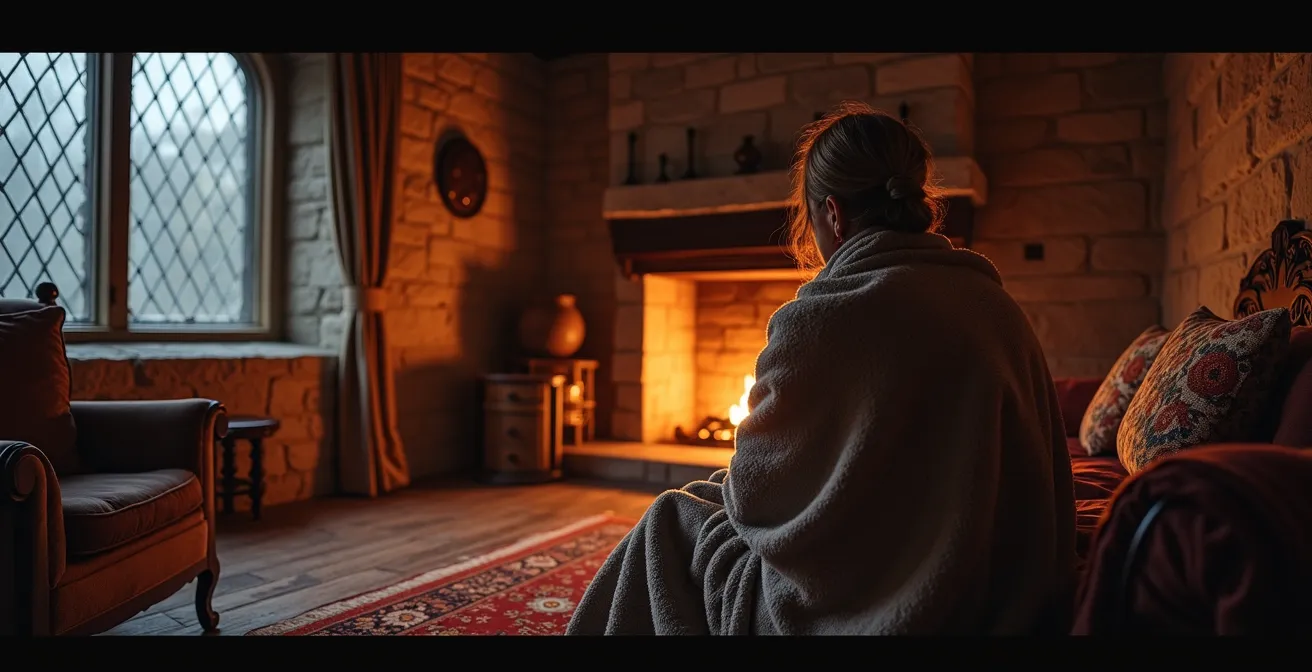
This image captures the romantic ideal, but also hints at the reality. Notice the thick blankets and the reliance on the fireplace for warmth. While incredibly atmospheric, it underscores the importance of managing your expectations for thermal comfort. The charm of frost on the windowpane is best enjoyed from a warm room.
To help you navigate this, consider this scorecard which breaks down the key comfort factors. Before you book your fairy-tale getaway, use these questions to probe the property and understand exactly what kind of experience you are signing up for.
| Factor | Authentic Castle Experience | Modernized Castle Hotel | What to Ask Before Booking |
|---|---|---|---|
| Heating | Fireplace only, cold corridors | Central heating throughout | Are all rooms centrally heated? |
| Plumbing | Bathroom down the hall | En-suite facilities | Distance to nearest bathroom? |
| Accessibility | Spiral staircases, uneven floors | Elevators, modern standards | Are there ground floor rooms? |
| Wi-Fi | Limited or none | High-speed throughout | Is this a digital detox property? |
| Ghost Stories | Part of the experience | Marketed as features | Any reported paranormal activity? |
A stay in a drafty castle can be a magical, story-worthy adventure, but only if you go in with your eyes open and a very warm pair of socks.
Which Niche Websites List These Alternative Lodgings?
Once you’ve decided on the *type* of unique experience you want, the next challenge is finding and booking it. Mainstream platforms like Booking.com and Airbnb have made inroads into this space, but the truly special and unusual properties are often found on smaller, niche websites. These platforms are curated by enthusiasts and specialists who understand the specific community covenants of each lodging type. A site dedicated to monastery stays, for example, will provide more relevant details about prayer times and curfews than a generic booking engine ever could. The key for the resourceful traveler is knowing which of these specialized platforms to trust.
Navigating this world of niche booking sites requires a healthy dose of skepticism and a good checklist. The passion of the platform’s founder doesn’t always translate to secure payment gateways or robust customer support. Before you enter your credit card details, you need to do some due diligence. Look for signs of a professional operation: secure HTTPS connections, clear host verification processes, and a good volume of recent reviews. One of the most effective ways to gauge a platform’s reliability is to test its customer support with a pre-booking inquiry. A quick, helpful response is a great sign; silence is a major red flag. Platforms like Monastery Stays or Good Night and God Bless have built reputations over years, precisely because most individual monasteries lack their own booking systems.
To help you match your travel intent with the right platform, this table categorizes some of the most reliable niche players in the alternative lodging space. Think of it as your little black book for finding everything from a spiritual retreat to a historic castle.
| Traveler Type | Recommended Platforms | What They Offer |
|---|---|---|
| Spiritual Seeker | Monastery Stays, Good Night and God Bless | Websites that help book monastery stays, as most lack their own booking sites |
| Skill Builder | Workaway, HelpX, WWOOF | Work exchange programs on organic farms |
| Eco-Conscious | Bookitgreen, Ecobnb | Verified sustainable accommodations |
| History Buff | Historic Hotels of Europe, Pousadas.pt | Castles, monasteries converted to hotels |
| Budget Traveler | Trusted Housesitters, Couchsurfing | Free or low-cost accommodation options |
The Trust Checklist for Niche Booking Sites
- Verify secure payment gateways: Look for HTTPS in the URL and be wary of sites that only request direct bank transfers.
- Check host verification processes: Legitimate sites should have a system for verifying property ownership and host identities.
- Assess review volume and recency: Look for properties with at least a handful of recent reviews (posted within the last 6 months).
- Test customer support responsiveness: Send a test inquiry with a question before you book to see how quickly and helpfully they respond.
- Research the platform’s history: Established sites with a long track record are generally more reliable than brand-new ones.
By using these specialized platforms, you’re not just finding a room; you’re tapping into a community of like-minded travelers and hosts, dramatically increasing your chances of finding the perfect, authentic experience.
Guided Retreat or Solo Cabin: Which Is Better for Mental Clarity?
The quest for mental clarity often leads us to seek solitude, but the form that solitude takes can dramatically shape its effectiveness. The choice between a structured, guided retreat and a solitary stay in a remote cabin is not a matter of which is “better,” but which is better for *you*, right now. This is a crucial decision in intentional lodging. Are you seeking the supportive framework of a guided experience to navigate a specific stressor, or do you need the unstructured freedom of a solo sojourn to foster a creative breakthrough? Understanding your goal is the first step to choosing the right environment.
A guided retreat, whether focused on yoga, meditation, or wellness, offers a powerful community covenant of shared purpose. You are surrounded by others on a similar journey, and the schedule, meals, and activities are all designed to support a collective goal. This can be incredibly effective for dealing with acute stress or learning a new practice. In contrast, a solo cabin in the woods offers a covenant of pure self-reliance. There is no schedule but the one you create, no guide but your own intuition. This is ideal for deep creative work, long-form journaling, or simply reconnecting with your own inner rhythm without external influence.
Interestingly, a hybrid model is emerging, offering the best of both worlds. A fascinating example is Le Couvent des Minimes, a converted 17th-century convent in France. It offers guests spacious, private rooms for solitude, complemented by a massive 7,500-square-foot L’Occitane spa. Guests can choose their level of engagement, combining the privacy of a solo stay with the optional, structured healing activities of a world-class wellness retreat. This model acknowledges that sometimes, the path to clarity requires both quiet introspection and expert guidance.
Your Preparation Checklist for a Mental Clarity Retreat
- Pre-trip journaling: Take time to document your intentions. What specific clarity are you seeking from this time away?
- Digital detox prep: Set your out-of-office messages, inform key contacts, and download any offline maps, music, or books you’ll need.
- Match retreat type to your goal: Choose a guided retreat for managing acute stress or learning new skills; opt for a solo stay for creative breakthroughs.
- Pack mindfully: Bring comfortable clothing, a journal, and any personal items for reflection. Intentionally leave work laptops and other distractions at home.
- Plan for integration: Schedule a buffer day or two after your retreat to ease back into your routine and integrate the insights you’ve gained.
Whether you choose the supportive structure of a group or the radical freedom of solitude, the most important step is to choose with intention. Define what “mental clarity” means to you at this moment, and then find the lodging that provides the perfect container for that discovery.
How to Verify If a Hotel Runs on Solar or Diesel Generators?
For the eco-conscious traveler, a lodge’s “green” claims are as important as its thread count. But in the world of remote and unique accommodations, “off-grid” can mean two very different things: a sustainable haven powered by the sun and rain, or a noisy, fume-filled compound reliant on a diesel generator. The community covenant of a true eco-lodge is one of deep respect for its environment, a promise that often requires a bit of remote sleuthing to verify. How can you tell if the lodge you’re eyeing truly runs on solar or is just “greenwashing” its diesel habit?
The first step is to become a digital detective. Tools like Google Maps are invaluable. Switch to the satellite view and zoom in on the property’s roof. Are there visible solar panels or a small wind turbine? Look for large water collection tanks. Use the Street View feature, if available, to get a ground-level perspective. These visual clues are often more reliable than the marketing copy on a website. Many properties are proud of their infrastructure and will feature it in their photo galleries. If they don’t, it might be a red flag. A great example of a region that promotes this transparency is Slovenia, where a growing family of accommodations are part of the Slovenia Green labeled accommodations program, which sets clear standards.
If visual evidence is inconclusive, don’t be afraid to ask direct questions. A truly sustainable host will be happy to talk about their systems. Ask about their water source, their waste management practices, and, crucially, their energy generation. A key question is: “Do you have specific hours for electricity?” A lodge that limits power to certain hours is often running a generator, while a solar-powered one typically offers electricity 24/7, weather permitting. Look for third-party certifications, which act as an independent audit of a property’s claims.

This image of raindrops on a solar panel, with the forest reflected in its surface, captures the essence of a truly integrated eco-lodge. It’s a reminder that the best technology is that which works in harmony with nature, not in opposition to it.
Your Remote Sleuthing Checklist for Eco-Verification
- Use Google Maps satellite view to spot physical infrastructure like solar panels, wind turbines, or large water tanks on the property.
- Check Google Street View for a ground-level perspective of any visible renewable energy systems.
- Ask the host directly about their water source, waste management system, and especially their hours of energy generation.
- Look for credible third-party eco-certifications, like the Slovenia Green label or other recognized national or international standards.
- If sustainability features aren’t visible in their online gallery, request photos. A proud eco-host will be happy to share them.
By taking these extra steps, you’re not just booking a room; you’re casting a vote for a more sustainable and honest form of tourism.
Key takeaways
- The best unique stays are defined by a “community covenant”—the rules, rhythms, and trade-offs you accept when booking.
- Authenticity often comes at the cost of modern convenience; be prepared for trade-offs like drafty castles or work requirements on farms.
- Vetting your choice is crucial, whether it’s by asking a castle host about heating or using Google Maps to verify an eco-lodge’s solar panels.
How to Practice Shinrin-Yoku (Forest Bathing) in Ancient Forests?
The Japanese practice of Shinrin-yoku, or “forest bathing,” is more than just a walk in the woods. It’s a profound, meditative experience of immersing your senses in the atmosphere of the forest. To truly practice Shinrin-yoku, your choice of lodging is paramount. It should not be a distant base you commute from, but an integrated part of the experience itself. The ideal lodging acts as a seamless transition between the human world and the natural world, a place where the forest is not a view, but an extension of your living space. This is a community covenant with nature itself.
Lodgings designed for this purpose are often architectural marvels in their own right, built to enhance, not dominate, the surrounding environment. A striking example is Granö Beckasin in Swedish Lapland. Their “Bird Nests” are essentially luxury treehouses built from sustainable materials, nestled high in the pine trees. With expansive river views by day and skylights for stargazing at night, they are available year-round, offering a cozy, insulated perch from which to observe the forest in all its seasons. This type of accommodation becomes your sensory portal to the forest, making the practice of Shinrin-yoku an all-day affair, not just a scheduled activity.
But you don’t need a designer treehouse to practice forest bathing. The principles of Shinrin-yoku are adaptable to any natural setting adjacent to your unique lodging. You can practice mindful walking between the rows of an orchard at a farm stay, use the walled garden of a monastery for sensory meditation, or adapt the techniques to a shoreline walk from a coastal lodge. The key is to slow down, disconnect from technology, and engage all five senses: notice the play of light through the leaves, listen to the subtle sounds of the undergrowth, smell the damp earth, feel the texture of bark, and even taste the clean air. Some eco-lodges even have certified Forest Therapy guides on staff to help you deepen your practice.
A Guide to Adapting Forest Bathing to Any Setting
- Farm orchards: Use the structured rows of fruit trees for a mindful walking meditation at sunrise or sunset.
- Monastery gardens: Leverage the peace and quiet of enclosed gardens for focused sensory meditation exercises.
- Coastal lodges: Adapt the techniques to shoreline walks, focusing on the rhythm of the waves and the details of tide pools.
- Look for hosts who are certified Forest Therapy guides; they can offer a deeper, more structured experience.
- Download a self-guided app like ‘Forest Bathing Finder’ if you are new to the practice and staying in a solo location.
By choosing your lodging with this intention, you transform your trip from a simple vacation into a deeply restorative journey, allowing the forest to be not just a place you visit, but a state of being you inhabit.