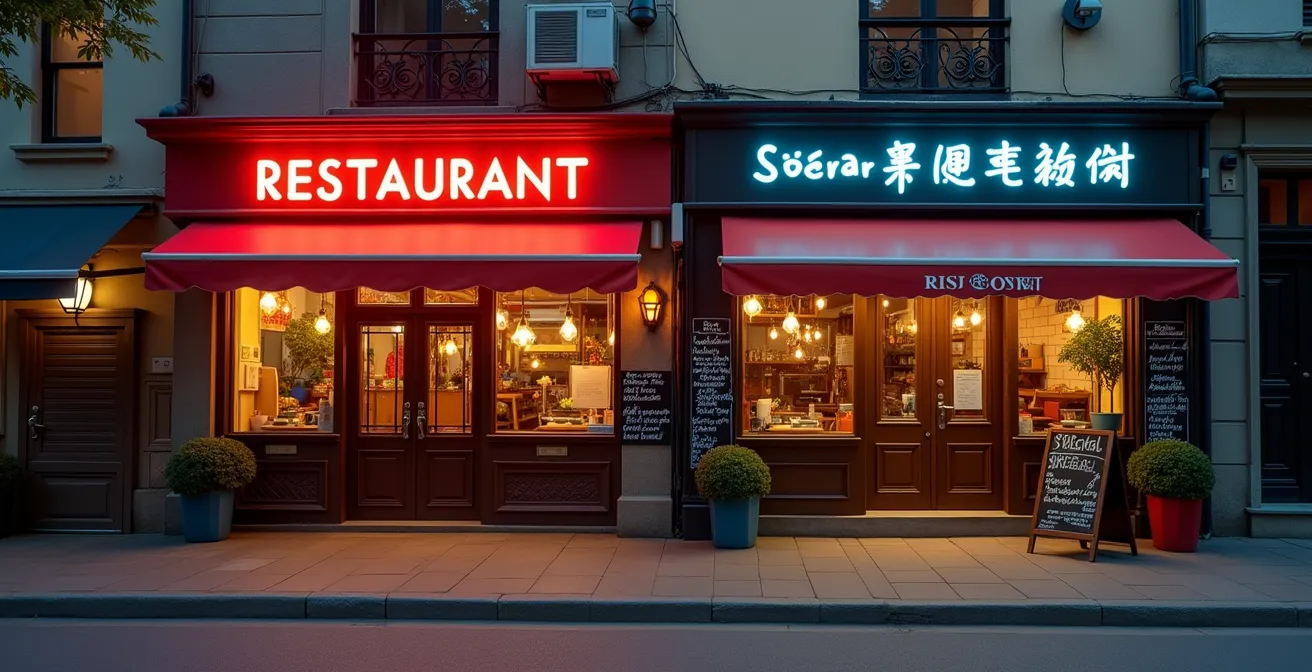
You might think spotting a tourist trap is about avoiding bad food. That’s a mistake. These establishments aren’t just lazy; they are sophisticated operations running a specific playbook to part you from your money. This isn’t about luck; it’s about recognizing the psychological engineering and operational tactics designed to lure you in. Once you see the machinery behind the facade, you can’t unsee it, and you’ll never fall for the game again.
The feeling is universally dreaded. You’re hungry, in a beautiful, unfamiliar city, and you settle into a charming-looking restaurant. But as the meal progresses, a sinking realization dawns: the food is mediocre, the bill is inflated, and the “authentic” experience feels hollow. You’ve been had. Most travel advice offers a simple checklist of red flags: menus with pictures, aggressive hosts, prime locations. While correct, this advice barely scratches the surface. It tells you what to avoid, but not why these signs are infallible indicators of a system designed to exploit you.
These restaurants operate on a business model that has nothing to do with culinary passion or return customers. It’s a high-volume, low-quality churn built on a transient clientele. But what if the key wasn’t just avoiding the obvious traps, but understanding the operational playbook behind them? What if you could learn to deconstruct their “theatrics of authenticity” and see the manufactured experience for what it is? This is not a guide to finding a good restaurant; this is a field manual for identifying a bad one by exposing its inner workings, from the psychology of its menu design to the economics of its location.
This article will dissect the anatomy of the tourist trap. We will explore the specific tactics they use, the financial incentives that drive them, and the subtle cues that differentiate a genuine local spot from a carefully crafted performance. By the end, you won’t just be a tourist looking for a meal; you’ll be an analyst, capable of navigating any city’s culinary landscape with confidence.
Summary: Deconstructing the Tourist Trap Playbook
- Why Photos of Food on the Menu Are a Major Red Flag?
- How to Handle “Touts” Who Try to Drag You Into Shops?
- The “Piazza Premium”: How Much Extra Do You Pay for the View?
- The “Authentic” Signs That Actually Mean “Manufactured for You”
- The “One Block Over” Rule: How Far to Walk to Find Real Prices?
- The Customs Trap: Which Spices Are Confiscated at the Border?
- The Signs of a “Tourist Trap” Tour That You Must Cancel Immediately
- How to Eat Street Food Anywhere Without Getting Sick?
Why Photos of Food on the Menu Are a Major Red Flag?
A glossy, laminated menu filled with vibrant pictures of food isn’t a helpful guide; it’s a confession. In the restaurant industry, this is the clearest signal that the establishment has prioritized marketing over cooking. A real kitchen, run by a chef proud of their craft, operates on fresh, seasonal ingredients. Their menu is small, changes often, and is written for an audience that trusts the words. A picture menu, by contrast, is a fixed contract. It promises a dish will look exactly the same in August as it does in February, a feat only possible with a freezer and a microwave. As travel expert Rick Steves bluntly puts it, these photos often mean there isn’t even a functioning kitchen on-site, just an assembly line for reheating pre-made, frozen meals.
This is the first page of the operational playbook: remove the variability and skill of a real chef and replace it with a foolproof, low-cost system. The high-gloss glamour shots are not there to inform, but to persuade. They target a diner who doesn’t speak the language and is making a decision based on pure visual appeal, not on quality. The menu becomes a booklet-sized visual trap, often with the same core ingredients reappearing under different names. It’s a classic sign of an operation that doesn’t expect you to come back; they just need to get you in the door once.
Think of it as a business that sells pictures of food, and the plate you receive is merely merchandise. A place confident in its product doesn’t need to show you a photo; you can smell the quality from the street.
How to Handle “Touts” Who Try to Drag You Into Shops?
You’re walking down a picturesque cobblestone street when a friendly host appears, menu in hand, blocking your path. “My friend, best table for you! Free drink!” This isn’t hospitality; it’s a form of psychological coercion, and it’s the second major tell of a tourist trap. A quality restaurant is a destination, not an interception. They don’t need to employ touts because their reputation, aroma, and the sight of happy diners are their only required salespeople. As one travel blog astutely observes, the logic is simple:
If a restaurant’s food, atmosphere, and service really are superior, it will show. You’ll smell the enticing aromas, and you’ll see a lively dining room full of satisfied, smiling patrons. No usher necessary!
– Maddy’s Avenue Travel Blog, How to Avoid Tourist-Trap Restaurants in Europe
The tout’s job is to break your momentum and engage you. Travel experts analyzing their tactics note that they employ strategies ranging from persistent verbal engagement to physically attempting to guide you in. The “free” offer is bait, often appearing on the bill later under a vague “service charge.” Handling them requires a firm, pre-planned strategy. The most effective method is to treat them as an environmental obstacle, not a person to engage in conversation with. Avoid eye contact, maintain your walking pace, and use a simple, universally understood hand gesture of refusal without breaking stride. Any hesitation or polite engagement is seen as an opening.
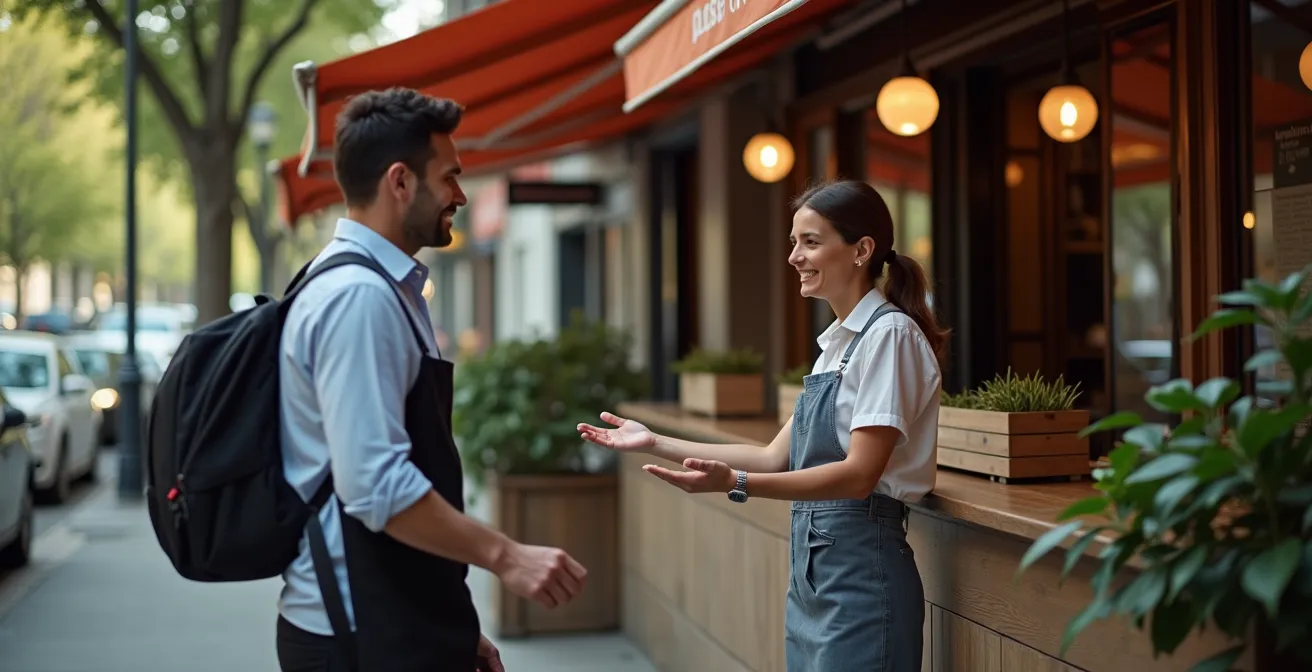
The image above captures the essence of this interaction. It’s a battle of wills played out in body language. The savvy traveler keeps their eyes forward, their posture purposeful, and their direction unwavering. You are not being rude; you are refusing to participate in a transaction that is, by its very nature, designed against your best interests. Your silence is the most powerful response, communicating clearly that you are not a potential mark.
Remember, a great meal is never at the end of a desperate sales pitch.
The “Piazza Premium”: How Much Extra Do You Pay for the View?
The restaurant with the perfect, unobstructed view of the Colosseum, the Eiffel Tower, or the main city square is selling real estate, not food. This prime location comes at an enormous cost in rent, and that cost is passed directly on to you in what’s known as the “Piazza Premium.” These establishments know that a constant stream of tourists will pay for the photo opportunity, regardless of the quality of the food. They can afford to serve overpriced, microwaved lasagna because their target customer is a one-time visitor who is buying the view first and the meal second. This business model is incredibly lucrative, fueled by a market where visitors are a significant source of revenue. In fact, research reveals that 41% of fine dining restaurant sales come directly from travelers and visitors.
The playbook is simple: secure the best location, charge a premium for it, and cut corners on everything else. The quality of the ingredients, the skill of the chef, and the attentiveness of the service become secondary concerns. You are paying for the seat, and the food is merely an accessory to the experience. The savvy traveler, however, knows how to hack this system. You can have the view without falling for the trap.
The most effective strategy is to decouple the experience. Go to the beautiful piazza cafe, order a single coffee or aperitif, take your photos, and soak in the atmosphere. Then, when you’re ready for a real meal, walk away. By treating the premium-view establishment as a bar, you get the benefit without paying the full price of the manufactured dining experience. A good meal at a fair price is almost always just a few streets away, where the rent is lower and the restaurants have to compete on quality to survive.
Never let a great view convince you to eat a bad meal. The two are rarely found in the same place.
The “Authentic” Signs That Actually Mean “Manufactured for You”
The most insidious tourist traps are not the overtly tacky ones, but those that have mastered the theatrics of authenticity. They have learned what tourists *think* an authentic experience looks like and have created a perfect replica. These are the places with carefully distressed wooden signs, servers in “traditional” costumes, and, most tellingly, large signs in English boasting “No Frozen Food” or “Family Recipe.” As travel expert Rick Steves points out, a truly authentic restaurant with fresh ingredients doesn’t need to advertise it. Their small, handwritten, single-language menu and the crowd of locals inside are all the proof they need. A sign shouting about freshness is a desperate attempt to sound authentic, which is the most inauthentic thing a restaurant can do.
This is a performance, manufactured for an audience. According to a study analyzed by HuffPost, the top criteria for a tourist trap are above-average pricing, amenities tailored for tourists, and a glaring lack of cultural authenticity. These “authentic” signs are a prime example of an amenity tailored for tourists—they are designed to assuage the specific fear of a traveler, not to reflect the reality of the kitchen.

The difference is in the details. Genuine authenticity is found in the worn patina of a well-used table, the subtle imperfections of a hand-thrown ceramic plate, or a menu that reflects what was good at the market that morning. Manufactured authenticity is a perfect, repeatable, and heavily marketed illusion. It feels like a movie set because, in an operational sense, it is. The goal is to create a compelling story that justifies the high prices, even when the food itself is an afterthought.
Remember, authenticity whispers; it doesn’t shout in block letters.
The “One Block Over” Rule: How Far to Walk to Find Real Prices?
There’s a simple, almost magical, rule for escaping the gravitational pull of a tourist trap zone: walk. The “One Block Over” rule—or, more accurately, the “Three Blocks Over” rule—is the single most effective strategy for finding authentic food at local prices. The economic geography of tourism is stark. The highest rents and the most aggressive traps cluster around major attractions. But this “tourist bubble” has a surprisingly sharp edge. As you walk away from the epicenter, the entire economic model changes. Restaurants can no longer survive on a one-time stream of visitors; they need to build a loyal local clientele. This forces them to compete on quality, service, and price.
Travel guru Rick Steves lives by this principle, stating his method is to “go three blocks away [and] find a little no-name place on a low-rent location, thriving with an enthusiastic local clientele.” The question is, which direction to walk? The key is to navigate away from the tourist flow and toward the rhythm of local life. Walk until the souvenir shops are replaced by hardware stores, laundromats, and bakeries. Head toward universities, libraries, or neighborhood parks—places where real people live and work. This is where you’ll find the spots that are busy at local mealtimes, not just during peak tourist hours.
Your Action Plan: The 3-Block Escape Strategy
- Map It Out: Use a digital map to drop a pin on the main attraction. Then, manually scan the area three to five blocks away, specifically looking for streets that are not main thoroughfares.
- Read the Street Signs: Walk until the businesses change. When you see a dry cleaner, a butcher shop, or a local-language-only bookstore, you know you’ve exited the tourist zone and entered a real neighborhood.
- Follow the Hubs: Navigate toward non-tourist hubs. Government buildings, local courts, universities, and residential parks are magnets for authentic, no-nonsense eateries that cater to a daily workforce.
- Verify with Local Voices: When you find a potential spot, check its online reviews. Specifically filter for or focus on reviews written in the local language. These are your most reliable sources.
- Observe Dining Times: A restaurant packed with locals at 1 PM in Spain or 8 PM in Italy is a goldmine. A place that is empty at local mealtimes but full at 6 PM is likely waiting for tourists.
The best meal of your trip is often just a five-minute walk from the worst one.
The Customs Trap: Which Spices Are Confiscated at the Border?
The search for authenticity doesn’t end with a meal; it often extends to bringing a piece of the local flavor home with you. Aromatic spices from a bustling market seem like the perfect souvenir, but this can lead you straight into the “Customs Trap.” Many travelers are unaware that border protection agencies have strict biosecurity rules to prevent the introduction of foreign pests and diseases. Bringing back the wrong type of spice can result in its confiscation and a potential fine. The risk isn’t the spice itself, but what it might be carrying.
The key differentiator is processing. Commercially packaged, sealed, and clearly labeled dried spices are almost always permissible. The danger lies with unprocessed, “fresh from the farm” items. Whole roots, fresh leaves or stems (like curry leaves), or anything containing viable seeds can be flagged as high-risk agricultural products. Citrus products, including dried peels or leaves, are often prohibited from many countries due to the risk of spreading devastating citrus diseases. To avoid disappointment, you must declare all food items. This declaration rarely leads to confiscation for allowed items but failing to declare can lead to penalties.
The following table, based on general guidance from travel and tourism data, provides a simplified overview of risk categories. However, it’s crucial to research the specific rules for your home country before you buy.
| Risk Level | Examples | Requirements |
|---|---|---|
| Generally Safe | Commercially packaged, dried, sealed spices | Clear labeling required |
| Requires Declaration | Whole roots, unprocessed items | Must declare and undergo inspection |
| High-Risk/Forbidden | Viable seeds, fresh leaves/stems, citrus products | Usually confiscated at border |
The most authentic souvenir is one you’re actually allowed to bring home.
The Signs of a “Tourist Trap” Tour That You Must Cancel Immediately
The tourist trap restaurant doesn’t always operate alone. It is often a key component in a larger, symbiotic ecosystem involving organized tours. You might be on a day trip, herded by a guide to a seemingly charming, pre-selected restaurant for lunch. This is rarely a choice based on quality; it’s a business transaction. Chef Okan Kizilbayir describes this as the “circle of life” for tourist traps: tour guides deliver busloads of customers in exchange for kickbacks. The restaurant, guaranteed a high volume of one-time customers, has zero incentive to produce quality food. This model is fueled by the significant portion of travel budgets allocated to dining; according to National Restaurant Association data, a substantial part of tourist spending, sometimes estimated between 25% and 35%, goes to restaurants.
Since the food is an afterthought, these establishments compensate with what the chef calls “bombastic presentations.” This is the theatrics of authenticity turned up to eleven. Expect sparkly candles on desserts, loud, intrusive music, servers in elaborate costumes, and other grand gestures designed to create a “memorable” experience that distracts from the subpar meal. The goal is for you to leave with a great photo and a fun story, completely forgetting that the chicken was dry and the pasta was bland. The tour guide gets their commission, the restaurant gets its high-margin revenue, and you, the tourist, get a bad meal disguised as a party.
The red flags are clear. If your tour guide is overly enthusiastic about one specific restaurant, if the stop feels mandatory, or if the restaurant’s atmosphere feels more like a stage show than a dining room, you are likely in a trap. Another major sign is a lack of choice. If everyone on the tour is eating from the same limited, fixed-price menu, it’s a clear indication of a mass-catering operation. The best defense is to ask questions beforehand. Inquire about the lunch arrangements for any tour you book. If the answer is vague or points to a single, mandatory stop, consider it a deal-breaker or plan to opt-out and find your own food.
Don’t let your day trip become a forced march to a bad meal. Your time and money are more valuable than a tour guide’s commission.
Key Takeaways
- Tourist traps are not just bad restaurants; they are systems running a specific operational playbook based on location, psychology, and theatrics.
- The most reliable signs of a trap are not just what you see (picture menus, touts) but what you don’t see (locals, small seasonal menus).
- The most powerful counter-strategy is physical movement: walking three blocks away from a major attraction drastically increases your chances of finding authentic, fairly-priced food.
How to Eat Street Food Anywhere Without Getting Sick?
After deconstructing the elaborate traps of manufactured restaurants, the most authentic and exhilarating culinary experience often lies in the complete opposite direction: street food. Here, there are no hidden kitchens or fancy theatrics. The entire operation is transparent, but this transparency comes with its own set of rules for safety. Getting sick from street food is not a matter of bad luck; it’s a failure to perform a quick but crucial hygiene audit. The key is to trust your eyes and follow the locals, not your guidebook.
The first thing to assess is the vendor’s process. The single most important checkpoint is the separation of money and food. A vendor who handles cash and then touches your food without washing their hands or changing gloves is a major red flag. Look for a two-person operation (one for money, one for food) or a vendor who meticulously uses gloves or tongs. Observe their workspace: are there separate cutting surfaces for raw meat and cooked items? Does the cooking oil look clean and fresh, or is it a dark, repeatedly used sludge? Finally, ensure your food is cooked to order and served piping hot. High heat is your best defense against bacteria. A vendor serving pre-cooked food that’s been sitting in a warmer is a risk.
Beyond the vendor themselves, pay attention to the water. Food safety experts warn of hidden water-borne risks. Ice in your drink, pre-cut fruit that may have been washed in contaminated water, fresh salads, and uncooked sauces like salsas can all be sources of trouble. The safest path is to stick to foods cooked at high temperatures right in front of you, fruits that you peel yourself (like bananas or oranges), and beverages from a sealed bottle or can. The ultimate sign of a safe vendor, however, is a long line of locals—especially office workers, students, and taxi drivers. These are people who eat there daily and cannot afford to get sick. Their repeat business is the most reliable certification a street food stall can have.
The final step in avoiding the tourist trap is to embrace its antithesis: the honest, transparent, and delicious world of street food, armed with the knowledge to do so safely.