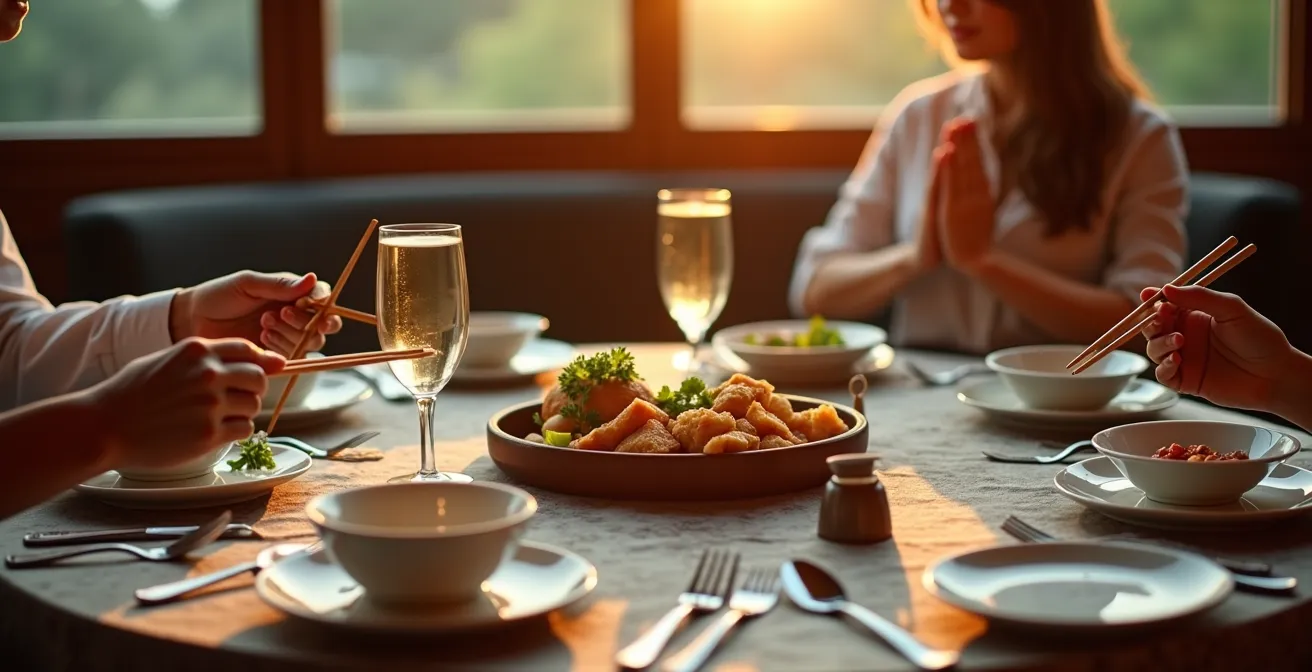
Contrary to popular belief, mastering foreign dining etiquette isn’t about memorizing endless rules, but about understanding the ‘cultural grammar’ that shapes a meal.
- The logic behind tipping, sharing food, and even dinner times is rooted in deep-seated social contracts and historical context, not arbitrary customs.
- Observing local behaviors, like pre-dinner rituals or the use of serving utensils, provides more insight than any rulebook.
Recommendation: Focus on showing respect and a willingness to learn—by asking questions and engaging in reciprocity—which is more valuable than perfectly executing every local custom.
The anxiety is familiar to any seasoned traveler: a shared platter arrives, and you’re unsure which utensil to use. A bill comes, and the complex calculus of tipping begins. You’re offered a dish you cannot eat, and you search for the words to refuse without causing offense. In these moments, we realize that a meal is far more than sustenance; it is a complex social performance, rich with unspoken rules and potential pitfalls. Many guides offer lists of dos and don’ts, a patchwork of advice that is difficult to remember and apply. You might learn not to stick your chopsticks upright in rice in Japan or to use your right hand to eat in the Middle East, but these are isolated facts.
But what if the key wasn’t memorizing a dictionary of rules, but learning the language itself? The real challenge for the culturally curious traveler is to move beyond simply avoiding offense and toward genuine understanding. This requires a shift in perspective. Instead of seeing etiquette as a set of arbitrary commands, we can view it as a form of cultural grammar—a logical system built on shared history, social values, and even philosophies of hygiene. Understanding this grammar allows you to deduce the correct action in a new situation, rather than frantically searching your memory for a specific rule.
This guide is designed to teach you that grammar. We will deconstruct the social machinery behind the meal, exploring the deep logic that dictates customs around the world. By examining the ‘why’ behind the ‘what,’ you will gain the confidence to not only navigate any dining situation with respect but also to transform every meal into a profound opportunity for cultural immersion.
This article explores the core components of this cultural grammar, from the economics of tipping to the rituals of gift-giving. The following sections will provide you with the anthropological tools to read the table like a local, ensuring your dining experiences are enriching, not embarrassing.
Summary: The Cultural Grammar of Global Dining Etiquette
- Why Tipping Is Insulting in Japan but Mandatory in the USA?
- How to Share Food “Family Style” Without Breaking Hygiene Norms?
- Authentic Recipe or Tourist Version: How to Spot the Difference?
- The Offense of Refusal: How to Say No to Food You Can’t Eat?
- When to Eat Dinner: Why Dining at 6 PM Marks You as a Tourist?
- When Translation Apps Fail: Avoiding Cultural Insults in Translation
- The Right Gift to Bring Your Host Family in Different Cultures?
- How to Experience True Cultural Immersion Without Being Intrusive?
Why Tipping Is Insulting in Japan but Mandatory in the USA?
The act of tipping is one of the most confusing and emotionally charged aspects of international dining. It’s a perfect example of how an action considered polite in one culture is offensive in another. The difference isn’t arbitrary; it reflects two fundamentally different social contracts between the customer, the server, and the establishment. In the United States, the tip is a core part of a server’s income. The menu price covers the food, but the tip covers the service. Not tipping is, in effect, a refusal to pay for a service rendered. This system is so entrenched that the USA is the only country where a 20% tip is standard.
In stark contrast, in countries like Japan and South Korea, excellent service is considered a standard, integral part of the dining experience, and its cost is already built into the menu prices. Staff are paid a full living wage, independent of customer gratuities. In this context, leaving extra money can be seen as implying that the server is not well-paid by their employer or that the establishment’s pricing is inadequate. It can create a sense of awkwardness or even be perceived as a mild insult—a gesture of pity rather than appreciation. According to a global tipping analysis, while 66 countries expect a tip around 10%, the zero-tipping philosophy remains strong in several East Asian nations.
Navigating this requires looking for clues. In many European countries, check the bill for phrases like “service compris” or “servizio incluso,” which indicates the service charge is already included. If it isn’t, a smaller tip of 5-10% or rounding up the bill is common practice. The key is to understand that you’re not just leaving money; you’re participating in a local economic and social system. Your action has a meaning defined by that system, not by your own cultural habits.
How to Share Food “Family Style” Without Breaking Hygiene Norms?
Communal dining, or “family style,” is a beautiful expression of community, but it brings with it a complex set of rules governed by a culture’s specific hygiene philosophy. What seems clean and normal in one place can be seen as highly unhygienic in another. In most Western cultures, the rule is absolute: shared dishes are served with dedicated serving spoons and forks. Using your personal cutlery to take food from a communal platter is a major faux pas, seen as transferring saliva and germs to the shared food.
This paragraph introduces the concept of communal dining etiquette. To understand the different cultural approaches visually, the illustration below highlights the proper use of serving utensils.
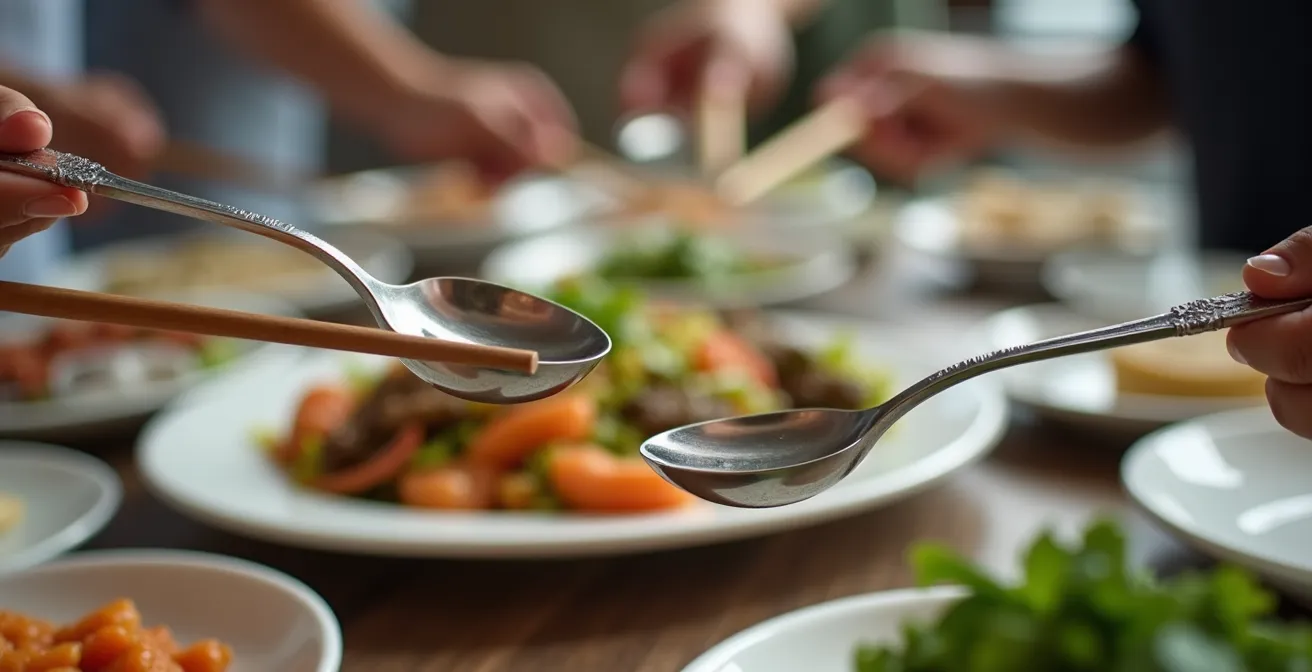
As this image suggests, maintaining a separation between personal and communal utensils is key. However, other cultures have different solutions. In many East Asian contexts, as detailed in an explanation of Chinese restaurant etiquette, diners are expected to flip their chopsticks around and use the clean, wider end to transfer food from the platter to their personal bowl. This clever method maintains hygiene without cluttering the table with extra utensils. In other cases, a separate pair of “gong kuai” (serving chopsticks) is provided. In Ethiopia, diners eat from a large communal platter of injera (a sourdough flatbread), but the rule is to only take food from the section of the platter directly in front of you, respecting the personal space of others.
Understanding these variations is crucial. The underlying principle is universal—preventing the transfer of germs—but the method is culturally specific. Observing and adapting to the local method shows you respect not just the food, but the health and comfort of your dining companions.
This table breaks down some of the common approaches to communal dining across different regions, illustrating the diversity of hygiene philosophies at the table.
| Culture/Region | Serving Method | Key Rule |
|---|---|---|
| Western | Dedicated serving utensils | Never use personal cutlery for shared dishes |
| East Asian | Flip chopsticks or serving spoons | Use clean end of chopsticks for communal plates |
| Ethiopian | Direct from injera platter | Take only from section directly in front of you |
| Mediterranean | Serving spoons provided | Take smaller portions first, can return for seconds |
Authentic Recipe or Tourist Version: How to Spot the Difference?
One of the greatest joys of travel is tasting a dish in its place of origin. But how can you be sure you’re eating the real deal and not a watered-down version designed for tourists? The difference often lies in the complexity, spice level, and inclusion of “challenging” ingredients that locals love but foreigners might find intimidating. Tourist-focused restaurants often sweeten savory dishes, reduce spice, and remove ingredients like offal, fermented elements, or strong-smelling herbs to appeal to a broader, less adventurous palate. They are also typically located near major landmarks, feature menus in multiple languages with glossy photos, and have staff beckoning you from the street.
Finding authenticity requires becoming a temporary cultural anthropologist. It’s about looking for the subtle signals that indicate a restaurant serves a local clientele. The most reliable method is the “Worker’s Lunch Strategy.” Locals, especially during their workday lunch, prioritize three things: authenticity, speed, and value. They don’t have time for tourist traps. A restaurant packed with people in work uniforms or business attire between 12 PM and 2 PM on a weekday is one of the best indicators of authentic, high-quality local food. These establishments often have a high table turnover rate, as locals eat efficiently before returning to work.
Another key is to observe the menu itself. A short, handwritten menu, perhaps only in the local language, that changes daily is a golden sign. It suggests the chef is cooking with fresh, seasonal ingredients, rather than relying on a large, static menu of frozen staples. By venturing a few blocks away from the main tourist squares and looking for these signs, you trade convenience for a much more rewarding and genuine culinary experience.
Action Plan: The “Worker’s Lunch” Strategy for Finding Authentic Food
- Location Scout: Search for restaurants at least a kilometer away from major tourist attractions, in residential or business districts.
- Clientele Analysis: Look for establishments packed with locals during weekday lunch hours (12-2 PM), especially those in work attire.
- Menu Inspection: Prioritize places with short, handwritten daily menus, ideally only in the local language.
- Ingredient Check: Observe if the dishes on offer contain challenging or specific ingredients that locals appreciate but tourists often avoid (e.g., specific herbs, offal, fermented products).
- Ambiance Audit: Listen for animated conversations in the local language and notice if there’s a high table turnover rate, indicating efficiency and popularity.
The Offense of Refusal: How to Say No to Food You Can’t Eat?
Being offered food is a universal gesture of hospitality and generosity. Refusing that offer, therefore, can be one of the most delicate social maneuvers a traveler has to perform. In many cultures, sharing food is a primary way of showing care and respect, and a refusal can be interpreted as a rejection of the host themselves, not just the dish. This is especially true if the host has gone to great expense or effort to prepare something special for you. A flat “No, thank you” can feel cold and ungrateful, creating an awkward and potentially offensive situation. Forgetting to finish everything on your plate can also send mixed signals; in some countries, it means you are full and satisfied, while in others, it implies you didn’t enjoy the food or are still hungry.
The key to a polite refusal is to make it about your limitations, not their food. This is the essence of the “Praise, Deflect, Explain” formula. You must shift the reason for refusal from their offering to your own personal circumstances (e.g., an allergy, a dietary restriction, or feeling unwell). This protects the host’s honor and shows that you would partake if you could.
The process starts with genuine praise: “That looks absolutely delicious!” or “What a beautiful presentation, thank you so much for thinking of me.” This validates their effort. Next, you deflect by explaining your limitation: “Unfortunately, I have a food allergy that prevents me from eating it,” or “My doctor has advised me to avoid this ingredient.” Finally, you express sincere regret: “I am so sorry to miss out on what I’m sure is a wonderful dish.” If the issue is preference rather than a medical necessity, the best strategy is to accept a very small “token” portion, try a single bite, and compliment it. The most effective strategy of all is pre-emptive: inform your host of any major dietary restrictions when you first accept their invitation.
When to Eat Dinner: Why Dining at 6 PM Marks You as a Tourist?
One of the most immediate signs of a tourist is not what they eat, but *when* they eat. Arriving at a restaurant in Madrid or Buenos Aires at 6 PM for dinner will often mean dining in an empty room, catered to by staff preparing for the local rush that won’t start for another three to four hours. The timing of meals is a fundamental rhythm of life, deeply connected to a region’s climate, work culture, and social traditions. It’s a part of the cultural grammar that dictates the flow of the entire day.
In Mediterranean countries like Spain and Italy, the main meal was traditionally eaten in the mid-afternoon, followed by a rest (siesta) during the hottest part of the day. This pushes the evening meal later, often not beginning until 9 or 10 PM. The hours before dinner are filled with social rituals like the Spanish *paseo* (an evening stroll) or the Italian *aperitivo*, a pre-dinner drink with light snacks designed to whet the appetite and socialize. This ritual is a destination in itself, as shown in the scene below.

Conversely, in Nordic countries, the limited daylight hours in winter and an earlier start to the workday mean that dinner is often eaten as early as 5 or 6 PM. In the United States, a standard 9-to-5 workday culture has led to a “happy hour” and dinner time centered around 6 or 7 PM. To dine like a local, you must adjust your internal clock and embrace the local rhythm. Eating at the same time as locals not only helps you find more authentic restaurants (as they will be open and busy) but also allows you to participate in the important social rituals that frame the meal itself.
The following table illustrates how dramatically dinner times and their associated pre-meal rituals can vary, all driven by distinct cultural and environmental factors.
| Country/Region | Typical Dinner Time | Pre-Dinner Ritual | Cultural Reason |
|---|---|---|---|
| Spain | 9-11 PM | Tapas and paseo (evening walk) | Afternoon heat and siesta culture |
| Italy | 8-10 PM | Aperitivo hour (6-8 PM) | Mediterranean climate and social tradition |
| USA | 6-7 PM | Happy hour drinks | Early work finish, longer evening |
| Argentina | 10 PM-midnight | Merienda (late afternoon snack) | Late work hours, social culture |
| Nordic Countries | 5-6 PM | Coffee break (fika) | Limited daylight in winter |
When Translation Apps Fail: Avoiding Cultural Insults in Translation
In an age of powerful technology, it’s tempting to believe a translation app is all you need to bridge a language gap at the dinner table. While incredibly useful for deciphering a menu, relying on them for conversation can be a social minefield. Language is more than words; it’s steeped in context, hierarchy, and politeness. A direct, literal translation often strips away this crucial nuance, leading to communication that can feel blunt, overly familiar, or even disrespectful. The app doesn’t understand the social relationship between you and your host, and this is where it fails.
The most significant issue is the inability of most apps to handle levels of politeness. Many languages, such as Japanese with its complex system of honorifics (*keigo*), have multiple ways of saying the same thing depending on the age, status, and relationship of the speakers. As one traveler noted, an app might translate “thank you,” but it can’t choose the right version to convey the deep respect owed to an elderly host. This was their experience:
A traveler in Japan shared how their translation app couldn’t capture the nuanced levels of politeness (keigo) required in formal dining situations. The app translated ‘thank you’ correctly but failed to convey the appropriate level of formality, making them sound overly familiar to their elderly host, which was considered disrespectful in the context.
The solution is not to discard the tool, but to use it with etiquette and awareness. Instead of holding a stilted, app-mediated conversation, use it as a targeted tool. It’s best for specific nouns (“what is this ingredient?”) rather than complex sentences. A good practice is to ask permission before pulling out your phone and to show the screen to your host, making it a collaborative tool rather than a barrier. Better yet, learn the five most important phrases (please, thank you, delicious, excuse me) in the local language beforehand. Your imperfect, human attempt will almost always be received with more warmth than a perfect, robotic translation.
The Right Gift to Bring Your Host Family in Different Cultures?
Arriving at someone’s home for a meal with a gift is a near-universal sign of appreciation. However, the symbolic value of the gift can vary wildly between cultures, and a well-intentioned present can inadvertently become an offensive one. The world of gift-giving is filled with taboos rooted in superstition, linguistic coincidences, and cultural history. In Chinese culture, giving a clock is a major taboo because the phrase for “giving a clock” (sòng zhōng) sounds identical to the phrase for “attending a funeral.” Similarly, giving sharp objects like knives can symbolize the severing of a relationship in many cultures.
Beyond the object itself, the ritual of presentation and opening the gift is equally important. In the United States, a gift is usually opened immediately with enthusiastic thanks. In many Asian cultures, however, a gift is often set aside to be opened later in private. This is done to avoid appearing greedy and to prevent any potential embarrassment for either the giver or receiver if the gift’s value is misjudged. Presenting a gift with both hands is a common sign of respect in Japan and China, while in the Middle East, it should be given only with the right hand, as the left is considered unclean.
So how do you choose the right gift? The best approach is to move away from generic items like wine or chocolates and select something with personal significance. This is the “Gift from Home Gold Standard.”
Case Study: The “Gift from Home” Gold Standard
Etiquette experts consistently recommend bringing a high-quality item that is specific to your home country or region. An analysis of traveler experiences found that hosts most appreciated thoughtful, region-specific products like artisanal honey from a local farm, a special blend of coffee from a hometown roaster, or a small, handcrafted item. These gifts succeed because they tell a story about who you are and where you come from. They act as conversation starters and demonstrate a level of thoughtfulness and preparation that a generic, last-minute purchase cannot match, making the gesture far more memorable and meaningful.
Key Takeaways
- Dining etiquette is a cultural language based on history and social values, not just random rules.
- Understanding the ‘why’ behind customs (like tipping or sharing food) is more effective than memorizing dos and don’ts.
- The most respectful act is showing a genuine willingness to learn and adapt, even if you make small mistakes.
How to Experience True Cultural Immersion Without Being Intrusive?
True cultural immersion at the dinner table goes beyond simply eating the food and following the rules. It’s about transitioning from a passive observer to a respectful participant. The fear of being intrusive often holds travelers back, causing them to remain quiet and distant. However, the key to bridging this gap lies in a powerful and universal concept: the principle of reciprocity. Your host has offered you food, hospitality, and a window into their culture. The most meaningful way to show your gratitude is to offer something in return, no matter how small.
This doesn’t have to be a material object. Reciprocity can be an offer to help clear the table or wash the dishes after the meal. Even if your host politely refuses, the gesture itself is what matters. It communicates that you see the meal not as a service being provided to you, but as a shared experience between equals. You can also share a part of your own culture. Teach your hosts a simple card game, show them photos of your hometown, or, if appropriate, offer to cook a simple dish from your country on another day. These acts of sharing transform the dynamic from a one-way observation into a two-way cultural exchange.
Curiosity, when framed with humility, is another form of reciprocity. Instead of asking “Why do you eat this?” which can sound judgmental, ask “What is the story behind this dish?” This invites your host to share their knowledge and heritage, positioning them as the expert and you as the eager student. The most powerful phrase in a traveler’s toolkit might just be, “This is new to me, could you please show me the proper way?” As one expert puts it:
Frame admitting you don’t know something as a sign of respect, not weakness.
– Travel Etiquette Expert, 10 Most Fascinating Food Etiquette Rules Around the World
Ultimately, navigating foreign dining is not a test of perfection but an exercise in empathy. By focusing on the cultural grammar behind the rules and embracing a spirit of humble curiosity and reciprocity, you can turn any meal into a moment of genuine human connection.