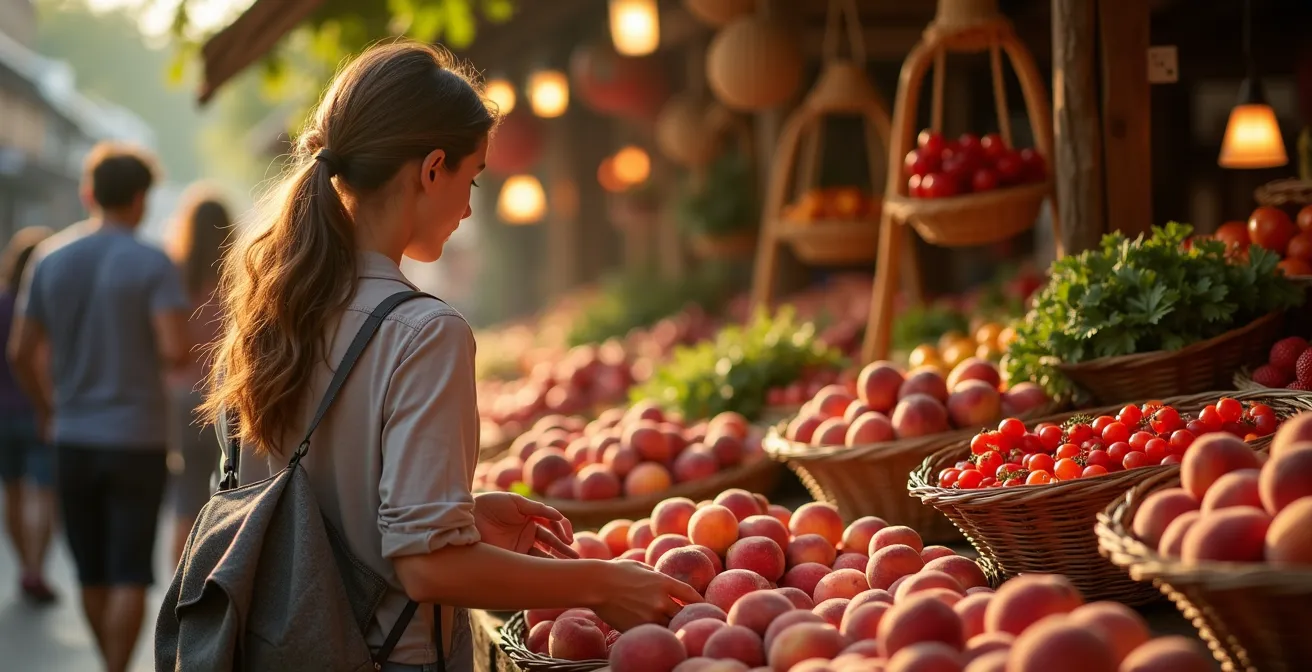
Contrary to popular belief, simply visiting a farmer’s market abroad doesn’t guarantee you’re eating local or seasonal food.
- Many markets and restaurants mix authentic local goods with bland, mass-produced imports that have traveled thousands of miles.
- Without the right skills, you’re likely missing out on the incredible flavor and nutritional benefits of peak-season produce.
Recommendation: The key is to stop being a passive tourist and start acting like a “food detective”—training your senses to spot the subtle clues of authenticity, from the weight of a real tomato to the specific wording on a menu.
There’s a universal moment of disappointment for any food-loving traveler: you’re standing in a vibrant, sun-drenched foreign market, you buy what looks like a perfect, ruby-red tomato, and you take a bite. It’s watery, mealy, and utterly devoid of flavor. How can something that looks so right taste so wrong? This is the paradox of our globalized food system, where looks deceive and the promise of a place’s authentic taste is often a mirage. The common advice—”shop at farmers’ markets” or “eat what the locals eat”—is a good start, but it’s fundamentally incomplete. It doesn’t protect you from the greenhouse-grown impostor or the apple that’s been in cold storage for eight months.
As a chef, my entire philosophy is built on a simple truth: real flavor is born from the earth, under a real sun, at the precise moment nature intended. It cannot be faked in a hothouse or preserved over a 1,500-mile journey. This guide is designed to give you that chef’s advantage. Forget generic lists of what’s in season where. Instead, I’m going to teach you how to see, smell, and taste the difference. We’re going beyond the obvious to build your “food detective” skills. You’ll learn to decode the subtle language of a market stall, read a menu for what it *doesn’t* say, and understand the real environmental cost of your choices. This is about transforming your travels from a series of meals into a delicious investigation, connecting you to the true flavor terroir of every place you visit.
This comprehensive guide will walk you through the essential skills for sourcing and enjoying genuinely seasonal food abroad. From understanding the science of flavor to decoding market stalls and restaurant menus, you will gain the practical knowledge to elevate your culinary travel experiences.
Summary: A Chef’s Guide to Authentic Seasonal Eating Abroad
- Why a Tomato in Season Tastes 10x Better Than a Greenhouse Import?
- How to Spot Imported Fruit disguised as “Local” in Markets?
- Frozen or Fresh Import: Which Is More Eco-Friendly in Winter?
- The Pesticide Risk of Eating Out-of-Season Fruits Abroad
- How to Read a Menu to Spot the Seasonal Specials Instantly?
- How Does Your Dining Choice Affect Your Trip’s Carbon Score?
- When to Visit Night Markets to Get the Freshest Batches?
- How to Buy and Transport Spices Legally and Freshly?
Why a Tomato in Season Tastes 10x Better Than a Greenhouse Import?
That explosive, sweet-yet-tart flavor of a perfect summer tomato isn’t an accident; it’s a direct result of its environment. When a plant grows naturally in its season, it’s engaged in a complex conversation with the sun, soil, and air. The sun’s energy drives photosynthesis, creating the natural sugars (measured in Brix) that give fruit its fundamental sweetness. But flavor is more than just sugar. It’s the intricate tapestry of volatile organic compounds—terpenes, esters, and aldehydes—that create the unique aroma and complex taste profile we associate with “freshness.” A greenhouse tomato, grown under artificial lights and often picked green to survive long-distance shipping, never fully develops this chemical symphony. It has the structure of a tomato, but not its soul.
This isn’t just a matter of taste; it’s about nutrition. The same natural processes that create flavor also produce vitamins and phytonutrients. For instance, Japanese researchers found that spinach grown naturally in season contains 3x more vitamin C than spinach grown out of season. When you eat seasonally, you are consuming a plant at the absolute peak of its vitality, packed with the nutrients it developed to thrive in its natural cycle. An imported, out-of-season fruit is a pale imitation, a snapshot of a plant that was cut off from its life source weeks before it reached your plate. This is why a chef’s first rule is always to follow the calendar, not the supermarket aisle.
Your Action Plan: Five Sensory Tests to Identify Peak Season Produce
- The Smell Test: Get close. Ripe, seasonal produce has a potent, complex aroma you can often detect from a short distance. A greenhouse tomato might smell faintly of the vine, but a sun-ripened one smells sweet, earthy, and green all at once. If it smells of nothing, or faintly of plastic packaging, walk away.
- The Weight Test: Pick it up. Freshly picked seasonal fruit and vegetables have a higher water content, making them feel surprisingly heavy for their size. An old or long-traveled item will feel lighter and less dense.
- The Visual Check: Look for imperfection. Nature is not uniform. Seasonal produce from local farms often comes in irregular shapes, sizes, and varied colors. Perfect, glossy uniformity is a hallmark of industrial farming designed for shipping, not flavor.
- The Texture Test: Feel the skin. Truly fresh produce has a firm, vibrant texture. A cucumber should be firm, not spongy. A peach should have a taut skin with a gentle give. Look for a natural waxy bloom on things like plums and grapes, not an artificial, polished shine.
- The Taste Sample: When in doubt, ask for a taste. In many markets, vendors are proud of their produce and will happily offer a sample. A seasonal fruit will have layers of flavor—sweetness, acidity, and aromatic notes—while an industrial one will be one-dimensionally sweet or simply watery.
By training these five senses, you bypass the marketing and connect directly with the quality of the food. This sensory blueprint is your most reliable tool for finding authentic flavor anywhere in the world.
How to Spot Imported Fruit disguised as “Local” in Markets?
Walking into a foreign farmers’ market feels like a guarantee of authenticity, but the reality is more complex. Economic pressures mean some vendors supplement their local offerings with cheaper, imported produce to ensure a full-looking stall. Your job as a food detective is to learn the tells that separate the real from the repackaged. The most obvious clue is uniformity. Nature is beautifully inconsistent; a stall where every apple is the exact same size, shape, and blemish-free sheen is a red flag. True local produce often has dirt on it, comes in varied sizes, and might show a few cosmetic imperfections from a recent harvest.
Pay close attention to the packaging and presentation. Handwritten signs on messy cardboard or reused wooden crates are a good sign—it suggests a small-scale farmer, not a large distributor. Conversely, perfect stacks in uniform, branded plastic or cardboard boxes scream “wholesale.” Another pro tip is to watch where local chefs and older residents shop. They are the experts, and their purchasing patterns are a map to the highest quality and most honest vendors. Don’t be afraid to engage the vendor. Ask a simple question like, “When was this picked?” A true local farmer will know the answer instantly (“this morning!”), while a reseller might be vague.
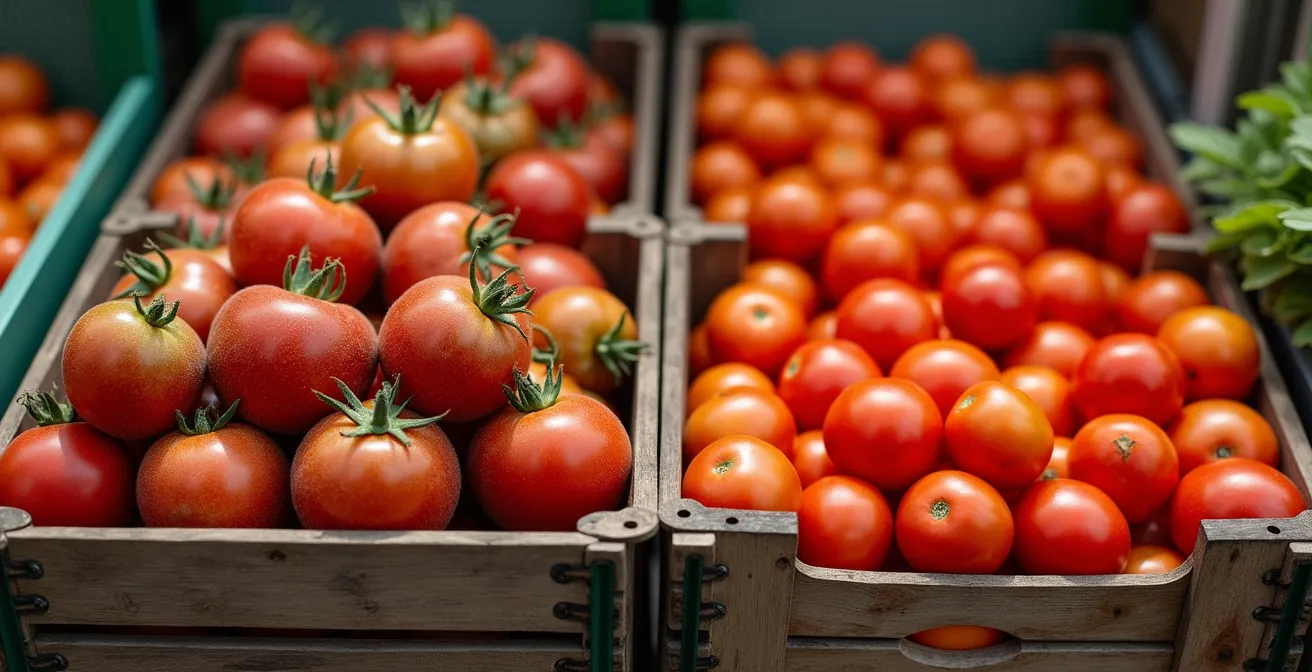
The distance food travels has a direct and dramatic impact on its quality. A 2003 Leopold Center study, for example, found that Iowa-grown apples traveled just 61 miles to reach consumers. By contrast, apples from other states journeyed an average of 1,726 miles before being sold. This vast difference in “food miles” means the imported apple was likely picked weeks, if not months, earlier and has been artificially preserved, degrading its taste and texture. Spotting these impostors is key to unlocking the true, fresh flavors of your destination.
Frozen or Fresh Import: Which Is More Eco-Friendly in Winter?
As an eco-conscious traveler, you face a dilemma in the colder months. You crave fresh berries for your breakfast, but you’re in a northern climate in January. The “fresh” berries at the market look tempting, but they’ve likely been air-freighted from across the equator, creating a massive carbon footprint. In the next aisle, you see frozen berries, harvested at their peak last summer. Which is the better choice? The answer is almost always the frozen option. This is where understanding the “Carbon Hierarchy” of produce becomes essential for making sustainable choices.
Research consistently shows that your food’s journey is a major factor in its environmental impact. Opting for locally grown, seasonal food is always the gold standard. However, when that’s not possible, we must compare the alternatives. The energy required to fly a small punnet of fresh raspberries from South America to Europe is astronomically higher than that used to freeze and transport them by sea or land. Freezing technology has advanced to the point where nutrients are locked in almost instantly at the peak of ripeness, often resulting in a more nutritious product than the “fresh” equivalent that has been degrading for weeks in transit.
This table breaks down the carbon impact of your winter produce choices, helping you make the most sustainable decision when local and seasonal isn’t an option. As a study on sustainable eating habits shows, making informed choices can have a real impact on your travel footprint, with one analysis highlighted by Made To Sustain showing a clear hierarchy of environmental cost.
| Option | Carbon Impact | Nutritional Quality | Best Choice When |
|---|---|---|---|
| Air-freighted fresh | Highest (10x local) | Variable, often degraded | Never recommended |
| Greenhouse heated | High (5x local) | Good if consumed quickly | Special occasions only |
| Sea-freighted fresh | Moderate (2x local) | Often picked unripe | Tropical fruits only |
| Frozen at peak season | Low (1.5x local) | Excellent, nutrients locked | Best winter option |
| Local root vegetables | Lowest | Excellent when stored properly | Always preferred |
Embracing this hierarchy means shifting your mindset. Instead of chasing the illusion of eternal summer with air-freighted strawberries, learn to love the hearty, delicious, and low-impact local root vegetables of winter, and supplement them with peak-season frozen fruits for a touch of summer brightness. It’s a choice that’s better for the planet and often for your palate, too.
The Pesticide Risk of Eating Out-of-Season Fruits Abroad
When a fruit or vegetable is grown outside its natural season and native environment, it’s fighting an uphill battle against nature. It’s more vulnerable to pests and diseases it wouldn’t normally encounter. To compensate, industrial-scale agriculture often relies on a heavier arsenal of chemical interventions, including pesticides, fungicides, and waxes, to ensure the product survives its long journey to market looking pristine. This means that beautiful, out-of-season grape you’re about to eat in Southeast Asia might carry a chemical residue from its trans-oceanic voyage.
For a traveler, this presents a tangible health risk, especially in countries where regulations on pesticide use may be less stringent or poorly enforced. The chemicals are concentrated on the skin, making fruits with thin or edible skins (like berries, apples, and peppers) a higher risk. This is another powerful argument for seeking out genuinely local and seasonal produce, which requires fewer chemical crutches to thrive. Local farmers using traditional or organic methods are your best bet for cleaner food.
When you can’t be certain about the origin of your produce, you can take several steps to mitigate your risk. Following food safety guidelines is paramount for any traveler. Here are some key strategies to minimize your exposure to pesticides:
- Choose thick-skinned fruits and vegetables, such as bananas, avocados, mangoes, and melons. The peel provides a natural barrier that you discard.
- Always wash and peel produce yourself. Use bottled or purified water to wash, and then peel the item to remove the outer layer where most residues concentrate.
- Avoid pre-cut fruit platters. While convenient, they present a double risk: potential contamination from unhygienic preparation and the inability to wash or peel the fruit yourself.
- Prioritize seasonal produce. As we’ve discussed, it’s less likely to have required heavy chemical treatments.
- Shop at trusted farmers’ markets. This gives you the unique opportunity to ask the grower directly about their practices. Look for stalls that advertise as “organic” or “no-spray.”
How to Read a Menu to Spot the Seasonal Specials Instantly?
A restaurant menu is more than a list of dishes; it’s a story about the chef’s philosophy. As a traveler, learning to read that story is your best tool for finding an authentic, seasonal meal. The first and most obvious clue is the physical menu itself. A giant, laminated, multi-page tome that looks like it hasn’t changed in years is a huge red flag. It screams “frozen and pre-made.” What you’re looking for is evidence of change and immediacy.
Look for chalkboard specials, paper inserts, or a small, single-page menu. These formats are easy to update daily or weekly, allowing a chef to respond to what’s fresh and available from the market. This is the clearest signal that the kitchen is driven by ingredients, not by a static supply chain. A chef who writes their menu on a chalkboard is telling you they went to the market this morning and got excited about something. That’s the restaurant you want to be in.

Beyond the physical format, pay attention to the language. Vague, generic descriptions like “vegetable medley” or “seasonal vegetables” often hide a reliance on a standard mix of frozen or imported basics. A truly seasonal chef is proud of their ingredients and will be specific. Here’s how to decode the language:
- Look for hyper-specific descriptions: “Heirloom tomatoes from [Local Farm Name]” is a world away from just “tomato salad.” Specific variety names (e.g., “Chanterelle mushrooms,” “Fava beans”) are also a great sign.
- Identify seasonal anchor ingredients: Certain ingredients define a season. Asparagus and ramps scream spring; zucchini blossoms and sweet corn signal summer; squash and mushrooms mean autumn.
- Ask the server: A simple, direct question like, “What did the chef get in fresh today?” or “What are you most excited about on the menu right now?” can cut through the noise. A passionate server in a good restaurant will know the highlights.
- Choose simplicity: Dishes with just a few ingredients are often designed to showcase the quality of one star component. A plate of perfect asparagus with olive oil and salt is a celebration of seasonality; a complex casserole can hide a multitude of sins.
–
By developing this “menu literacy,” you can instantly spot the kitchens that are truly connected to their local terroir and seasons, ensuring a meal that is not just food, but an experience.
How Does Your Dining Choice Affect Your Trip’s Carbon Score?
Every choice you make as a traveler has an environmental footprint, and your dining habits are a significant, often overlooked, part of that equation. The concept of “food miles”—the distance food travels from where it is grown to where it is eaten—was first explored in a groundbreaking 1994 study. This research revealed a startling reality: in a conventional food system, produce travels an average of 1,500 miles. By contrast, locally sourced food typically travels less than 100 miles. For a traveler, this difference is your opportunity to make a positive impact.
When you consciously choose a restaurant that sources locally or buy directly from a farmer at a market, you are actively reducing your meal’s carbon footprint. Research has shown that embracing a diet of local, seasonal produce can lower your food-related carbon emissions by up to 7%. While that may seem modest, the impact is amplified when combined with other conscious choices, such as opting for plant-based meals. The journey of food is a hidden contributor to your trip’s overall environmental cost, and choosing local is the most direct way to mitigate it.
Case Study: The Impact of Food Miles
The foundational research on food miles provided a powerful metric for understanding our food system. It quantified the immense logistical chain required to stock a typical grocery store, with produce traveling an average of 1,500 miles. For a traveler, this means that eating a “standard” meal in a tourist-focused restaurant often supports a global, high-carbon supply chain. In stark contrast, making the effort to find produce at a local farmers’ market, where the average travel distance can be less than 100 miles, directly shrinks your environmental impact. This simple choice represents a significant reduction in transport-related emissions, making it one of the most effective eco-friendly actions you can take on the road.
The numbers are stark and compelling. One analysis found that local, in-season foods travel approximately 27 times less distance than their imported counterparts. Think about that for a moment. By choosing the fresh-picked strawberries from the farm down the road instead of the ones flown in from another continent, you are slashing the transportation carbon footprint of that food by over 95%. This isn’t a small, incremental change; it’s a massive reduction. As a traveler, you vote with your wallet every time you eat. Choosing local is a powerful vote for a cleaner, more sustainable, and ultimately more delicious food system.
When to Visit Night Markets to Get the Freshest Batches?
Markets, whether morning or night, operate on a distinct rhythm of supply and demand. Arriving at the right time can mean the difference between getting the absolute freshest produce and picking over the day-old leftovers. For night markets, which are social and culinary hubs in many parts of the world, timing is everything. Don’t just wander in whenever; approach it with the strategy of a chef sourcing for their restaurant.
The golden rule is to follow the professionals and the savvy locals. There are typically two peak times for freshness at a market. The first hour of opening is when local restaurant staff and serious home cooks arrive to get the best selection before it’s picked over. The second prime window is often during the early evening restock, usually between 4 and 6 PM. This is when farmers who have done a second harvest in the afternoon arrive with a new wave of peak-fresh produce. Watch for vendors unloading new crates and you’ll know you’ve found the freshest batch. Conversely, the lull in the middle of the day is often the worst time to shop for delicate items, as the morning’s stock has been sitting out for hours.
Case Study: San Diego’s Market Evolution
The Hillcrest Farmers’ Market in San Diego provides a great example of how markets can become integral to a traveler’s itinerary. Initially a traditional weekend morning market, it became a go-to spot for tourists and local chefs alike, who knew to arrive early for the best seasonal finds. Recognizing the demand, the market’s organizers expanded to include weekday evening markets. These events transformed from simple shopping venues into vibrant social hubs, allowing travelers to experience authentic local food culture after a day of sightseeing and access peak-fresh ingredients for self-catered meals, perfectly aligning their travel experience with the local food rhythm.
Here is a strategic timeline for your market visit:
- First Hour (Opening): The best selection. This is when chefs shop. Go now for choice and quality.
- Early Evening (4-6 PM): The second wave. Catch produce that was harvested just hours before.
- Follow the Locals: Notice when the market gets busy with local shoppers after their workday. This is a reliable indicator of fresh arrivals.
- Last Hour (Closing): The bargain hunt. Vendors are looking to offload their remaining fresh items and are more open to discounts. Great for stocking up, but the selection will be limited.
- Weekday Advantage: If possible, visit on a weekday. Markets from Tuesday to Thursday are often less crowded, allowing for more relaxed interactions with vendors.
–
Key Takeaways
- True flavor is a direct result of seasonal, sun-ripened growth; it’s a complex chemical process that cannot be replicated in a greenhouse or during long-distance shipping.
- Become a “food detective” in markets: look for irregularity, dirt, and handwritten signs as markers of authentic local produce, while avoiding perfect uniformity and branded packaging.
- In winter, choosing produce that was frozen at peak season is often a far more nutritious and eco-friendly choice than “fresh” produce that has been air-freighted across the globe.
How to Buy and Transport Spices Legally and Freshly?
Bringing home spices is one of the best ways to bring your travel memories back into your own kitchen. But to do it right, you need to focus on two things: maximizing freshness and navigating customs legally. The number one rule for freshness is to always buy whole spices. Pre-ground spices lose their volatile oils—the source of their aroma and flavor—incredibly quickly. A ground cumin might taste like dust in six months, but whole cumin seeds, toasted and ground just before use, will remain potent for years. Whole peppercorns, cinnamon sticks, cardamom pods, and nutmeg are your best friends.
When buying, use your senses just as you would with fresh produce. Apply the “Sniff Test”: fresh, high-quality spices should have a powerful, almost overwhelming aroma when you smell them up close. If they smell faint or dusty, they are old. For brittle spices like cinnamon or star anise, use the “Snap Test.” They should snap cleanly and release a burst of fragrance. A spice that bends or crumbles softly is stale. Once you’ve made your purchase, transfer them to airtight containers as soon as possible to preserve those precious oils during your journey home.
Navigating customs is the final, crucial step. The key is honesty and proper packaging. Never try to hide food items. Here is your essential checklist for getting your treasures home safely:
- Keep Spices in Commercial Packaging: Whenever possible, buy spices that are in sealed, commercially labeled packages. Customs officials need to be able to identify what you are bringing in. Avoid unmarked plastic baggies from market stalls if you can.
- Declare Everything: On your customs form, declare all food items, including your spices. It’s far better to have an agent look at your declared items and wave you through than to be caught hiding something, which can result in fines and confiscation.
- Avoid Fresh Plant Parts: This is the most critical rule. Do not bring back any fresh roots (like ginger or turmeric), leaves, or viable seeds that could be planted. These are considered agricultural risks. Dried and processed spices are generally fine; fresh plant material is not.
- Store Properly for Travel: Use airtight containers or double-bag your spices to prevent them from perfuming your entire suitcase and to protect them from moisture.
Following these simple rules ensures your carefully selected spices make it home to enrich your cooking, serving as a delicious and aromatic souvenir of your travels.
Start practicing these food detective skills on your next trip—or even at your local market. By shifting your perspective from a passive consumer to an active investigator, you will not only eat better and more sustainably, but you will also forge a deeper, more delicious connection with every place you visit.