The fear of getting sick is the biggest barrier to authentic travel eats, but the solution isn’t avoidance—it’s intelligence.
- Learn to “decode” a food stall’s queue by analyzing its demographics, not just its length.
- Master the hidden rules of food freshness by aligning your mealtimes with local culture.
- Understand that how a vendor operates is a clearer safety signal than any government certificate.
Recommendation: Ditch the generic rules and develop real ‘street food intelligence’ to eat confidently and safely anywhere in the world.
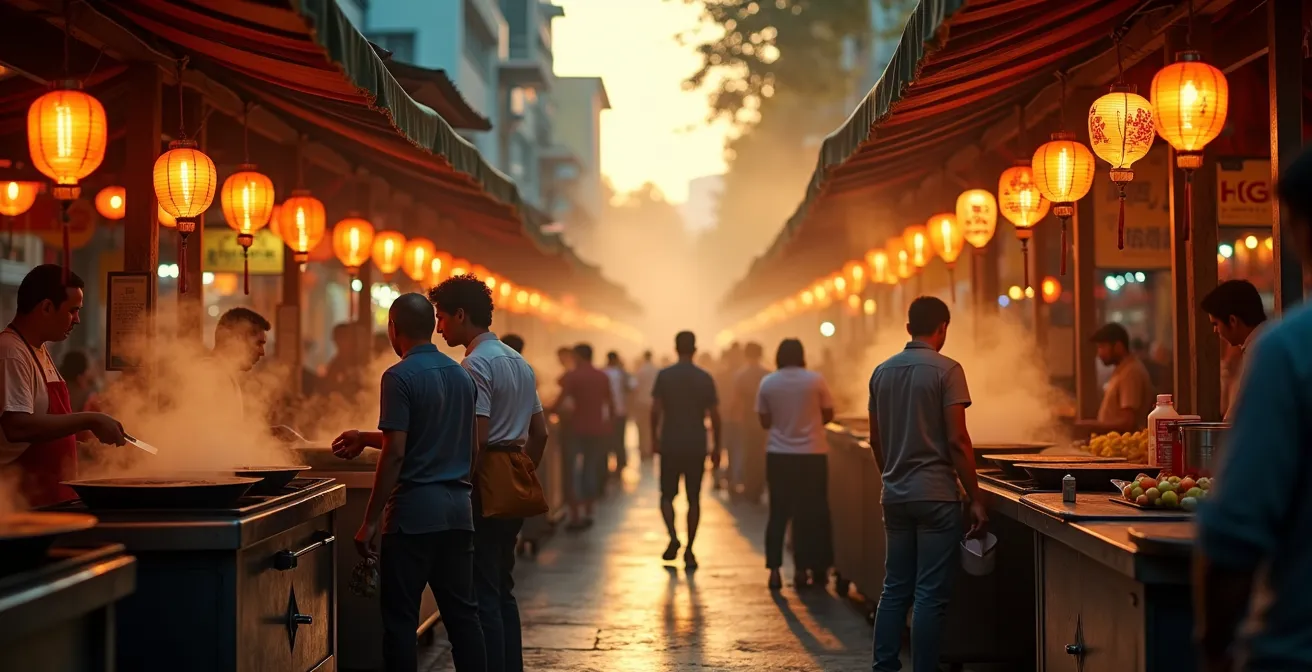
The scent hits you first: a chaotic, intoxicating blend of sizzling garlic, charred meat, and exotic spices. Your eyes scan a vibrant mosaic of steaming woks, bubbling pots, and colorful ingredients you can’t even name. This is the heart of travel, the pulse of a city—the street food scene. For any adventurous eater, it’s pure temptation. But then, the voice of caution whispers in your ear, conjuring horror stories of “Delhi belly” and vacations spent hugging a toilet. This internal battle between desire and fear is the ultimate traveler’s dilemma.
The late, great Anthony Bourdain, a man who built a legacy on exploring culture through food, famously embraced this tension. As he once said:
I’ve long believed that good food, good eating, is all about risk.
– Anthony Bourdain, Travel philosophy on street food
But risk doesn’t have to mean being reckless. The standard advice—”eat hot food,” “avoid ice”—is a good starting point, but it’s kindergarten-level knowledge. It misses the nuance and, frankly, the fun. The real secret to navigating the world’s culinary back-alleys is not about a rigid set of “don’ts,” but about developing what I call Street Food Intelligence. It’s a skill set, a way of seeing and interpreting the subtle cues of a food stall’s ecosystem. It’s about learning to read the environment like a local, which is crucial when you consider that research shows over 2.5 billion people eat street food every day. They’re not all getting sick, and you don’t have to either.
This guide is designed to upgrade your software. We’re moving past the basic rules to give you the tools to make smart, confident decisions, whether you’re in a night market in Taipei or a food cart in Mexico City. You’ll learn how to decode queues, communicate without words, understand the all-important freshness cycle, and protect yourself from more than just bacteria. Let’s get started.
Table of Contents: Your Guide to Street Food Mastery
- Why a Long Line of Locals Is Your Best Safety Guarantee?
- How to Order Complex Dishes Using Only Gestures and Smiles?
- Cooked or Raw: Which Street Foods Should You Absolutely Avoid?
- The “Tourist Price” Scam: How to Pay What the Locals Pay?
- When to Visit Night Markets to Get the Freshest Batches?
- How to Survive the First 24 Hours in a Country Where You Don’t Speak the Language?
- How to Log Cash Expenses That Don’t Appear on Your Bank App?
- How to Navigate Foreign Dining Etiquette Without Offending Your Hosts?
Why a Long Line of Locals Is Your Best Safety Guarantee?
“Follow the crowds” is the oldest trick in the travel book, but it’s a blunt instrument. True Street Food Intelligence lies in decoding that crowd. A long line isn’t just a sign of popularity; it’s a live-stream of crucial data about safety and quality. The first thing to understand is that high turnover is your best friend. A busy stall means ingredients aren’t sitting around; they are constantly being replenished and cooked, which dramatically reduces the risk of spoilage. It’s a real-time indicator that the food is fresh.
But don’t just look at the line’s length; analyze its composition. Are there families with young children eating there? This is a powerful trust signal. Locals, especially parents and grandparents, are instinctively protective and would never risk feeding their kids something from a questionable source. If you see multiple generations sharing a meal, you’ve likely found a neighborhood institution that has earned its community’s trust over years.
Also, observe the flow. A stall that is consistently busy throughout the day is often a better bet than one that only gets a rush at peak lunch hour. This continuous flow indicates a reliable reputation. Watch the dishes being served. If they are being prepared and handed out in a constant, fluid motion, it confirms that high turnover is in effect. Don’t just follow other tourists; make sure the line is dominated by people who live there. They hold the real knowledge.
Ultimately, that line of locals isn’t just a queue; it’s a collective, unspoken endorsement. It’s a community vouching for the vendor’s quality and safety, and that’s a more reliable review than anything you’ll find online.
How to Order Complex Dishes Using Only Gestures and Smiles?
The language barrier can feel like a solid wall between you and that incredible-looking dish you can’t pronounce. But in the world of street food, your hands and your expression are a universal currency. Mastering non-verbal communication is not just possible; it’s often more effective and fun. The key is to be observant, confident, and friendly.
Case Study: The Food Ranger’s Point-and-Smile Method
Trevor James, the vlogger behind “The Food Ranger” with millions of subscribers, has eaten his way through over 40 countries, often in remote areas where English is non-existent. His primary technique is simple: point enthusiastically at a dish that looks good, either on someone else’s plate or in the cooking area. He follows this with what he calls the “watch and replicate” method—observing how a local orders, what condiments they add, and how they pay. His success from rural China to the Middle East proves that a big smile and clear gestures are powerful tools for delicious discovery.
Before you even approach the stall, watch a full transaction. See what others are ordering. When it’s your turn, make eye contact, smile, and point directly at the food you want. If you want what someone next to you is having, a simple point and a nod towards their bowl works wonders. Use your fingers to indicate quantity: one finger for one serving, two for two. To specify ingredients, point at them. To refuse an ingredient, use a clear, slow head shake or a hand-waving-away gesture.
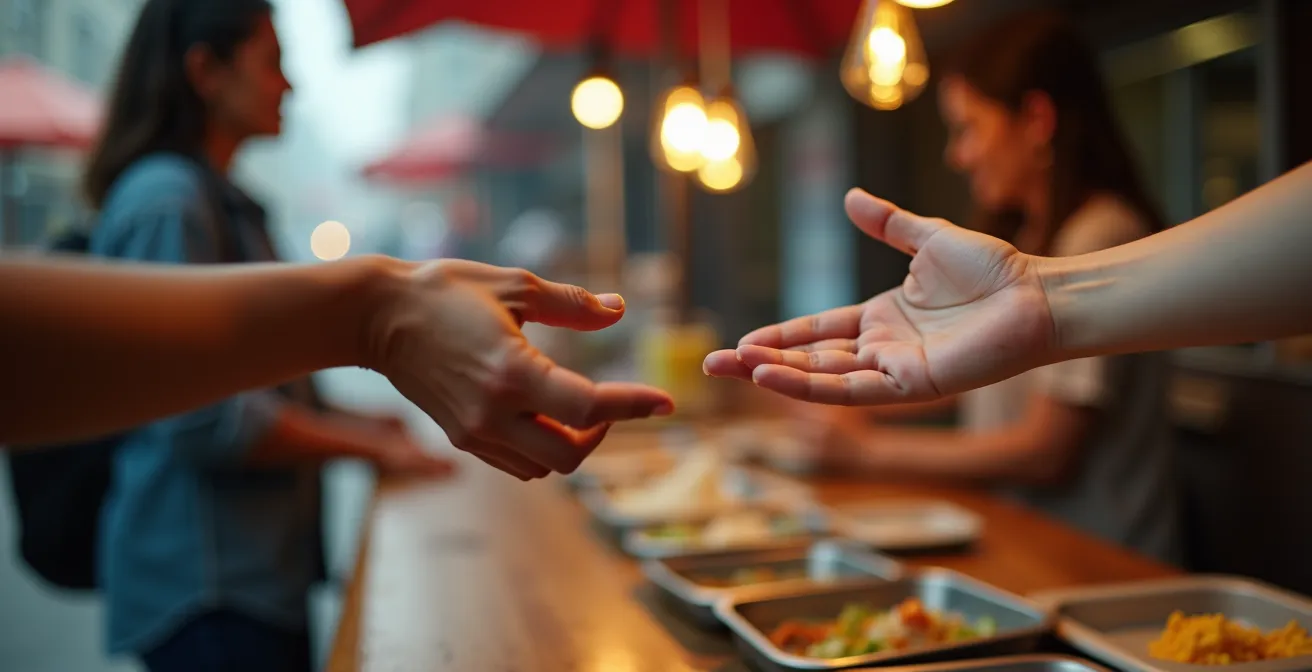
These gestures are your vocabulary. A pinching motion with your thumb and index finger can mean “just a little” (for spice), while an open palm held up can mean “stop” or “that’s enough.” Don’t be shy. Most vendors appreciate the effort and are masters at interpreting these signals. Your enthusiasm and willingness to communicate, even imperfectly, often result in a warmer reception and maybe even an extra scoop of the good stuff.
Remember, your goal isn’t perfect grammar; it’s a delicious meal. A genuine smile builds an instant rapport that a translation app never can. It turns a simple transaction into a positive human interaction.
Cooked or Raw: Which Street Foods Should You Absolutely Avoid?
This is where your Street Food Intelligence gets scientific. The single most important factor for food safety is temperature. The rule is simple: hot food should be HOT, and cold food should be COLD. Anything in between is a potential hazard. Bacteria thrive in what’s known as the “temperature danger zone.” According to food safety experts, bacteria multiply fastest in temperatures between 40-140°F (5-60°C). Food that has been sitting out at lukewarm temperatures is a gamble you don’t want to take.
Always choose food that is cooked to order right in front of you. Look for the steam rising off a freshly grilled skewer, the sizzle of a wok, or the bubbling of a deep fryer. These are all signs that the food has been heated to a temperature that kills most harmful bacteria. Conversely, be extremely wary of pre-cooked dishes sitting in trays or on display, unless you can see they are being kept over a constant, vigorous heat source.
When it comes to raw foods, the risk increases. The primary danger comes from the water used to wash them, which might be contaminated. This is why fresh, leafy salads or unpeeled fruits are often on the “avoid” list for cautious travelers. The table below provides a clear, scannable guide to help you make smart choices.
| Food Type | Risk Level | Why | Alternative |
|---|---|---|---|
| Raw leafy greens | High | Often rinsed with contaminated water | Cooked vegetables |
| Fruits you can peel | Low | Protected by natural barrier | N/A – Safe option |
| Steaming hot food | Low | Heat kills bacteria | N/A – Safe option |
| Ice in drinks | High | May be made from tap water | Bottled beverages |
| Raw seafood/ceviche | High | Parasites and bacteria risk | Fully cooked seafood |
The safest bet with raw items is always fruit that you can peel yourself, like bananas, oranges, or mangoes. The peel acts as a natural, sterile package. Think of it this way: if it’s steaming, sizzling, or peelable, you’re likely in the clear. If it’s lukewarm, raw, and unpeelable, it’s best to admire it from a distance.
The “Tourist Price” Scam: How to Pay What the Locals Pay?
Getting overcharged isn’t just about losing a dollar or two; it’s about feeling like an outsider, a mark. Avoiding the “tourist price” is a key part of feeling street-smart. This isn’t about aggressive haggling, which is often inappropriate for food. It’s about observation and being prepared. The goal is to pay the fair, local price with confidence.
Your first move happens before you even order: stand back and listen. Watch at least one or two locals complete a transaction. See what they pay. Even if you don’t understand the language, you can see the bills or coins they hand over. This gives you the baseline price. When you have this knowledge, you approach the transaction with confidence. Many vendors have a set price, but some will quote a higher one to an obvious tourist. Knowing the real price is your best defense.
Another powerful strategy is to always carry small bills and change. Rolling up to a stall and trying to pay for a $1 snack with a $50 bill immediately flags you as unprepared and makes giving you the correct change “difficult.” Having exact or near-exact change signals that you are a seasoned traveler who understands the local economy. It also makes the transaction faster and smoother for the vendor. As a writer for AFAR Magazine aptly put it:
Pointing and nodding your head works just fine when you’re hungry and there’s a language barrier. Think of it as Yelp in real time.
– AFAR Magazine, How to Eat Street Food Without Getting Sick
Look for visual pricing cues. Is there a menu board, even a faded, handwritten one? Try to decipher it. If you’re quoted a price that seems off, you can politely point to the board. If there’s no menu, ask for the price of two different items. This can help reveal if prices are standardized or being invented on the spot. If you feel you’re being quoted an unfair price, your best move is a polite smile and slowly walking away. Often, the price will magically drop to the correct one.
This isn’t about being confrontational. It’s about demonstrating awareness. When you show you’ve done your homework, you are treated less like a tourist and more like a savvy visitor, earning you respect and the local price.
When to Visit Night Markets to Get the Freshest Batches?
Timing is one of the most underrated aspects of Street Food Intelligence. Showing up at the right time doesn’t just mean smaller crowds; it means getting the absolute best, freshest food the vendor has to offer. Every food stall has a “freshness cycle,” and learning to sync with it is a game-changer. This often means adjusting your own eating schedule to match the local culture.
Case Study: The Vietnamese Pho Freshness Cycle
In the West, pho is often considered a lunch or dinner meal. But in its native Vietnam, it is fundamentally a breakfast food. The best pho vendors start simmering their broth the night before, and the peak of flavor and freshness is in the early morning hours when locals flock to the stalls before work. A traveler who shows up for pho at 2 PM is eating a broth that is hours past its prime. By eating when the locals eat, you are guaranteed to be tasting the dish as it’s meant to be: at its absolute peak.
This principle applies to night markets as well. The “golden hour” for a night market isn’t necessarily when it’s most crowded, but often during the setup phase, just as vendors are finishing their prep. This is when the first, freshest batches of food are being cooked. Arriving as the market comes to life allows you to get ahead of the main rush and enjoy food made from pristine, just-prepped ingredients. For grilled items, arriving later, near closing, can also be strategic, as vendors cook fresh final batches to sell off remaining stock, sometimes at a discount.
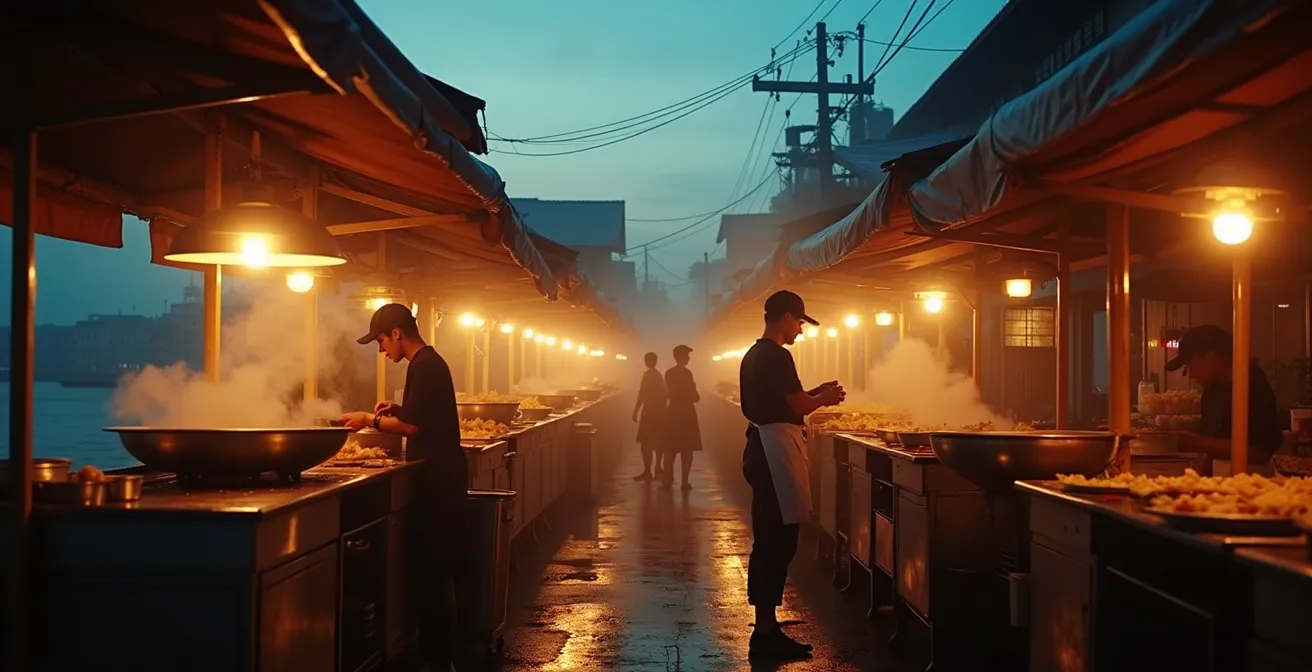
Observe the stall’s operations. A vendor using a small wok and cooking constantly is a “continuous-batch” operation, meaning almost every dish is fresh. Be more cautious of buffet-style displays where large trays of food may sit for hours. The following checklist will help you perfect your market timing.
Your Action Plan for Peak Freshness: A Market Timing Checklist
- Visit during setup ‘golden hour’: Arrive as vendors are firing up their grills for the first, freshest batches of the evening.
- Watch for restocking signs: A delivery of fresh ice, new crates of vegetables, or a fresh slab of meat arriving are all excellent signs.
- Identify cooking styles: Prioritize continuous-batch vendors (small woks, constant cooking) over single-pot operations where food might sit.
- Eat at local peak times: Observe when the market gets busiest with locals, as this indicates the highest turnover and freshest food.
- Choose made-to-order: Avoid buffet-style displays that sit for hours; always opt for food that is cooked specifically for you.
By treating your visit not as a random drop-in but as a strategic mission, you transform your chances of getting a good meal into a near certainty of getting an exceptional one.
How to Survive the First 24 Hours in a Country Where You Don’t Speak the Language?
Your first day in a new country is a sensory overload. Everything is unfamiliar, and the language barrier can feel especially intimidating. This is the critical period to build your confidence. Your goal for the first 24 hours isn’t to have the most epic culinary adventure, but to achieve a few small, successful interactions that will set a positive tone for the rest of your trip.
Your first mission, before you even think about street food, should be supermarket reconnaissance. A quick walk through a local grocery store is a crash course in the local economy. You’ll learn the real prices of basic goods like water and snacks, see local brands, and get a feel for the currency without the pressure of a one-on-one transaction. This knowledge is your armor against being overcharged later.
Next, prepare for the inevitable “lost in translation” moment. A brilliant and simple safety measure is to take a screenshot of your hotel’s name and address in the local script and set it as your phone’s lock screen. If you get lost, you can simply show your phone to a taxi driver or a helpful local without needing a single word. Also, keep hand sanitizer easily accessible. While many stalls are clean, a sink with soap isn’t always available, and this is your reliable backup.
When you’re ready for your first street food purchase, frame it as a confidence mission. Don’t start with the most complex dish on the menu. Start simple. Pick a stall, stand back, and watch a complete local transaction from start to finish. See how they order, how they pay, and what they do with their food. Then, step up and replicate it. Master a few universal gestures: a smile (universal for “hello, I’m friendly”), a slight nod or bow (a sign of respect in many cultures), and putting your hands together in a prayer-like gesture (a common way to say “thank you” in Asia). These small acts of cultural awareness go a long way.
That first successful purchase—no matter how small—is a huge victory. It breaks the ice and proves to yourself that you can navigate this new environment. This small win will fuel your courage for more ambitious food adventures to come.
How to Log Cash Expenses That Don’t Appear on Your Bank App?
One of the joys of street food is that it operates in a world of cash. A dollar here, a few coins there—it’s easy to lose track of your spending. But for a vlogger, traveler, or anyone on a budget, tracking these small expenses is crucial. Traditional budgeting apps fall short because these transactions are invisible. The solution needs to be just as fast and analog as the purchase itself.
This is where a simple, brilliant system comes into play: the photo-receipt. It requires no special apps or notebooks, just the phone you already have with you. The method is exactly what it sounds like: after you buy a piece of street food, take a quick photo of it before you dig in. This one action accomplishes two things simultaneously.
Case Study: GRRRLTRAVELER’s Photo-Receipt System
Christine Kaaloa of the travel blog GRRRLTRAVELER, who has been traveling solo for over eight years, perfected this method. She recommends taking a quick photo of every street food purchase. At the end of the day, this creates a visual spending log in her camera roll. She can scroll through, remember each item, and tally the costs. More than just a budget tool, it becomes a food diary, helping her remember the names of dishes she loved and which stalls to revisit (or avoid). She combines this with a daily envelope system for her cash, writing the day’s total spend on the outside before refilling it for the next day.
The photo-receipt system is incredibly effective because it’s visual and immediate. At the end of the day, you can scroll through your photos and create a quick expense report. You’ll have a picture of the grilled pork skewer, the mango sticky rice, and the bubble tea, making it easy to recall and log your spending. This is far more effective than trying to remember a dozen tiny cash purchases hours later.
Beyond budgeting, this practice creates a fantastic visual record of your culinary journey. Your camera roll becomes a delicious travelogue, a far more evocative souvenir than a list of numbers in a spreadsheet.
Key Takeaways
- Trust the Local Ecosystem: A busy stall with high turnover, especially one frequented by families and children, is your most reliable safety indicator.
- Heat is Your Shield: Prioritize food that is cooked fresh and served steaming hot. Be wary of anything lukewarm or raw items that you can’t peel yourself.
- Timing is a Superpower: Eat when the locals eat. Syncing with the local “freshness cycle” guarantees you’re getting food at its absolute peak quality.
How to Navigate Foreign Dining Etiquette Without Offending Your Hosts?
Your Street Food Intelligence journey isn’t complete without understanding the final piece of the puzzle: respect. How you eat is just as important as what you eat. While the specific rules of dining etiquette can vary wildly from one culture to another, the core principles of being a gracious guest are universal. Showing respect not only prevents you from accidentally offending your host but also enriches your experience and can lead to warmer interactions.
While the stakes for hygiene are real—the Centers for Disease Control and Prevention (CDC) estimates that foodborne diseases cause about 48 million illnesses in the US each year—the risk of cultural missteps can be just as unsettling. Fortunately, a few simple actions are appreciated almost everywhere. As the experts at the Legal Nomads food blog point out, some of the most effective tools are non-verbal.
The most powerful etiquette tools are universal. Eating all of your food, making an audible ‘mmm’ sound of enjoyment, and making eye contact with a smile and a nod when you leave are understood and appreciated everywhere.
– Legal Nomads Food Blog, How to Eat Street Food Without Getting Sick
Finishing all the food on your plate is a near-universal sign of appreciation. It signals that you enjoyed the meal and are not wasteful. A simple, audible sound of enjoyment—a happy “mmm”—cuts through any language barrier to say “this is delicious.” Finally, when you leave, don’t just vanish. Make eye contact with the vendor, offer a warm smile, and give a distinct nod or a slight bow. This small gesture closes the loop on your interaction, acknowledging them as a person, not just a service provider.
Now that you’re armed with Street Food Intelligence, you’re ready to go beyond being a tourist. You’re equipped to be an explorer. Go out there, be observant, be brave, and taste the incredible stories the world has to offer, one delicious, steaming-hot, and safely chosen bite at a time.